Winery Not Showing Up on Google? If You're Not in the Top 3, You Don't Exist
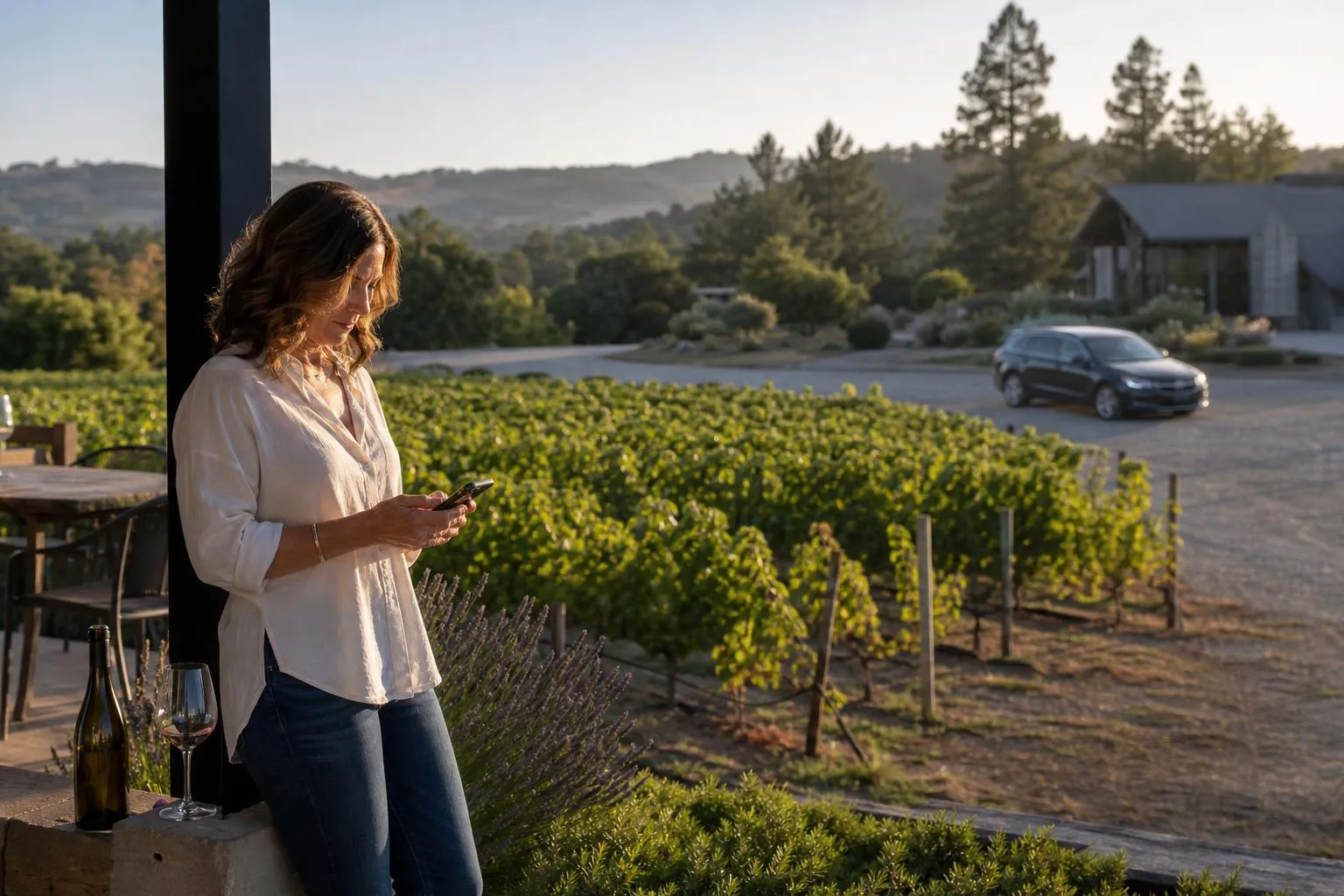
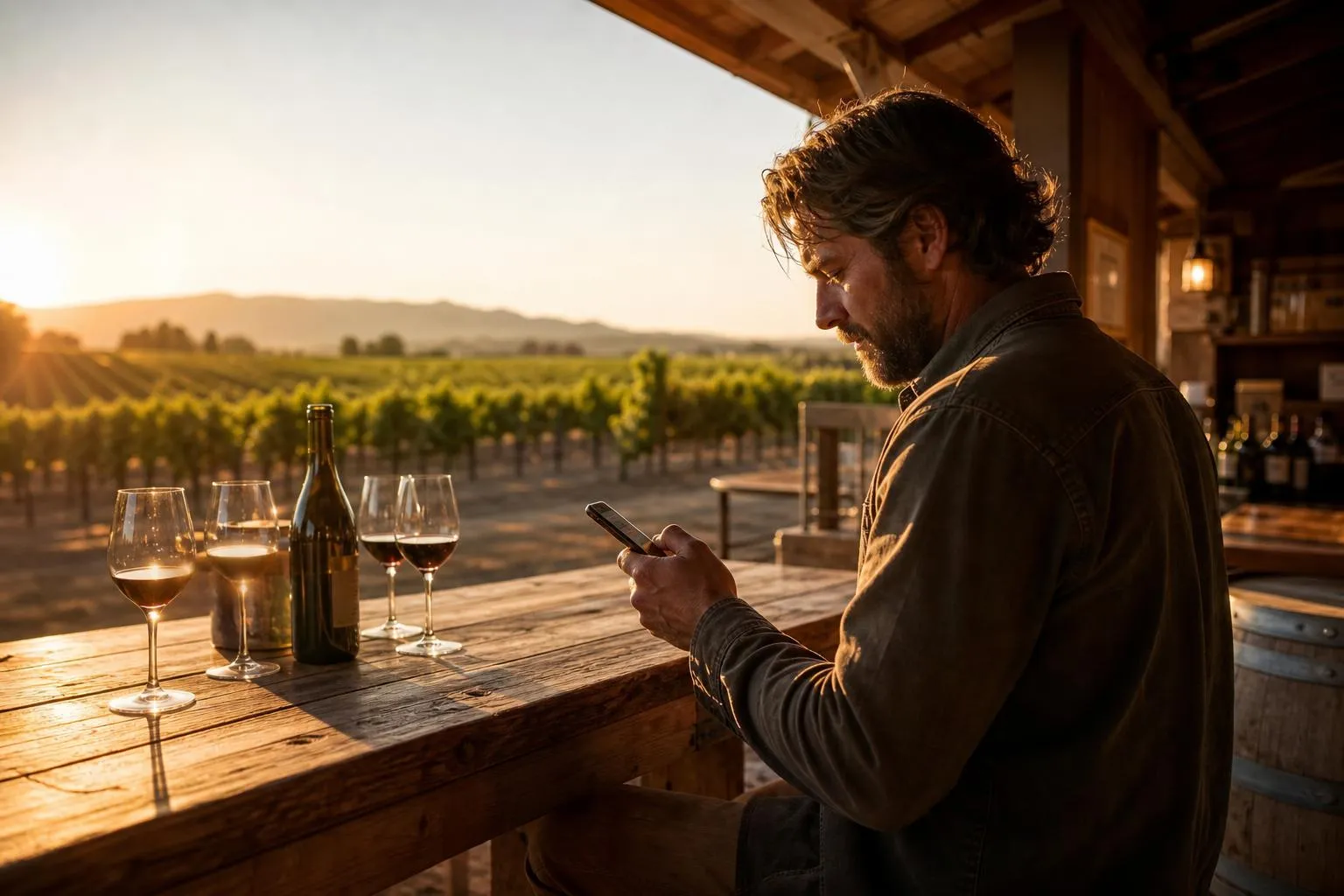
Here’s how your next visitor actually picks a winery for Saturday. Not the version tourism boards imagine. The version that happens on a phone in a hotel lobby.
A couple planning a weekend away decides Friday night where they’re spending Saturday afternoon. One of them types “wineries near me” or “[your region] tasting room” into their phone. Google shows a map with three pins. They glance at photos, check if reservations are easy, and pick. If the site is confusing or the hours look wrong, they move to the next pin without a second thought.
That’s the decision. Under a minute, three candidates, one weekend booked. Nobody’s flooding a basement here, but the mechanics are identical to any local search: speed, proof, and a clear next step win the click.
Nobody scrolls to page two of tasting room results. Almost nobody scrolls past the map. If you’re not in that top cluster, you’re not “ranked lower” for the weekend crowd with a full tank of gas and a free Saturday. You don’t exist to them.
Two lists decide who fills the tasting room
Local search splits into two lists, and most wineries only half-play either one.
The map pack is the three pinned wineries at the top, ranked largely off your Google Business Profile: review volume, rating, recency, correct hours, and whether your address and phone number match everywhere they appear online.
The organic results below it are where your website itself has to win the click, especially for the researched visits: club membership comparisons, private tastings, harvest events people plan weeks ahead for.
Most winery owners get scraps from both lists and blame the region being “oversaturated with tasting rooms,” while the winery two roads over quietly fills every Saturday slot. You can rent visibility with advertising on Google, but it stops the day the budget does. The free lists keep paying once you actually hold the spot.
Your own website is what’s holding your ranking down
Owners treat the website and the ranking as unrelated. They’re not. Google looks directly at your site to decide placement, and an old one drags the whole listing down with it. If your website isn’t getting you bookings, this is usually where it starts.
It’s slow. Speed is a direct ranking input. Google found 53% of mobile visitors abandon a page after 3 seconds, and Portent measured a 4.4% conversion drop per additional second. The bounce data doesn’t leave room for argument:
| Mobile load time | Bounce probability vs a 1-second page |
|---|---|
| 1 to 3 seconds | +32% |
| 1 to 5 seconds | +90% |
| 1 to 6 seconds | +106% |
| 1 to 10 seconds | +123% |
The average mobile page loads in 8.6 seconds. A site that opens in about a second wins the one ranking factor entirely in your hands.
It’s not mobile-first. Google ranks the mobile version of your site, and most tasting room searches happen on a phone in a car. A reservation widget that only works on desktop costs you rank before anyone even reaches your tasting fees.
It’s thin. A single page listing “wine tasting available” gives Google nothing to match against “wine club [your region]” or “private tasting [your town].” No page for club tiers, no page for events, no ranking for either.
It’s stale. A homepage still promoting last spring’s release, with no mention of this season’s harvest event, tells Google and the visitor both that nobody’s minding the shop.
Why “just run some ads” or “just do SEO” misses the point
The reflexive move is either boosting a few Instagram posts or hiring someone to bolt SEO onto the existing site. Both are decoration on a foundation Google is comparing head to head against the best-built winery site in your region, every day.
Buying SEO for the old site
- Cheaper this month than a rebuild: local retainers run $500 to $1,500
- No new platform, no re-uploading club tiers or bottle photos
- Keeps existing URLs and whatever link equity they carry
- Can work if the underlying site is already fast and mobile-first
Buying SEO for the old site
- The retainer fights the foundation instead of building on it
- You cannot retrofit a 1-second load into a heavy 2016-era theme
- Twelve months at $750 is $9,000 rented, and none of it is yours
- Most audits land on the same conclusion: you need a new site
What a top 3 spot is actually worth
Think about what the map pack is: every visitor in driving range planning a Saturday out, funneled into a queue and handed to three tasting rooms. Tasting fees are modest per head, but club joins compound for years and gift-season case orders run high. That queue gets divided every weekend, whether or not you’re in it.
The wineries holding those top spots aren’t necessarily pouring better wine (see why the worse winery wins your bookings). Their online presence just gives Google no reason to hide them.
How you actually get there
Nobody honest guarantees a #1 ranking. Anyone who does is selling something else. But the inputs that move the needle are no secret:
- A fast, mobile-first website with a real page for tastings, club tiers, and events: the raw material Google needs to rank you for each search.
- A complete, active Google Business Profile. Correct category, current hours, real photos of the tasting room and grounds.
- A steady drip of reviews. Asking after every visit beats one seasonal push, since Google weights recent proof heavily. Reviews also feed your local promotion.
Two of those are habits. The first is a build, and it’s the one that makes the other two actually pay off.
Get the foundation Google wants to rank
We build winery websites structured for local search from day one: loading in about a second, mobile-first, native tasting-room reservations, a wine club signup that doesn’t take three clicks to find, and shipping compliance that stops selling into states you can’t legally ship to. The point of the ranking is the pour.
Watch the free video walkthrough of a live winery site and see what a rankable foundation looks like. Pricing is published on the page, no contracts, launch in 7 days, changes live within 24 hours, and you own everything. Want the profile and review habit handled too? Ongoing growth services pick that up after launch.
Frequently asked questions
Why isn’t my winery showing up on Google?
Almost always three things: an incomplete or miscategorized Google Business Profile, too few recent reviews, and a website that’s slow, thin, or broken on mobile. Fix the first two yourself this week. The website usually needs a rebuild.
Can anyone guarantee me a top 3 ranking?
No. Anyone promising #1 is selling snake oil. What you control are the inputs: a fast site, a complete profile, recent reviews.
How long does it take to get into the map pack?
Profile fixes and new reviews often register within weeks, while competitive wine regions take months. The website is the slowest input to fix and the fastest to replace: ours launch in 7 days.
How much does a website built for local search cost?
Our Standard winery build is $2399£1,899 one-time and the Elite tier is $7500£5,900 one-time, both published on the page. Compare that to a $750 a month retainer fighting a foundation it can’t fix.
Next in this series: Your website looks fine on your laptop in the tasting room. Your visitor is scrolling it from the passenger seat.
Your move
Reading this does not book a job.
The owners who pull ahead are the ones who change one thing this week. If you want that one thing to be a website that sells and ads that put it in front of the right people, we build and run both for you.
Straight answer on whether we can help, usually the same day.