Why the Mediocre Winery Down the Road Books More Tastings Than You
You’ve poured their Cab. Thin, over-oaked, nothing you’d put your label on. Your vines are older, your winemaker actually trained for this, and your last vintage took a medal they didn’t come close to.
Their tasting room is booked out most Saturdays anyway. Yours has open tables at 2pm on a weekend in June.
Here’s the part nobody tells you at harvest dinners: visitors don’t book the best winery, they book whichever one looks like the easiest, safest afternoon in the first ten seconds of searching. That contest has almost nothing to do with what’s in the bottle, because a stranger scrolling on their phone hasn’t tasted either wine yet.
Nobody tastes the wine before they pick the winery
A couple planning a Saturday drive, or a group booking a birthday tasting, can’t sample your Syrah before they choose where to go. Whatever makes your wine better than the vineyard down the road is invisible to them until they’re already standing at your bar.
So they decide on what they can actually see:
- Whether the site loads fast enough to check if Saturday has an open slot
- Real photos of the tasting room and the view, not a stock vineyard sunset
- How many recent reviews mention the actual experience
- Whether reservations happen right there on the page, or require a phone call during business hours
- Whether the wine club is easy to find and understand
None of that is about what’s in the glass. That’s the game the vineyard with the fuller parking lot is winning. Why your winery website isn’t landing bookings covers the symptoms; this is what’s actually driving them.
The comparison happens in someone’s kitchen, not your tasting room
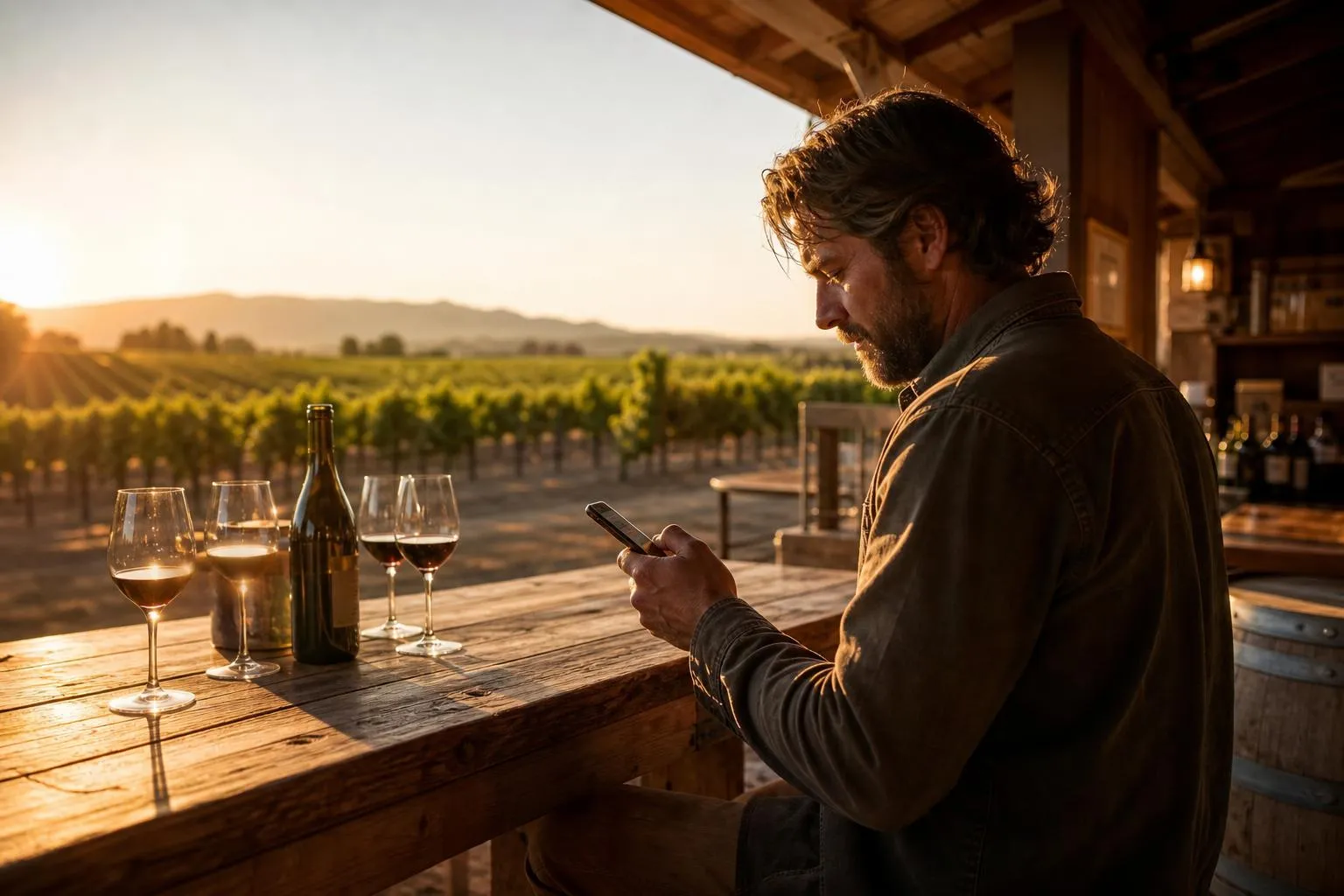
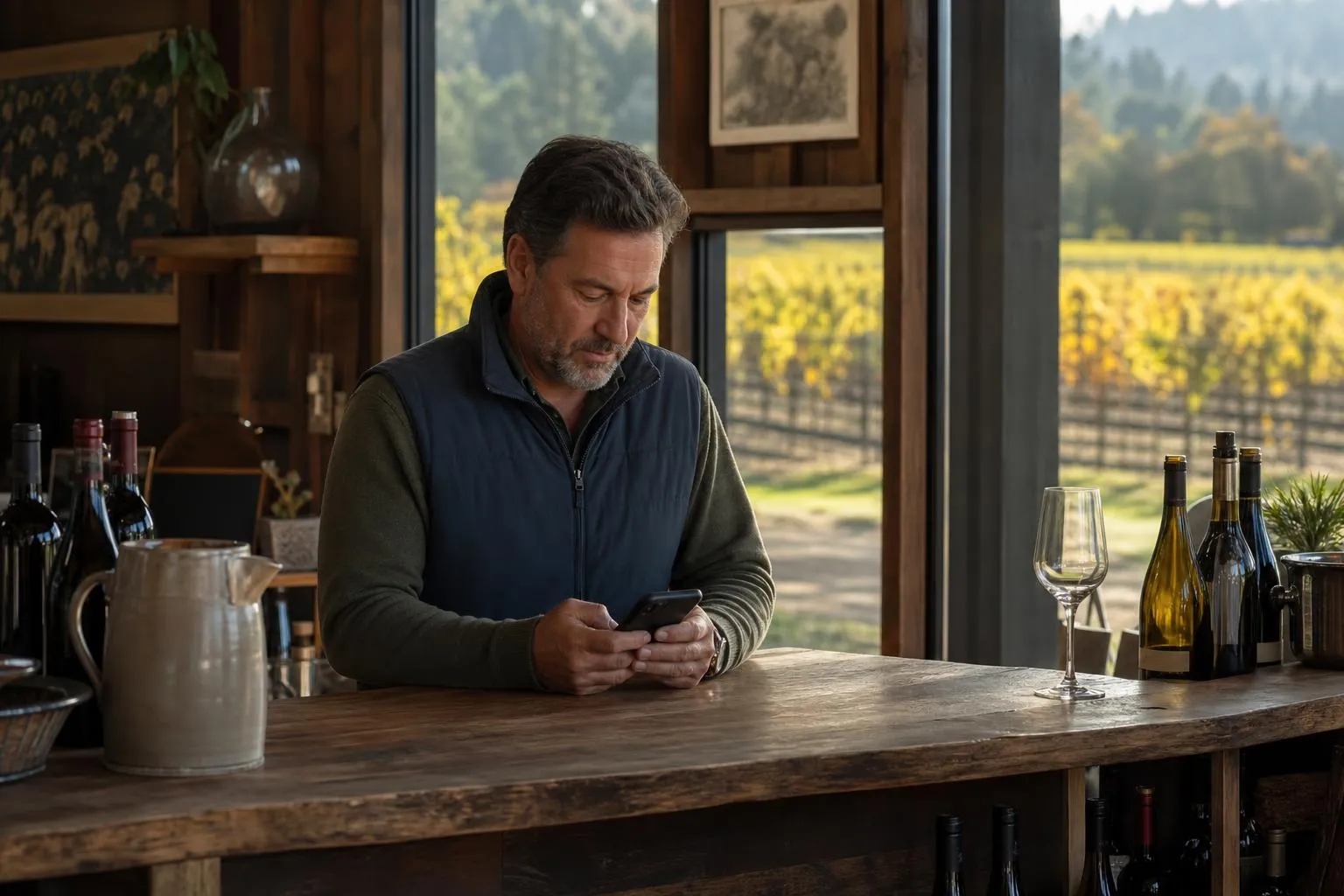
A wine region might have thirty tasting rooms within a short drive of each other. A visitor planning their Saturday opens two or three sites, glances at each for maybe ten seconds, and books. That happens on a Tuesday night from their couch, phone in hand, three tabs open at once.
The mechanics of that comparison are unforgiving:
| What the visitor experiences | The number | Source |
|---|---|---|
| A page takes longer than 3 seconds to load | 53% of mobile visitors leave | Google mobile research |
| Every extra second of load time | Conversions drop about 4.4% | Portent |
| Load time grows from 1 to 10 seconds | Bounce probability climbs 123% | Google/SOASTA |
| Average small-business site on a phone | Loads in about 8.6 seconds | Industry benchmarks |
The typical winery site loads almost three times slower than the point where half of visitors have already given up and tapped back. While the competing tasting room’s calendar widget is already showing open Saturday slots, your homepage is still loading a full-bleed vineyard photo nobody scrolled to see yet. Nobody decides your wine is worse. They just book the vineyard whose site answered first, a pattern also covered in how load time quietly costs wineries bookings.
The expensive part: these were your visitors, and your club members
This isn’t hypothetical. Every weekend, someone in your region decides where to spend their afternoon and, more importantly, where to join a wine club. Someone gets that membership. The only question is whose site made the decision easy.
You’re not just losing a Saturday reservation here and there. Your region’s better wine is sitting with open tables while a thinner one fills its tasting bar every weekend.
This gap closes in weeks, because you already own the proof
You can’t out-age a winery with a decade of vintages and reviews overnight. But the part that costs you the most, that first ten-second impression, is built from things sitting in your tasting room right now.
Real proof. Real photos of your space and your view, club tiers laid out plainly, and the reviews sitting unclaimed with visitors who meant to write one after their tasting. Most wineries have more raw proof than the competitor winning the click; it’s just not on the page. That’s the foundation behind getting more visitors and members for your winery.
A site built to book, not just look pretty. Fast on a phone, a live reservation calendar, a club signup that doesn’t require three clicks. Not a brochure, a booking engine. What actually drives winery conversion comes down to removing every extra step between “interested” and “booked.”
A clean local and regional footprint. Google Business Profile, reviews, and your event pages all pointing the same way, especially heading into harvest season.
The real decision is who builds it:
Rebuilding the site yourself
- Cheapest upfront: a DIY builder runs $20-$50 a month
- You control every photo, tier description, and word
- No waiting on a designer’s calendar, start tonight
Rebuilding the site yourself
- The true cost is your own time: 40-60 hours learning a builder is time not spent in the vineyard or the tasting room during your busiest season
- Templates rarely handle live reservations or shipping-compliance rules well
- Half-finished rebuilds tend to stay half-finished right through harvest
Take back the tastings that belong at your bar
The winery outdrawing you didn’t make better wine. They made themselves easier to book. That gap closes fast, and unlike them, you’ll actually deliver the experience once the reservation lands.
We build winery websites designed to win exactly this ten-second contest: instant tasting reservations, a club page that actually converts, pages built to rank for “wine tasting” plus your region, live in 7 days, done for you start to finish. Watch the free video walkthrough and compare it side by side with what your visitors see today.
You own everything, changes go live within 24 hours, no contracts. If you want your reviews and rankings handled through harvest season too, that’s what our ongoing growth services are for. Stop losing the tasting-room booking before anyone’s even tasted your wine.
Frequently asked questions
How does a mediocre winery outbook a better one?
Because a visitor can’t taste your wine before deciding where to go. They pick based on visible signals: photos, ease of reservation, review recency, mobile site speed. Whoever wins those signals wins the Saturday reservation and the club signup, regardless of what’s actually in the bottle.
Do reviews matter more than the website?
They work together, not against each other. Reviews and your Google profile get you shortlisted; the website turns that shortlist into a booked tasting or a club signup. A great review score pointing at a slow site with no online booking still loses visitors, so fix whichever is weaker first.
How quickly can this actually change?
Faster than most owners expect. A focused review push shows movement in about two weeks, and a rebuilt site can be live in 7 days. Outranking a decade of someone else’s reviews takes longer, but the first-impression gap deciding most weekend bookings is fixable before next month’s harvest events.
What does a done-for-you winery website cost?
Standard is $2399£1,899 one-time and Elite is $7500£5,900 one-time, both published on the get-website page. No contracts, changes go live within 24 hours, launch takes 7 days, and you own everything outright.
Should I just cut my tasting fee to compete?
No. The winery beating you usually isn’t cheaper, it just looks like the easier choice. A lower tasting fee subsidizes a proof problem, not a price problem. Fix what visitors actually see and you keep your margin along with the bookings.
Next in this series: If your winery isn’t in Google’s top 3, you don’t exist to most visitors
Your move
Reading this does not book a job.
The owners who pull ahead are the ones who change one thing this week. If you want that one thing to be a website that sells and ads that put it in front of the right people, we build and run both for you.
Straight answer on whether we can help, usually the same day.