Website Speed Is Losing You Bookings: What Every Extra Second Costs Your Winery
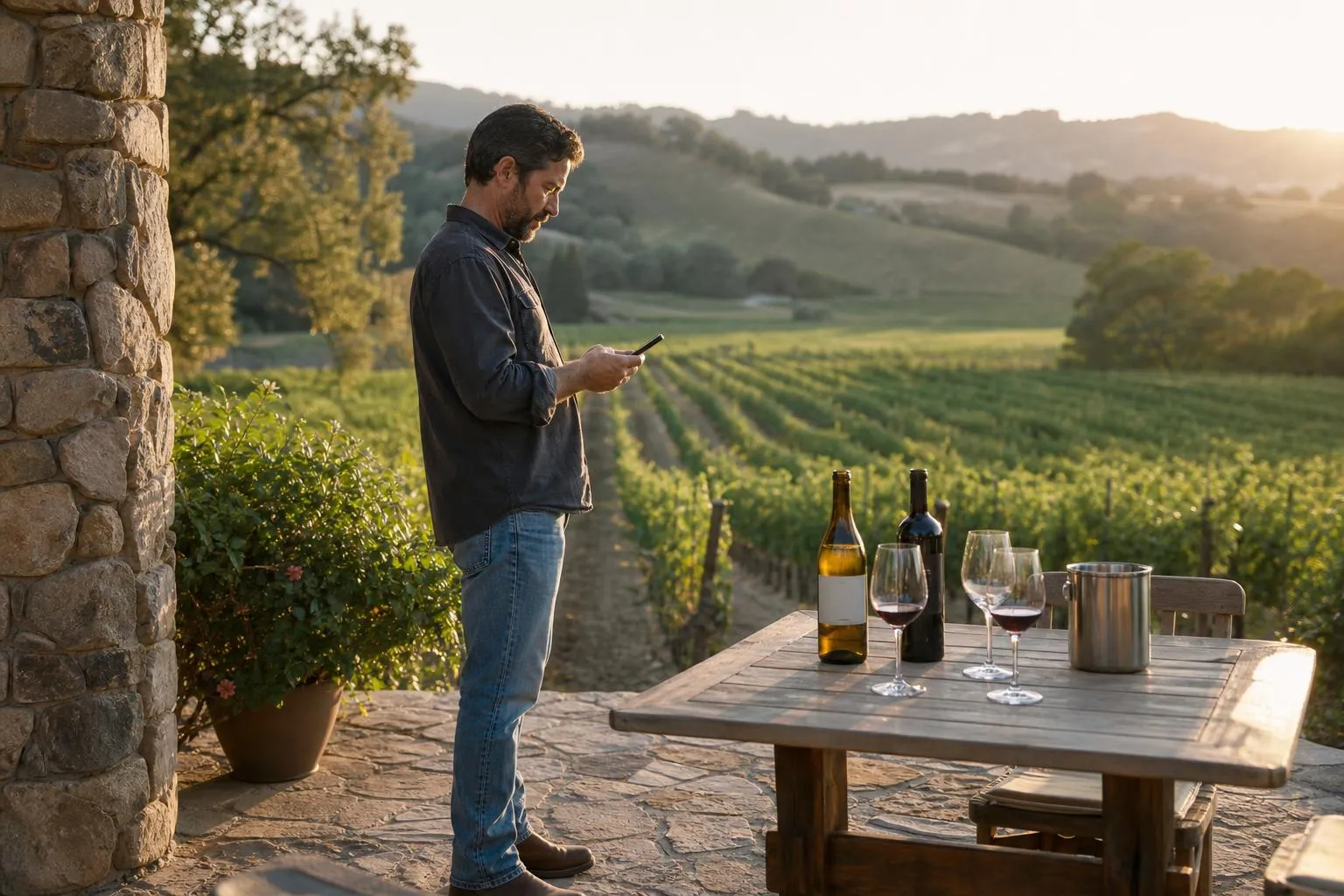
No visitor has ever left a message to say your winery website is slow.
They just picked a different vineyard for Saturday. No complaint, no one-star review about load times, nothing that shows up in your inbox. The reservation widget stalled on their phone somewhere on I-101, and they tapped back and booked the next tasting room on the list instead. You never see that booking to know it slipped away.
“Slow costs reservations” is not a guess. It’s one of the most measured effects on the internet, and the numbers are precise enough to put next to your tasting-room revenue.
What the research says about a stalling tasting page
53% of mobile visitors abandon a page that takes longer than 3 seconds to load (Google). Not “get restless.” Leave. Somebody planning a wine country weekend from the passenger seat has three other tasting rooms open in other tabs and no patience for a fourth that hangs.
Conversions drop roughly 4.4% for every additional second of load time in the first five seconds (Portent). Every second isn’t neutral waiting room. It’s a measurable slice of would-be reservations, gone.
A 10-second page increases bounce rate by 123% compared to a one-second load (Google). At that point the reservation widget might as well not exist.
Here’s the same research as one plain table:
| Load time | What the data says happens |
|---|---|
| 1 second | The baseline every other number is measured against |
| 3 seconds | 53% of mobile visitors have already left (Google) |
| 5 seconds | About 18% of conversions gone, at 4.4% per extra second (Portent) |
| 8.6 seconds | The average real-world mobile page load time |
| 10 seconds | Bounce rate up 123% versus a 1-second load (Google) |
Sit with those middle rows. A visitor gives your page three seconds. The average winery site takes almost nine. A site running a scenic full-bleed video header on top of an old plugin stack is, by construction, built to lose most of the people who reach it, and since most tasting-room research now happens on a phone somewhere on the drive out, the mobile number is the one that actually decides who shows up Saturday.
Run your own numbers
Say 300 visitors a month land on a slow page. If even 40% bail purely on load time, that’s 120 people who searched for wine country tasting, clicked your listing, and left before your hours ever loaded. They did the hard part already, finding you online, and a spinning wheel threw it away.
You don’t need many of those 120 to be real reservations for this to be the costliest gap in your whole marketing calendar.
The double penalty: Google is timing your pour too
Speed doesn’t just lose the visitors who already found you. It shrinks how many find you at all.
Page speed is a Google ranking factor, and Google ranks your mobile site head-to-head against every other tasting room in the region, the same competition covered in how wineries crack the Google top 3. A slow site slides down the results, so fewer visitors arrive in the first place, and then the slowness loses roughly half of the ones who do. The same flaw gets billed twice: once in rankings, once in every visitor Google still sends.
Fast sites run the opposite way: better rankings feed more traffic into a page built to hold it, compounding whatever you gained from tightening the reservation flow in the last article. That’s why speed is the highest-leverage fix on a winery website. It multiplies everything else.
Why your site is slow (it isn’t the rural Wi-Fi)
Test any slow winery site and the same four culprits keep showing up:
- A cinematic theme built to show off two hundred features you use five of, and all two hundred load regardless.
- A plugin stack: gallery sliders, club-signup popups, event calendars fighting for the same page load, each one adding weight.
- Full-resolution vineyard photography uploaded straight from a camera, several megabytes each, on a page meant to load fast on a spotty rural signal.
- The CMS itself, rebuilding every page from a database on every visit, like decanting a fresh bottle for every single pour instead of having it ready.
None of that is your actual pitch. Your tasting hours, your club tiers, your reservation button, all of it weighs almost nothing. The drag is machinery added for the site’s own sake, and visitors pay for it in seconds, often on a weak signal winding through the hills. So can the old site be tuned instead of rebuilt?
Squeezing speed out of the old site
- A caching plugin and compressed photography are cheap and can recover a second or two
- You keep the branding, copy, and URLs already in place
- A freelancer can handle the basics in a weekend for a few hundred dollars
Squeezing speed out of the old site
- The theme still ships all two hundred features underneath, so tuning usually plateaus around 4-5 seconds, still past the 3-second cliff
- Any plugin or theme update can quietly undo the gains with nobody watching
- You’re paying to make an outdated site marginally less slow instead of retiring it
Why that machinery got added in the first place, and why it’s now unnecessary, is the subject of the next article in this series.
What fast looks like
The sites we build load in a couple of seconds on cellular data because they’re engineered lean and mobile-first, with nothing on board that doesn’t help book a tasting. No plugin pile, no database, no unused feature bloat. Speed isn’t a tune-up applied at the end. It’s the constraint everything else is designed inside, the same discipline behind a tasting page that looks beautiful but never fills a reservation slot.
Watch the free video walkthrough of a live winery site and time it against your own, phone in hand, the way a visitor driving out from the city would. It’s built for you start to finish in 7 days, and if you want ongoing help driving traffic once it’s live, there are growth services for that too.
Frequently asked questions
How fast does a winery website need to be?
Under 3 seconds on a phone on cellular data, ideally under 2. Google’s 53% abandonment figure hits right at 3 seconds, and a visitor comparing three tasting rooms on the drive out has even less patience than that.
Can I just speed up my existing site?
Partly. Compressing photography and adding caching is worth doing this week and can recover a second or two. But when a cinematic theme and plugin stack are the real weight, tuning usually stalls around 4-5 seconds and the next update can undo it.
How much does a professionally built fast website cost?
Our Standard winery website is $2399£1,899 one-time, and the Growth tier is $7500£5,900 one-time, with full booking and shipping-compliance integration. Both prices are published, there are no contracts, changes go live within 24 hours, and you own everything. Set that against Dana’s yearly gap and the payback is short.
Will a faster site actually improve my Google ranking?
Speed is a confirmed ranking factor, and Google measures the mobile version of your site. It’s one signal alongside reviews, proximity, and relevance, so speed alone won’t land you in the top 3. But a slow site will keep you out of it while also losing the visitors you still get.
Next in this series: Still on WordPress? In the age of AI, that’s a dinosaur
Your move
Reading this does not book a job.
The owners who pull ahead are the ones who change one thing this week. If you want that one thing to be a website that sells and ads that put it in front of the right people, we build and run both for you.
Straight answer on whether we can help, usually the same day.