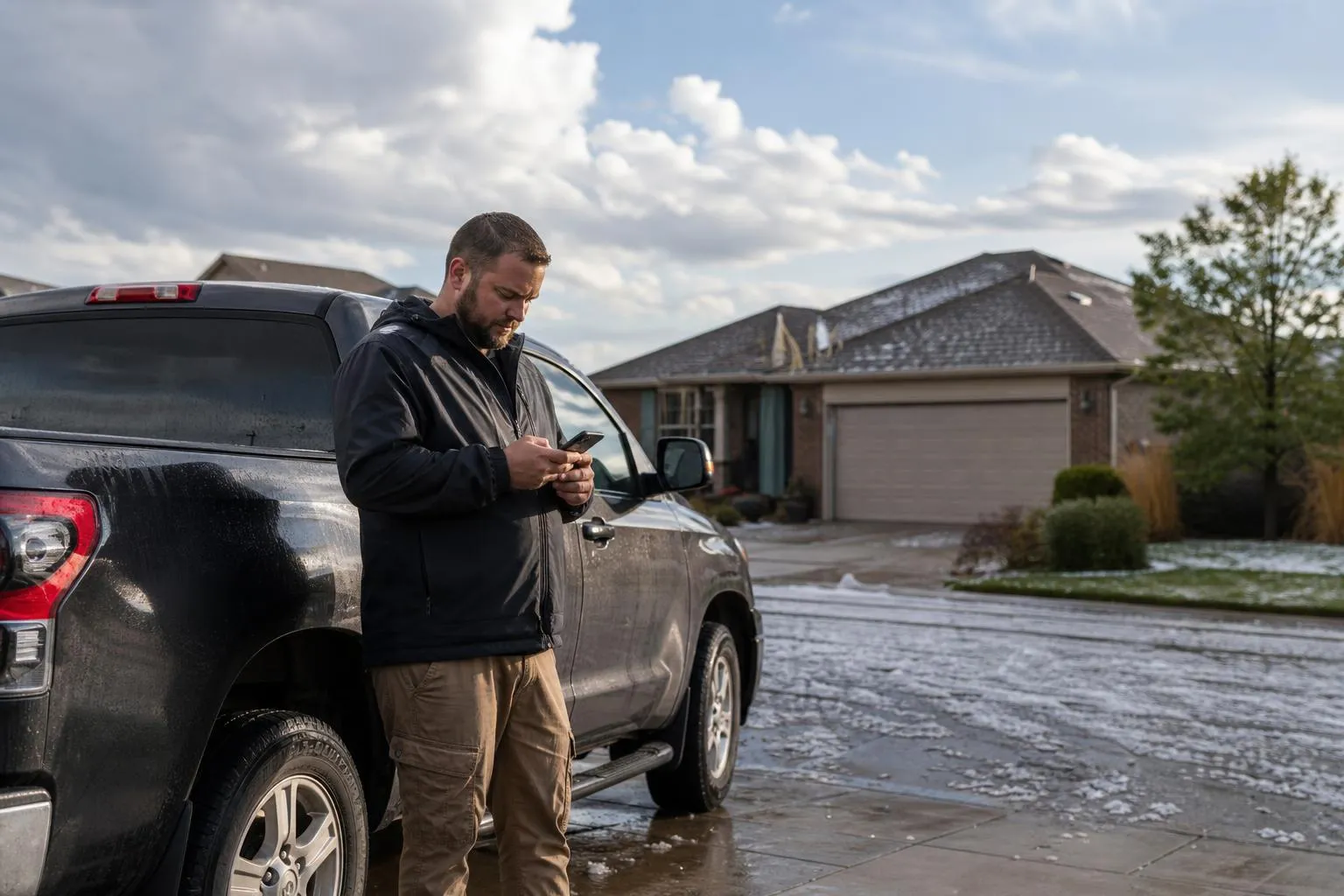
Roofer not showing up on Google? If you're not in the top 3, you don't exist
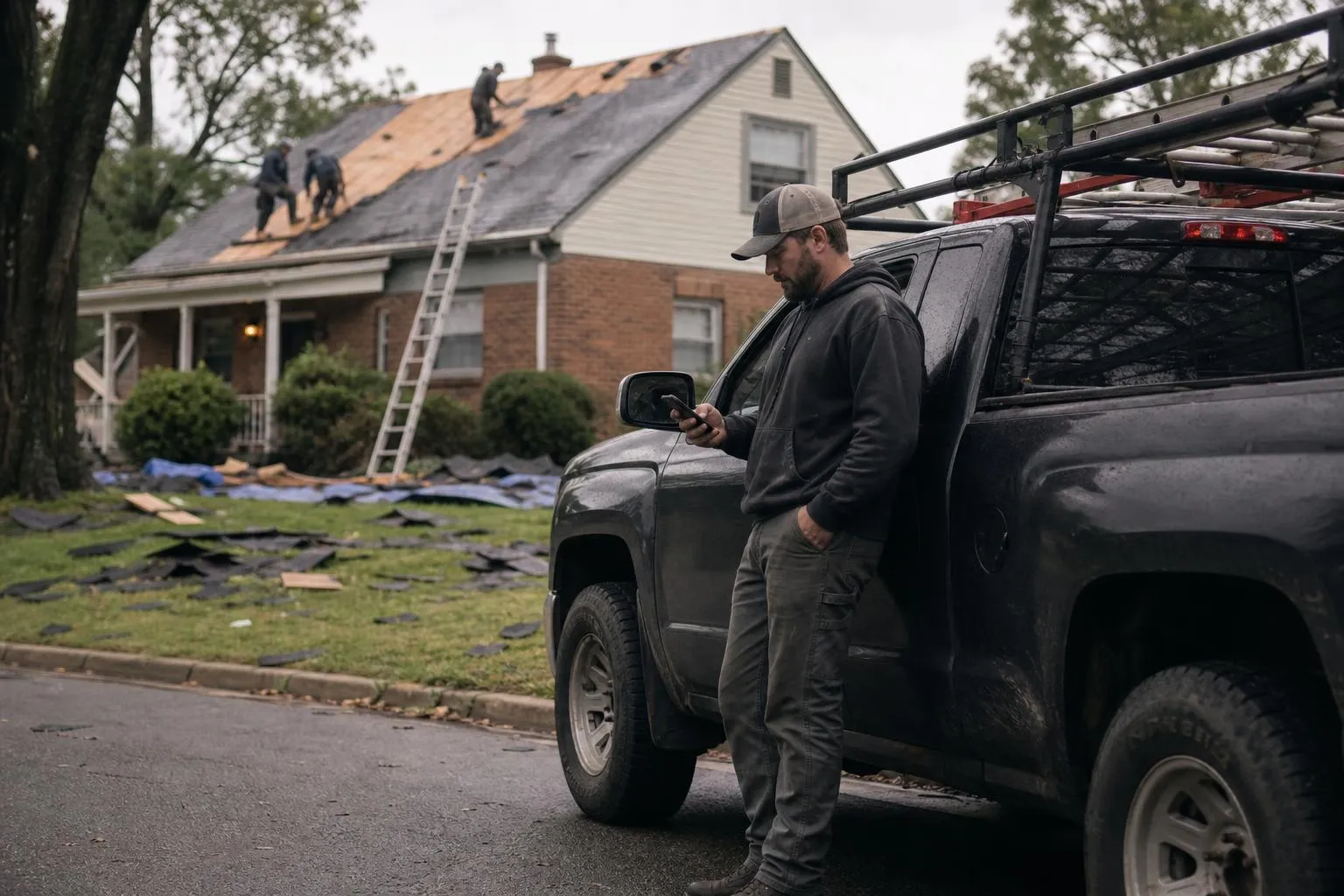
Here’s how your next customer finds a roofer. Not how marketing people say they do. How they actually do it.
There’s a stain spreading across the bedroom ceiling. They grab their phone and type “roofer near me” or “roof leak repair” plus their town. Google shows a map with three businesses pinned on it. They glance at the stars, maybe open one profile, and call. If the first call hits voicemail, they call the second.
That’s the entire customer journey. Thirty seconds, three candidates, one winner.
Nobody scrolls to page two. Almost nobody scrolls past the map. If you’re not in that top cluster, you’re not “ranked lower.” For the homeowner who needs a roofer right now, you don’t exist.
Two lists control your month
When someone searches locally, Google shows two lists that matter.
The map pack is the three pinned businesses at the top, where storm calls get won. It runs on your Google Business Profile: reviews (count, rating, recency), categories, service area, and how consistent your business info is across the web.
The organic results below it are where your website competes, and where the researched work comes from: full replacements, insurance claims, and gutter jobs people compare quotes on.
Most roofers focus on neither, get scraps from both, and conclude Google doesn’t work, while one or two competitors quietly eat the map pack every day. You can pay to jump the line with advertising on Google, but ads stop when the budget stops. The free lists keep paying as long as you hold your spot.
Your website is working against your ranking
Owners treat the website and the ranking as separate problems. They’re not. Google decides where you rank partly by looking at your website, and an old site actively pushes you down. If your roofing website isn’t getting you jobs, this is where the leak usually starts.
It’s slow. After a hailstorm every roofer in town gets searched at once, and the homeowner opens three sites in three tabs. The slow one gets closed first. Two numbers to keep on the truck dash: more than half of mobile visitors, 53%, bail on a page slower than 3 seconds (Google, 2016), and 1-second pages hold a threefold conversion edge over 5-second ones (Portent, 2022).
Roofing sites get slow for a predictable reason: drone shots of finished roofs and full-size crew photos uploaded straight from the phone. Shrink them, put the storm-damage number on the first screen, and you win back the factor Google ranks you on.
It’s not mobile-friendly. Google ranks the mobile version of your site, not the desktop version you approved years ago. A broken phone experience costs ranking before any homeowner sees it.
It’s thin. A five-page brochure that says “we do roofing” gives Google nothing to match against “storm damage repair” plus your town. No page for a service means no ranking for that service.
It’s stale. The same stock roof photo every competitor runs signals a site untouched since 2018.
Why “just running some SEO” won’t fix an old site
The standard move here is hiring someone to “do SEO” on the existing site. That’s paint over rusted flashing. The foundation is the problem, and Google compares your site head to head with the best local competitor’s every day.
Paying for SEO on the old site
- A smaller monthly bill than a rebuild, easier to carry between storm seasons
- No switch, no new design to learn
- Keeps your existing URLs and their history
- Works if the site underneath is already fast and mobile-first
Paying for SEO on the old site
- The retainer fights the foundation instead of building on it
- You can’t retrofit a fast load into a ten-year-old WordPress theme loaded with plugins
- Twelve months at $750 is $9,000 rented, nothing owned
- Most audits quietly end with “you need a new site anyway”
What one top 3 spot is actually worth
Think about what the map pack is: every homeowner in your service area with roof damage and a check from their insurer, sorted into a queue and handed to three companies. A full replacement is one of the biggest jobs a homeowner ever pays for. Storm season multiplies that queue fast, whether you’re in the room or not.
The crews holding those spots aren’t better roofers (see why the worse roofer wins your jobs). Their online foundation just gives Google no reason to hide them.
How you actually get there
Nobody honest can promise a #1 ranking, and anyone who guarantees one is selling snake oil. A roofer’s inputs are plain enough:
- A fast, mobile-first website with a page for each job you do (repairs, full replacements, storm and insurance work, gutters) and each town you cover, so Google can match you to the exact search.
- A complete, active Google Business Profile. Right category, real crew and job-site photos, service area set correctly.
- A steady drip of reviews. Asking after every finished roof, while the homeowner is still looking up at it, beats a one-time push. They also feed your local promotion.
The profile and the reviews are habits you can start after the next finished roof. The website is the build, and it is the part that turns a pinned listing into a phone call.
Build the foundation Google wants to rank
We build roofing websites structured for local search from day one: the storm-damage number on the first screen, light pages built for phones, a page for every service and town you cover, click-to-call in every section. The point of the ranking is the call.
The roofing website walkthrough shows a live roofing site with a page per service and town and click-to-call in every section. Our two prices are listed with it, $2399£1,899 (Standard website) or $7500£5,900 (Growth website), both one-time. Nothing locks you in, the site is yours, and it’s live 7 days after kickoff. After a storm, when you want a hail-damage banner up by morning, message us; most changes ship within 24 hours. Our local SEO and Google Business Profile management can run the profile and review side if you’d rather be on roofs.
Frequently asked questions
Why is my roofing company not showing up on Google?
Almost always three things: an incomplete or miscategorized Google Business Profile, too few recent reviews, and a slow or broken mobile site. Fix the first two this week; the website usually needs a rebuild.
Can anyone guarantee me a top 3 ranking?
No. Cold callers promise roofers first-page rankings every storm season, and none of them control Google’s map. You control the Roofing Contractor category, real job-site photos, a page for repairs, replacements, insurance work and gutters, and a review request after every finished roof.
How long does it take to get into the map pack?
A corrected category and a handful of reviews can register within weeks. During storm season, when every roofing company in the metro is pushing at once, movement is slower. Rebuild before the season starts; ours are live 7 days after kickoff.
How much does a website built for local roofing search cost?
$2399£1,899 for the Standard website or $7500£5,900 for the Growth website, posted on the page and paid once. You keep ownership, and no contract applies. A $750 monthly retainer comes to $9,000 a year without making the storm-damage page any faster.
Next in this series: Your site looks fine on your laptop. Your customer is standing in the yard staring at hail damage.
Your move
Reading this does not book a job.
The owners who pull ahead are the ones who change one thing this week. If you want that one thing to be a website that sells and ads that put it in front of the right people, we build and run both for you.
Straight answer on whether we can help, usually the same day.
More from the blog
Your roofing website looks fine on a computer. Your mobile customers are watching a ceiling stain spread
Read more
The trust tax: how an outdated roofing website kills referrals you already earned
Read more