How to Grow a Roofing Business
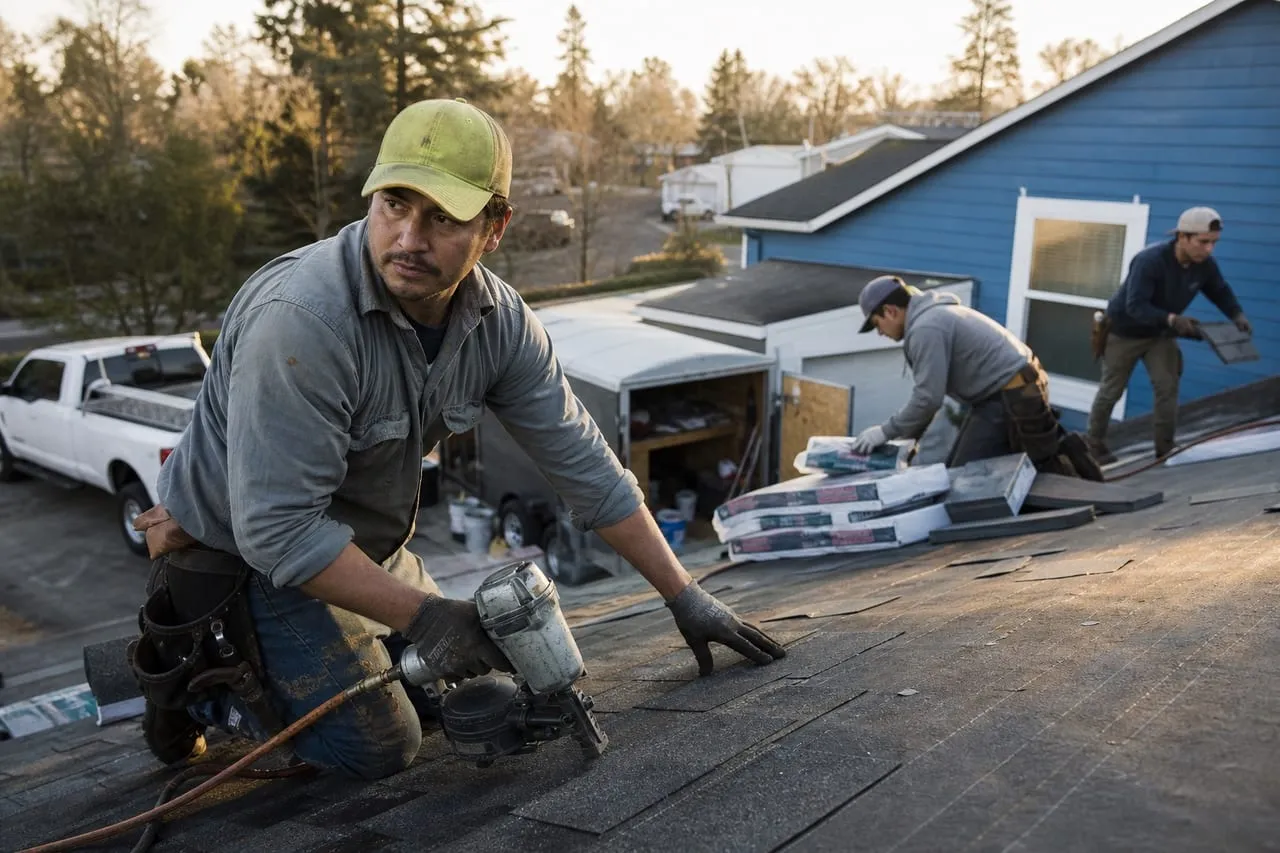
Most roofing companies stall at one crew not because the market is saturated but because the owner is the bottleneck. They are estimating, selling, ordering materials, managing the crew, collecting payments, and answering the phone. Growing past that means deliberately replacing yourself in those roles, in the right order. Here is how the math and the org chart actually work.
The growth stages, in numbers
Growth in roofing is not a smooth curve. It is three distinct companies, and each one runs on a different version of the owner. Knowing which row you are in tells you what to fix next, and what to ignore.
| Stage | Monthly revenue | Where the owner’s week goes | Key hires |
|---|---|---|---|
| Owner on the roof | $15k-$40k | Installing all day, quoting at night | Helpers only |
| One crew + foreman | $30k-$80k | Selling and quality control | Foreman |
| 2-3 crews | $120k-$300k | Sales, key accounts, leadership | Production manager, office admin |
The most expensive mistake in this table is entering the third row with the staffing of the second. A second crew added without a production manager means the owner now runs logistics for two crews instead of installing with one. Site checks get skipped, callbacks climb, and the review stream that feeds the lead engine dries up at exactly the moment two crews need feeding. The infrastructure goes in first, then the crew.
The first hire is always a foreman
A foreman is a working crew leader who can run the roof without the owner present. They tear off, lay underlayment, run the nailers, manage the helpers, and handle the homeowner walkthrough at the end.
What to look for:
- 5+ years on roofs
- Has run a crew before, even informally
- Speaks the language of the homeowner (not only the crew)
- Carries their own basic tool kit
Pay structures that work:
- Hourly $30-$45/hour plus production bonus per square.
- Salary $70k-$95k with a percent of crew profit.
- Pure piece rate $25-$40/square installed.
A foreman frees the owner to do the two highest-leverage activities: selling and quality control. Once a foreman is solid, monthly revenue typically jumps 40-80% within 90 days because the owner has bandwidth back. See when and how to hire and train staff for the hiring process.
What stops most owners is the sticker price, and the sticker price is real, because in roofing the salary is only the start. Workers comp for roofing crews is the most expensive in the trades and applies to every field dollar you pay. The honest way to decide is to put the loaded number next to what a freed-up owner actually produces.
The math only works if the business can carry the payroll while those new jobs land. The foreman gets paid weekly from day one; the revenue he unlocks arrives 30-90 days later.
Build a real sales process, not “I’ll get to it”
Solo owners run a chaotic sales process: leads come in, they call back when they can, drive out for estimates between job runs, and forget half the follow-ups. To grow, the sales process has to be writable:
- Speed to lead: every inbound call returned within 5 minutes during business hours, every form fill within 30 minutes. Each hour of delay drops close rate 10%.
- Standardized estimate template: bid per square, line-itemed (tear-off, decking allowance, underlayment, shingles, ridge cap, dump fees, permits, overhead). See setting best prices and billing.
- In-home or driveway close: bring the contract. The “I’ll email it over” close rate is 15-25%. The on-site close rate is 35-55%.
- Same-day follow-up: every estimate gets a text or call within 24 hours.
- 30-day nurture: every “not now” lead gets a quarterly touch.
A CRM (JobNimbus, Roofr, AccuLynx) at $80-$200/user/month is worth it once you have more than 20 leads/month.
Speed to lead matters more in roofing than in almost any other trade because the call is triggered by an event: a stain on the ceiling, last night’s storm, a crew on the neighbor’s roof. The homeowner calls three to five companies off the same search, and the first one to answer gets the estimate slot plus the trust that comes with answering. After a storm the window compresses further, because every roofer in the metro is chasing the same streets.
Your close rate is also a pricing instrument, not just a sales score. Closing under 30% of on-site estimates usually means slow follow-up or unqualified leads. Closing over 60% almost always means you are the cheapest bid in the driveway, and the margin you gave away stays invisible until year-end. The healthy band for a reviewed, referenced roofer is that 35-55% on-site range.
Add a production manager between you and the crews
The next bottleneck after a foreman is logistics. Material orders, dumpster scheduling, permit pulls, customer walkthrough scheduling, change-order paperwork, and crew dispatching consume 20-30 hours a week. Once you have 2+ crews, hire a production manager (often the original foreman promoted, sometimes a hire from a competing shop).
Production manager owns:
- Material ordering and supplier coordination
- Crew scheduling and dispatch
- Job site quality checks
- Change order approvals
- Customer communication during the build
Pay range: $65k-$110k/year. The hire pays for itself by recovering 25-40 hours of the owner’s time per week, which goes back into sales and new-market expansion.
The promote-or-hire question deserves more thought than it usually gets, because both paths fail in predictable ways.
Promoting your foreman: pros
- Already runs your quality standard and knows every crew member
- Keeps your best employee challenged and paid, which is how you keep him
- Supplier and customer relationships transfer with the title
Promoting your foreman: cons
- You lose your best roof and must backfill the crew lead role
- Great installers are not automatically great schedulers and paperwork handlers
- If the promotion fails, you risk losing him entirely, not just refilling a seat
The middle path is a 30-day trial: hand the foreman material ordering and next-week scheduling while he still runs his crew, and watch whether the paperwork happens without chasing. If it does, promote and backfill his crew. If it does not, hire the production manager out of an insurance-restoration shop, where the role is mature, and keep your foreman where he is great.
Marketing scales with the org
As crews grow, marketing has to grow with them. A two-crew shop needs 40-80 leads a month, which means a $5k-$10k/month spend in LSAs, search ads, and Facebook. See how to advertise on Google and how to advertise on Facebook for the paid playbooks.
The 40-80 number is not arbitrary. Two crews need roughly 14-20 installs a month to stay busy. At a 40% close rate that takes 35-50 estimates, and not every lead books an estimate, so the top of the funnel needs 40-80 raw leads. Work the math backward from crew capacity and the marketing budget stops being a guess.
Paid is the throttle, not the foundation. The free engine still carries a third to half of a healthy roofer’s volume: Google Business Profile reviews requested the day of completion, yard signs on every active job, and the neighbor-magnet effect of a clean, fast install on a visible street. Door-knocking after a storm converts best in a radius around your own job sites, because the truck across the street is the proof. Scale the paid spend on top of that engine, not instead of it.
Three-crew operations typically hire an in-house marketing coordinator or contract a roofing-specific agency at $3k-$8k/month.
Cash flow is the growth governor
Revenue growth and cash growth run on different calendars in roofing. Payroll is weekly. Suppliers are net-30. Retail customers pay on completion, and insurance carriers pay in stages, releasing recoverable depreciation only after the paperwork closes. Every new crew multiplies the number of jobs sitting inside that gap at once, which is how companies fail at three crews with full schedules.
This is why the $25k-$100k working credit line belongs in the growth plan from day one. Drawing on it to buy materials for sold, deposited jobs is healthy. Drawing on it to cover payroll for crews without backlog is the warning light. Pair the org build here with the weekly rhythm in how to successfully run a roofing business, because growth only multiplies what the operating cadence already does well, including its flaws.
Frequently asked questions
What is the right time to hire the foreman?
When you are turning down work, or when you are spending 60%+ of your week on roofs instead of selling. A clear sign: a $5k-$10k week of revenue lost because you could not be in two places.
Can I scale to 5 crews with one production manager?
No. The realistic ratio is one production manager per 2-3 crews. Past that, scheduling and quality control break.
What is the revenue cap on a one-foreman one-crew operation?
$30k-$80k/month depending on market and ticket size. Most settle around $50k-$60k/month with one experienced foreman.
What kills growth?
Cash flow timing. Customers pay slowly, suppliers are net-30, and payroll runs every week or two. Growing roofers need a working credit line ($25k-$100k) to absorb the gap.
Do I have to specialize?
No, but a tight service mix (asphalt shingle + metal + repairs) is easier to scale than a broad one (add commercial flat, gutters, siding). Pick a lane in year two.