Setting Prices and Billing for a Roofing Business
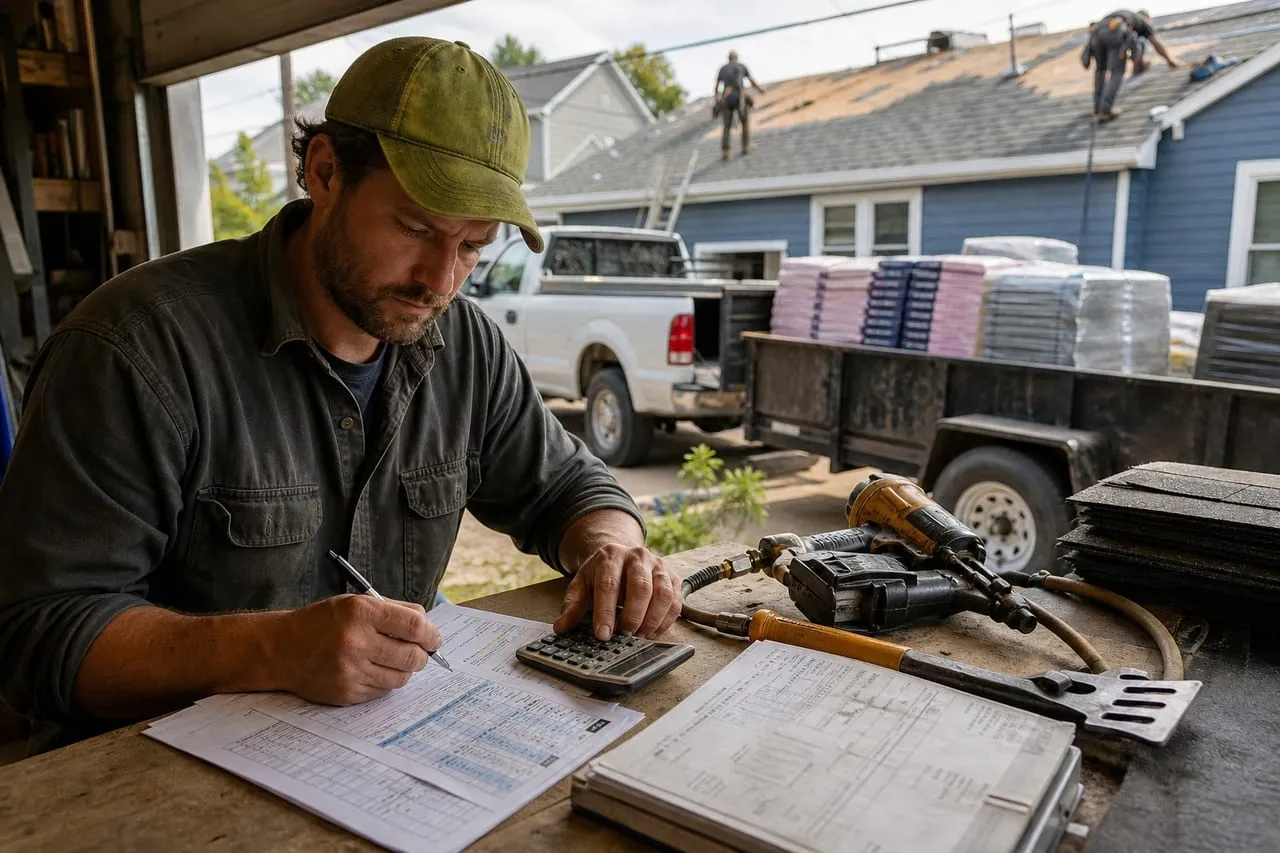
Pricing a roof is the single most expensive skill a roofer learns. Underbid and you lose the margin. Overbid and you lose the job. The roofers who run consistent 35-45% gross margins don’t guess. They use a per-square model with built-in allowances for the surprises the roof will hand them mid-tear-off. Here is the working math and the billing process that goes with it.
A roof is measured, not guessed, and the per-square model is what turns that measurement into a defensible price in fifteen minutes: count squares, apply your template, adjust for pitch and access. Just as important, per-square bidding makes every job comparable with the last one, so margin drift shows up in the Friday numbers instead of at tax time. The skill ceiling in roofing pricing is not the arithmetic. It is refusing to deviate from the template when a customer pushes, a competitor lowballs, or a slow week makes any signature look attractive.
Per-square pricing fundamentals
A “square” is 100 square feet of roof area. Bidding per square instead of per square foot makes the math cleaner and easier to communicate.
A typical residential asphalt shingle reroof bid breakdown:
| Bid line | Per square | What moves it |
|---|---|---|
| Tear-off | $50-$100 | Layers, pitch, fragile landscaping |
| Underlayment + ice and water shield | $25-$50 | Code requirements in cold states |
| Shingles (architectural), materials | $90-$140 | Brand, line, current supplier pricing |
| Install labor | $100-$170 | Pitch, stories, cut-up hips and valleys |
| Ridge cap, drip edge, flashing | $20-$40 | Chimneys and sidewall flashing add |
| Permit, dump fees, magnet sweep | $30-$60 | Local permit schedule, dump rates |
| Overhead and profit | $80-$140 | Your real overhead, measured not guessed |
| Installed total | $400-$700 |
The most misunderstood thing about that table: the lines are retail prices, not your costs. Your margin does not live in the “overhead and profit” row alone; each line carries a share of it, and that is deliberate. A bid that parks the entire margin in one visible row invites the customer to negotiate exactly that row away. The other quiet passenger in those lines is insurance: roofing workers comp (class 5551) runs $20-$50 per $100 of payroll, so a $40/hour installer really costs up to $60. If your labor line covers wages but not the comp load, every bid you win loses money in premium.
Use a printed or digital line-item bid template that shows every category. Customers trust line-item bids and approve change orders faster against them. See how to make a website for hosting a digital version of the template.
Allowances for what you can’t see
Two categories of surprise that eat margin if not allowanced:
- Decking replacement: $60-$90 per sheet of plywood replaced. Always bid with “first three sheets included, additional sheets at $X/sheet.” Most reroofs uncover 2-8 rotten sheets.
- Multiple tear-off layers: a roof with 2-3 existing layers takes 1.5-2x the tear-off labor. Inspect before bidding when possible. If not, bid for single-layer and write a change-order clause for additional layers.
Other contingencies to allowance: chimney flashing replacement, skylight reseal, vent boot replacement, ridge vent installation, gutter realignment. Each one adds $200-$1,500. Get them approved in advance or with a clear change-order process.
The allowance is a sales instrument as much as a protection. “First three sheets of decking included, $75 a sheet after” reads as fair and pre-agreed; an open-ended “decking billed as found” reads as a blank check and loses bids. You can also shrink the surprise before bidding: ten minutes in the attic with a flashlight reveals most water-stained or delaminated decking from below, turning a mid-job argument into a signed line item.
Change orders, deposits, and collections
Process discipline keeps the money flowing:
- Deposit: 25-33% on contract signing. No deposit, no schedule slot.
- Change orders: written, signed (or emailed and replied “approved”), with line item and price. Verbal change orders are a path to bad debt.
- Progress draw (large jobs): 50% on contract, 40% on material delivery, 10% on completion.
- Final invoice: handed to customer on completion walkthrough.
- Payment methods: check, credit card (with 3% fee passed through), ACH. Stripe, Square, or QuickBooks Payments are the standard.
Mobile payment matters. Customers who can swipe a card on completion pay 80% faster than customers who mail a check.
The contract is the pricing system’s enforcement arm, and roofing is a trade where scope creep arrives politely: “while you’re up there, could you just look at the gutters?” Every “just” is a change order. Profitable shops write tight contracts that name the exact shingle brand, line, and color; state what is included (three decking sheets, standard vent boots) and what is explicitly excluded (skylight reseal, gutter work, rotted fascia); and tie payment to dated milestones. The salesman’s verbal promises become your warranty obligations, so the rule is simple: if it is not written in the contract or a signed change order, it does not exist.
For job-cost discipline behind the pricing, see how to successfully run a roofing business.
Financing options to offer customers
Offering financing closes more jobs at higher ticket sizes. Customers who can’t write a $15k check today can finance over 60-84 months at $200-$350/month.
Common roofing finance partners:
- GreenSky
- Service Finance Company
- Ygrene
- Sunlight Financial (solar-adjacent)
- HomeAdvisor Pro Financing
Setup is free for the contractor. The dealer fee is 6-12% taken off your payout, but the close-rate lift typically more than covers it. A roofer that offers financing on every bid closes 15-25% more jobs at 5-10% higher ticket sizes.
The dealer-fee math deserves a closer look, because 6-12% sounds painful until it is compared with the alternative. On a $15,000 job, a 10% fee is $1,500, but the fee applies only to financed jobs while the close-rate lift applies to the whole pipeline. One wrinkle matters in practice: most lender agreements prohibit quoting financed customers a visibly higher price, so the fee has to live inside your standard per-square pricing rather than appearing as a surcharge. Price for it once, in the template.
Offering financing: pros
- Closes 15-25% more bids, concentrated in the $15k+ replacements that matter most
- The lender funds you in full at completion: no receivables to chase
- Tickets rise 5-10%: a better shingle reads as $30 a month, not $1,500
Offering financing: cons
- The 6-12% dealer fee comes off your payout on every financed job
- Funding waits on completion certificates and customer sign-off
- Cancellations or disputes inside the lender’s window can claw back a paid job
Whichever way you decide, revisit it annually alongside the rest of your pricing, because dealer fees and close-rate lifts both move with interest rates.
Pair pricing discipline with the lead engine in how to advertise your roofing business and the operational rhythm in how to grow a roofing business.
Frequently asked questions
Should I show pricing on my website?
A range, yes (“most reroofs in our area run $8,000-$25,000 depending on size, pitch, and material”). A fixed per-square price, no. Every job varies.
What’s a healthy gross margin?
35-45% gross on residential reroofs. Insurance restoration with proper supplements can hit 45-55%. Commercial flat roofs run 25-35%.
How do I handle a customer who balks at the price?
Walk through the line items. Show the scope. Offer financing. Never drop the price by 20% to “win the job.” That’s a job you wish you hadn’t won six weeks later.
Should I match competitor pricing?
No. Bid what your true cost + target margin requires. Customers who only compare price are bad customers. Customers who compare scope and reviews are good ones.
When do I raise prices?
Annually at minimum. Material costs rise, labor rises, WC rates rise. A roofer who hasn’t repriced in 18 months is bleeding margin on every job.