How to Advertise a Roofing Business
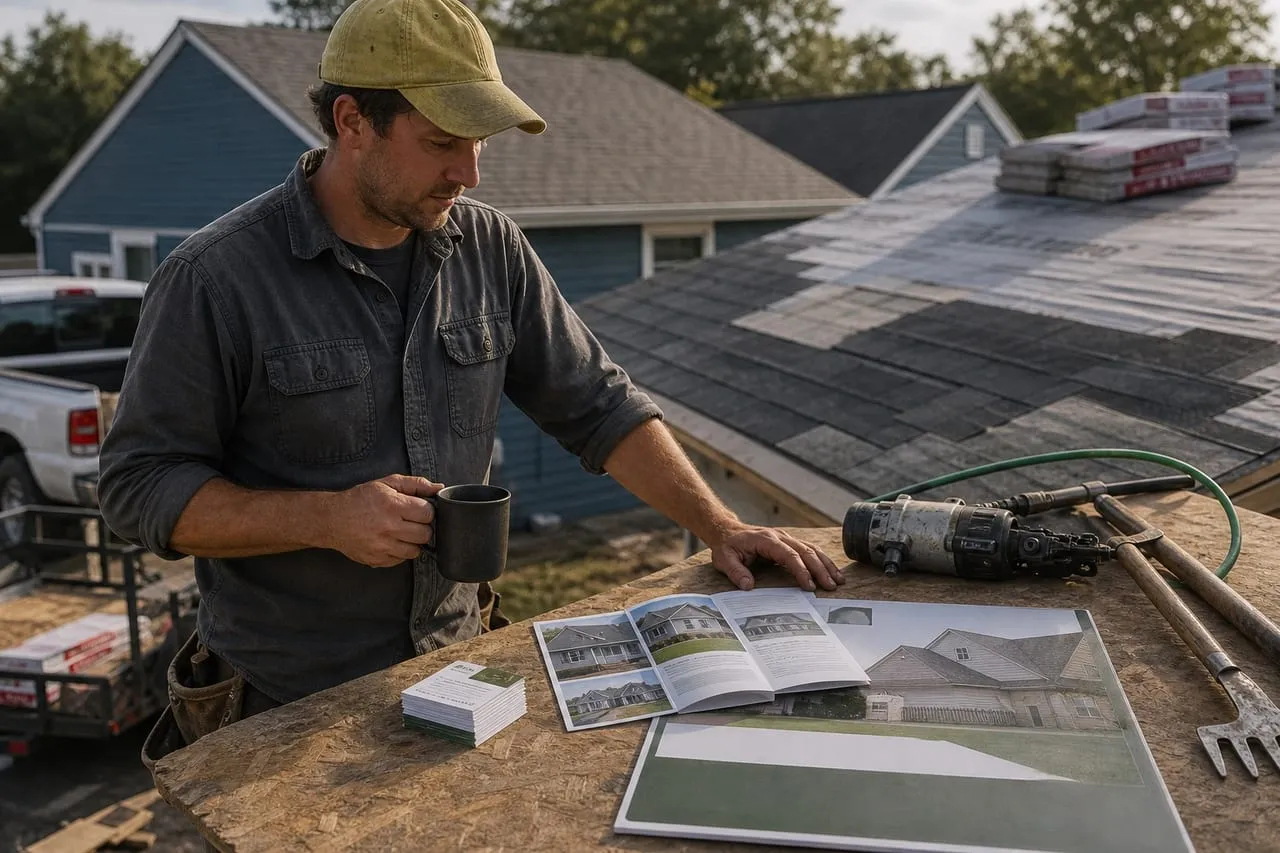
Advertising a roofing business is not a single-channel game. The roofers who fill their pipeline year-round run five to seven channels at once, each at a different ROI and timing. Some pay back in 48 hours (door-to-door post-storm). Some pay back in 12 months (SEO). The trick is knowing which to spend on at your current stage.
The cheap, high-trust channels first
If you have under five reviews and a brand new license, skip paid ads and run these:
- Google Business Profile: claim it, upload 30+ photos of past jobs (drone shots, before/afters), add every service as a category, post weekly updates. Ranks free in the local map pack within 4-8 weeks.
- Door-to-door canvassing: 48 hours after any storm, work the affected zip codes with a clipboard and a “free roof inspection” pitch. Conversion 1-3% of doors knocked, but a 200-door day produces 4-6 inspections and 1-2 closed jobs.
- Yard signs: 50 corrugated signs at $8-$15 each. One sign at every job for two weeks pulls 1-3 calls.
- Reviews: text every customer a Google review link the same evening you finish the job. Target 25 five-star reviews in the first 90 days.
These four channels, run hard, can fill a single-crew operation for under $1,500/month in spend. They are the foundation.
The reason they come first is not that they are cheap. It is that every paid channel converts through them. A homeowner who clicks your ad does not call from the ad; they open your Google profile, count the reviews, scan the photos, and then decide. Until that profile survives a 30-second inspection, paid traffic leaks. This is why two roofers can run identical campaigns and one pays $90 per booked inspection while the other pays $400: same ads, different trust assets behind them. The full ground-game playbook for these channels is in how to promote roofing locally.
| Channel | Typical cost | Cost per lead | Time to first lead |
|---|---|---|---|
| GBP + reviews | Free (your time) | $0 | 4-8 weeks |
| Post-storm canvassing | $20-$30/hr per canvasser | $60-$90 per inspection | 48 hours |
| Yard signs | $8-$15 per sign | $4-$8 per call | 1-2 weeks |
| Google LSAs | Pay per lead | $25-$80 | 1-2 weeks after approval |
| Google search ads | $50-$150 per click | $150-$350 | 1-4 weeks |
| Facebook lead-gen | $50-$150/day | $15-$40 | 24-72 hours |
| Wraps, shirts, sponsorships | $200-$5,000 one-time | Indirect | Months |
One timing nuance practitioners learn fast: the channels are not interchangeable week to week. In the ten days after a hailstorm, canvassing outperforms everything by a factor of five, because homeowners are staring at dented gutters with an open insurance window. In a quiet July, the same canvasser produces a tenth of the volume and your GBP and LSAs carry the pipeline. Budget by the calendar, not by habit.
Paid digital, in the right order
Once you have 20+ reviews, the paid channels start producing. Run them in this priority:
- Google Local Service Ads (LSAs): licensed/insured roofers show at the very top of search results. Pay per lead, $25-$80 per call, conversion rates of 25-40%. Full setup in how to advertise on Google.
- Google search ads: target “roof replacement [city]”, “storm damage roof”, “roofer near me.” $50-$150 cost per click in competitive markets but lead-quality is high.
- Facebook lead-gen ads: target homeowners 35-65 by zip with a “free roof inspection” offer. Cheaper leads ($15-$40) but lower intent. Detailed setup in how to advertise on Facebook.
- Retargeting: show ads to people who visited your site but did not call. Cheap and high-converting.
Budget guidance: a single-crew operation should not exceed $4,000-$6,000/month in paid ads in year one. The lead engine is fragile at that scale and overspending burns cash without building organic reach.
LSAs lead the order for a structural reason: you pay per lead, not per click, so Google carries the risk of the wasted click instead of you. On search ads you pay $50-$150 every time someone clicks, whether or not they call, and a landing page converting at 8% means you bought a dozen clicks per lead. LSAs invert that, and you can dispute leads that turn out to be solicitors or wrong-service calls and get them credited. For a new shop with thin cash, that risk transfer is the whole game.
Retail and insurance work need different mixes
The right channel mix depends on which roofing business you are actually in. Retail replacement work, where the homeowner pays cash or finances, is won on Google: LSAs, the map pack, and search ads, because that homeowner is actively shopping and comparing three bids. Insurance restoration work is won on the street: post-storm canvassing, adjuster relationships, and speed, because that homeowner did not know they had a claim until someone put a ladder on the house.
If you want the insurance side, advertising alone will not get you there. Carriers route preferred-vendor work through accreditation programs, and adjusters favor contractors who document damage properly and show up to inspections on time. The spend that grows that pipeline is not ad budget; it is canvasser wages and the discipline of being in an affected zip code within 48 hours. The relationship side of that engine is covered in how to get clients for a roofing business.
Brand and visibility channels
These do not generate direct leads but compound over time:
- Truck and trailer wraps: $3k-$5k full wrap, $1.5k-$2.5k partial. Every traffic light is an impression.
- Crew shirts and hard hat stickers: $200-$400 in setup. Customers see them on the job and neighbors notice.
- Sponsoring local sports: $300-$1,500 for a Little League team sponsorship. Brand recognition in tight communities.
- Vehicle parking strategy: park the wrapped truck near the jobsite curb, not in the driveway. Triples the visibility.
The honest way to think about this layer: it lowers the cost of every other channel rather than producing leads of its own. A homeowner who has seen your wrapped truck at two neighbors’ houses clicks your ad at a higher rate and haggles less on the bid. That is also why brand spend belongs in year two, after the lead engine works. A wrap on a truck nobody has a reason to call is a $4,000 paint job.
For the long game (Instagram brand, YouTube education, TikTok reach), see how to promote on Instagram and how to promote on YouTube.
The channel budget by company stage
| Stage | Organic / paid split | Monthly budget | Where the paid dollars go |
|---|---|---|---|
| Solo crew, first year | 70 / 30 | $1k-$3k | LSAs only |
| Two crews, year two | 50 / 50 | $4k-$10k | LSAs + Google search + Facebook lead-gen |
| Three+ crews, established | 30 / 70 | $15k-$50k | Add retargeting, YouTube remarketing, storm-chase Facebook campaigns |
The single biggest mistake is jumping to paid before reviews and GBP are in place. Paid ads send traffic to a brand that has not earned trust, and conversion collapses.
The top-end numbers look aggressive until you put them against revenue. A two-to-three-crew operation runs $120k-$300k a month in revenue, so even the $15k-$50k budget sits around 10-15% of revenue, which is normal in storm markets where one season decides the year. The discipline that matters is not the total; it is refusing to scale any channel before you know its cost per closed job. Owners who track only cost per lead reliably scale the channel that produces cheap leads that never close.
Should you run your advertising yourself, or hand it off?
For the first year, running your own mix is the right move: the channels that carry a new roofer (GBP, reviews, yard signs, storm canvassing) reward sweat, not agency fees. The math changes once paid spend climbs and your evenings vanish into juggling five channels at once. We put the real numbers side by side in an honest breakdown: what DIY advertising actually costs versus hiring a marketing agency. Run it yourself while the budget is small, and revisit when it is not. When you want it handled, request a free proposal.
Frequently asked questions
What is the single best free channel?
Google Business Profile combined with five-star reviews. The local map pack is the highest-intent lead source in roofing and it costs nothing once the work is in.
Should I hire a marketing agency?
Not in year one. Most roofing agencies charge $2k-$5k/month and only pay back at scale. Learn the channels yourself with the first $3k of spend, then hire when you cross $50k/month revenue.
How fast do paid ads work?
LSAs and Google search ads can produce leads within 24 hours of going live. Facebook needs 7-14 days to optimize. SEO is 6-12 months.
What is the worst channel for roofers?
Cold direct mail. Open rates are under 5% and per-lead cost is brutal. Yellow Pages and newspaper inserts are similar. Skip them.
Do I really need to door-knock after storms?
Yes if you want insurance restoration revenue. The roofers who own a storm market are on the streets within 48 hours of impact. Past that, the big chains have scooped the easy claims.
Your move
Reading this does not book a job.
The owners who pull ahead are the ones who change one thing this week. If you want that one thing to be a website that sells and ads that put it in front of the right people, we build and run both for you.
Straight answer on whether we can help, usually the same day.