How Do I Set Up and Register a Roofing Business
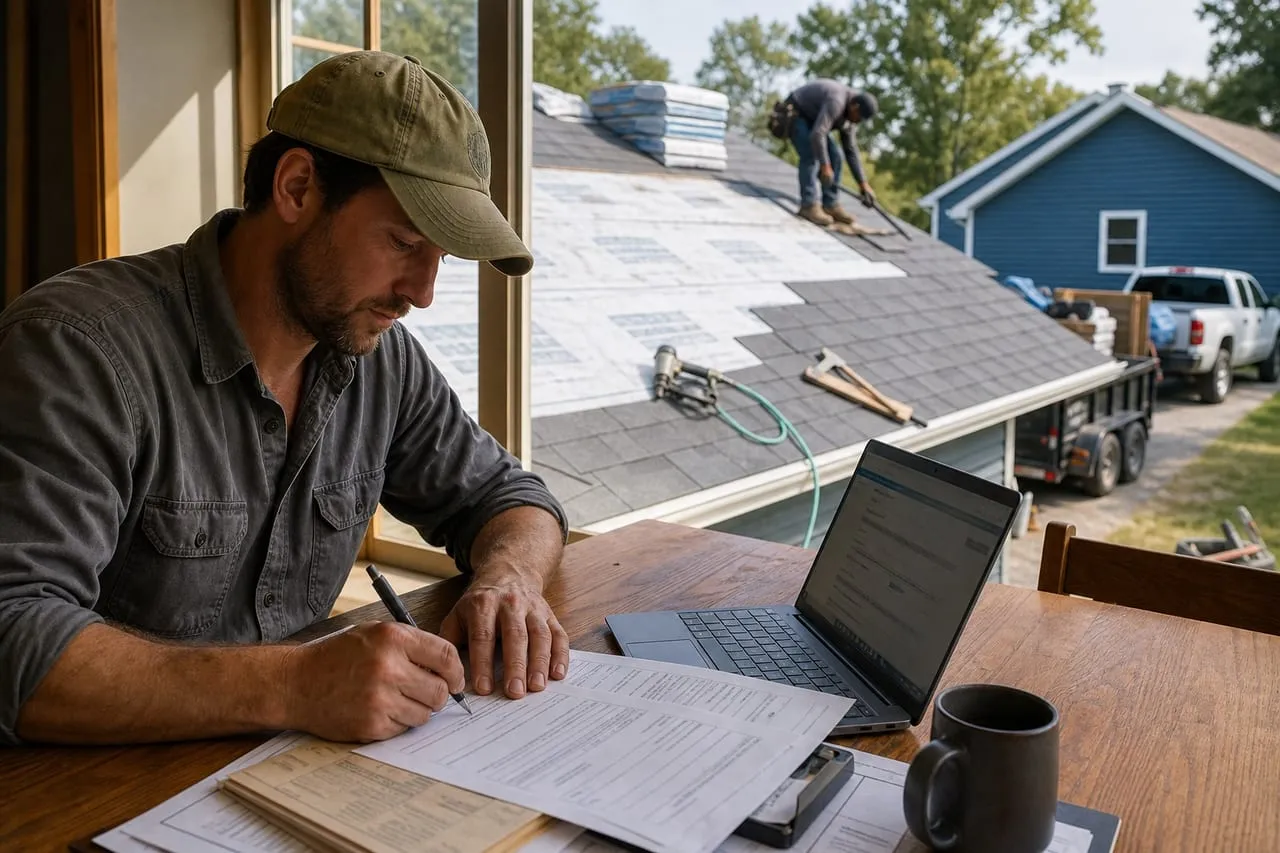
Setting up a roofing business is six pieces of paper and four phone calls. The order matters, because licensing usually requires proof of insurance, insurance requires a registered entity, and supplier net-30 accounts require all of the above. Here is the working sequence used by contractors who launched in the last twelve months.
Form the entity and get your tax IDs
Start with an LLC. It limits personal liability, separates your business banking, and is cheap to file (state fees run $50-$500). File articles of organization with your secretary of state, then immediately apply for an EIN on irs.gov. The EIN is free, takes 10 minutes, and unlocks everything downstream: business bank account, insurance binders, supplier credit.
If you plan to operate under a brand name different from the LLC name, file a DBA (“doing business as”) with your county or state. Example: LLC is “Smith Holdings LLC” but the truck says “Smith Roofing & Restoration.”
The liability shield deserves one honest sentence, because roofing is the trade where it gets tested. Falls and water damage produce the highest-severity claims in residential construction, and an LLC only protects you if you run it like a separate company. Commingle accounts, sign contracts in your own name, or pay your mortgage from the business card, and a plaintiff’s attorney will pierce the entity exactly when the claim arrives. The discipline costs nothing: separate bank account, contracts signed as the LLC, owner pay taken as a draw or salary.
A few traps worth knowing:
- Single-member LLC defaults to sole proprietor tax treatment. Elect S corp status once net profit clears $80k/year to cut self-employment tax.
- Open the bank account before any money moves. Use a real business bank (Chase Business Complete, Wells Fargo Initiate, Bluevine) so checks from insurance carriers clear without holds.
- Get a separate business credit card. Material runs and dump fees compound on personal cards.
Pull the contractor license
This is the slowest step and the one that separates licensed roofers from chuck-in-a-truck. Requirements vary heavily by state:
| State | What you need | Experience | Notes |
|---|---|---|---|
| Florida | State-certified or registered roofing contractor | 2 years | Trade + business exam |
| California | C-39 Roofing Contractor license | 4 years | Exam plus $25k bond |
| Texas | No state license | None | Most cities require registration, some an exam |
| Nevada, Arizona, North Carolina, South Carolina | State license | Varies | Exam and bond in all four |
| Most Midwest and Northeast states | City or county license | Varies | Simpler, but check every municipality you work in |
Order a license bond ($10k-$25k typical, costs ~$100-$300/year), pass the trade and business exams (most use PSI or Pearson VUE), and apply. Many states cross-check insurance certs as part of the application.
Bind insurance and workers comp
You need three policies before a single ladder leaves the truck:
- General liability: $1M per occurrence / $2M aggregate minimum. Annual premium $2,500-$8,000 depending on revenue.
- Workers compensation: required in nearly every state the moment you have one employee. Roofing is the highest-risk class code (5551), so premiums run $20-$50 per $100 of payroll.
- Commercial auto: required on the work truck, $1,500-$3,500/year.
Two practitioner details soften those numbers. First, if you launch owner-only and run piece-rate subs who carry their own coverage, most states let you exclude yourself from WC and buy what agents call a ghost policy, roughly $750-$1,500 a year. It exists purely to satisfy the certificate requirements of GCs, suppliers, and carriers who will not send work without one. Second, premiums are quoted annually but billed in installments, so the opening-day cash hit is a quarter of the scary number. The catch on the sub model: collect a current certificate of insurance from every sub every year, because an uninsured sub who falls becomes your employee in the eyes of the WC auditor, at back-premium rates.
Pick your insurance agent like a subcontractor, not a vendor. Roofing runs on certificates: every GC, every supplier credit application, and every commercial bid will ask for a COI naming them, sometimes the same afternoon. An agent who issues same-day certificates is worth a slightly higher premium, because a 48-hour certificate turnaround quietly costs you jobs.
If you want insurance restoration work, add Haag or HAAG-CI certification for one staff member. Some carriers also want you on a preferred contractor list.
Open supplier accounts and start operating
Once licensed and insured, take your cert package to ABC Supply, Beacon Building Products, and SRS Distribution. Apply for net-30 trade credit at all three so you can compare delivery pricing per job. Pull a permit for your first paid job (most cities require one for full reroofs), then run the work.
Open all three accounts even though you will favor one. The delivered price on an identical material list varies by hundreds of dollars per job between branches, and the spread is pure margin. The bigger reason shows up after a storm: when a hail event drops thousands of claims in a county, branches allocate scarce shingles to their account holders first. The roofer with one supplier waits; the roofer with three keeps crews moving. A second account costs nothing but a credit application.
Next steps after registration: buy the working kit in buying equipment and supplies, price your first jobs using setting best prices and billing, and start lead flow with how to advertise your roofing business.
Frequently asked questions
How long does the licensing process take?
Two weeks to four months depending on the state. California and Florida are the slowest. Texas and most city-level licenses can be done in 2-4 weeks.
Do I need an attorney to form the LLC?
No. Use your state’s online filing portal or a service like Northwest Registered Agent. Spend the legal budget on your contractor agreement instead.
Can I run as a sole proprietor?
Legally yes, but most insurers will not bind WC for a sole prop and supplier credit is harder. Spend the $200 on an LLC.
What does workers comp actually cost?
Roofing class code 5551 is $20-$50 per $100 of payroll. A foreman making $70k costs you $14k-$35k/year in WC alone. Build it into your bid.
Do I need a separate license for storm restoration?
Most states no, but some require a registration as a “residential contractor” or similar. Check your state attorney general site for “public adjuster” rules to avoid crossing the line.
Your move
Reading this does not book a job.
The owners who pull ahead are the ones who change one thing this week. If you want that one thing to be a website that sells and ads that put it in front of the right people, we build and run both for you.
Straight answer on whether we can help, usually the same day.