How Much Do You Need to Start a Roofing Business
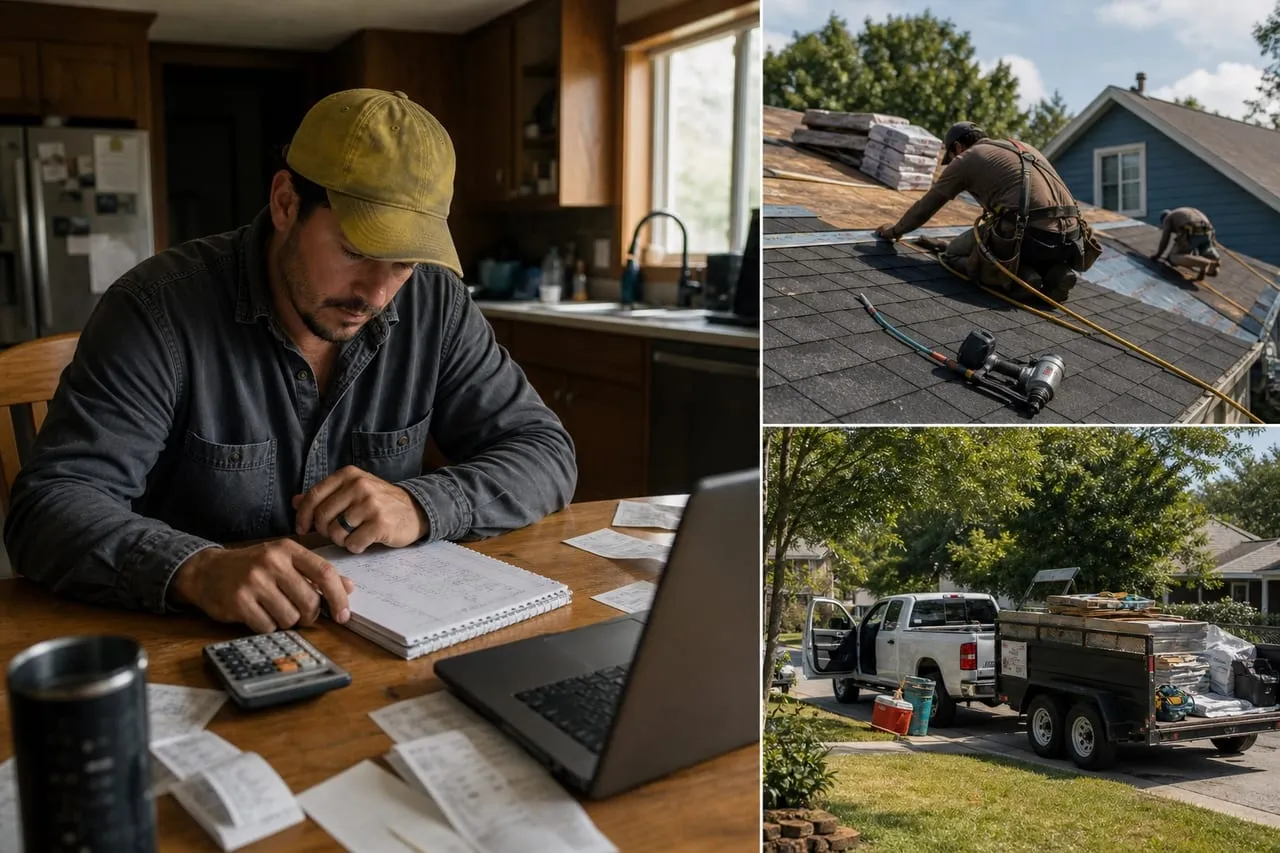
A roofing business can launch on $10,000 if you already own a truck and a friend gives you the first job. A clean, fully insured launch with a real lead pipeline runs $35,000-$50,000. Most owners land in the middle. Here is what each dollar buys and where the line items actually go.
Pick Your Build First
Three versions of the same one-crew company, so you can mix lines: your old truck with paid ads, or a clean truck with yard signs only.
| Line item | Lean launch | Standard | Loaded |
|---|---|---|---|
| Truck | $0 (yours survives a season) | $8,000-$18,000 high-mileage used | $18,000-$28,000 cleaner used |
| Debris handling | Rent dumpsters per job | Rent dumpsters per job | $7,000-$11,000 dump trailer |
| Ladders + fall protection | $1,500-$2,200 | $1,500-$2,200 | $1,500-$2,200 |
| Nailers, compressor, tools | $1,400-$2,000 | $1,600-$2,200 | $1,600-$2,200 |
| Entity, license, bond | $350-$1,800 | $350-$1,800 | $350-$1,800 |
| Insurance (opening cash) | $2,000-$3,500 | $2,500-$4,500 | $2,500-$4,500 |
| Marketing | $800-$1,500 signs + GBP | $1,500-$4,000 site + signs | $4,500-$12,000 wrap + ads |
| Working capital | $3,000-$5,000 | $5,000-$8,000 | $5,000-$10,000 |
| Total | $9,050-$16,000 | $20,450-$40,700 | $40,450-$71,700 |
Look at where the columns refuse to move. Ladders, tools, licensing, and insurance are nearly identical across all three builds, because the safety and legal floor of a roofing company costs $5k-$10k whether you are scrappy or polished. The entire remaining spread comes from three optional lines: the truck, the trailer, and marketing. Those are decisions about speed and image, not about whether you can legally and safely put a crew on a roof. Price the floor first, then decide how much speed you are buying.
Vehicle, trailer, and ladders ($2k-$30k)
The biggest swing item. A high-mileage 3/4-ton truck (Ford F-250, Chevy 2500) in working shape runs $8k-$18k. A new 12-foot dump trailer is $7k-$11k. Skip the trailer for the first 10 jobs and rent dumpsters at $400 a drop, which keeps the launch closer to $10k.
Mandatory ladders and access gear:
- Two Werner 32-foot fiberglass extension ladders: $900
- One Werner 16-foot multi-position: $250
- One pump jack setup (optional, useful for two-story tear-offs): $600
If you already own a working truck, this category drops to ~$1,800 and is the single biggest lever on your launch budget. The full kit with brand names and the trailer payback math is in buying equipment and supplies for a roofing business.
Nailers, compressor, and tear-off tools ($1.5k-$3k)
A working two-man crew needs:
- Two Bostitch RN46 or Hitachi NV45AB2 coil roofing nailers: $500
- One framing nailer (Bostitch F21PL): $250
- One Rolair JC10 or RIDGID 4-gallon compressor with hose: $400
- Four tear-off forks and two roofing shovels: $200
- Tarps, chalk lines, utility knives, magnetic sweep: $250
Buy a backup coil nailer in month two. The downtime from a single failed nailer mid-tear-off costs more than the spare.
License, insurance, and entity setup ($5k-$16k year one)
- LLC filing: $50-$500
- EIN: free
- Contractor license + exam fees: $200-$1,000
- License bond ($10k-$25k bond): $100-$300/year
- General liability ($1M/$2M): $2,500-$8,000/year
- Workers compensation: paid as a percent of payroll, not upfront, but expect a $1k-$3k deposit
- Commercial auto on the work truck: $1,500-$3,500/year
Add those up and year one costs $5k-$16k, but do not confuse the annual figure with the opening-day check. Carriers bill in quarterly or monthly installments, so the cash you need before the first job is roughly $3k-$6k: entity, license, bond, and the first installment on each policy. The rest bills across the year while revenue is coming in, which is exactly how a $10k launch coexists with a five-figure insurance stack.
These numbers move with your state. California and Florida sit at the top end. Most Midwest and Southeast states sit at the bottom.
For the full registration walkthrough see how do I set up and register a roofing business.
Marketing, first-month materials, and working capital ($4k-$20k)
Marketing rookies underspend here and then sit waiting for the phone:
- Google Business Profile photos (drone shots of three jobs): $300-$800
- Truck wrap and yard signs (50 signs): $2,500-$4,500
- A simple website with quote-request form: $500-$2,500 (done-for-you options like /get-website/ start at $499)
- First Google Ads or Local Service Ads budget: $1,500-$5,000/month
- Door-to-door canvassing supplies (door hangers, clipboards): $300
- Working capital reserve: $3,000-$10,000 depending on build
The honest note on this category: you cannot afford every line at once, and you do not need to. A lean launch runs signs, door hangers, and a free Google Business Profile for under $1,500 and skips paid ads entirely until month three. The $20k version of this category only makes sense in a crowded metro where you know nobody and need paid visibility to buy the first 20 jobs.
Working capital matters because suppliers may be net-30 but customers often pay in two installments (deposit + completion) and insurance jobs can drag to 90 days. Keep $5k-$10k in the operating account for payroll and fuel between collections.
Finance the Truck or Pay Cash?
The most common money question at this stage, and roofing adds its own wrinkles to it.
Financing the truck: pros
- Keeps the cash reserve intact for rain weeks and 60-90 day insurance checks
- A fixed payment is easy to price into every square you bid
- Builds business credit for the second truck when crew two arrives
Financing the truck: cons
- Used-truck business loans run roughly 8-14 percent APR
- The payment does not pause for a slow February or a hail-free season
- Lenders require full-coverage insurance, which raises your commercial auto premium
One thing first-time owners miss: with no revenue history, any business auto loan will ride on your personal guarantee anyway, so compare it against a plain personal auto loan, which is often cheaper for the same truck. The working rule: pay cash only if doing so still leaves at least one month of fixed costs ($8k-$15k for a single crew) in the account. If it does not, finance and keep the payment under 5 percent of a realistic month’s revenue. An empty account in week six is more expensive than any interest rate.
Spend in Payback Order
Not every startup dollar earns at the same speed, and the sequence matters more than the total. The license and insurance pay back instantly because without them you cannot legally invoice, and in most license states you cannot even enforce the contract. The Google Business Profile is free and typically produces its first organic call within 2-6 weeks once reviews land on it. Yard signs are the cheapest leads in the trade: $8-$15 per sign, 1-3 calls per active jobsite. Those three lines are the lean launch, and they are why it works.
The slow-payback lines are the ones that feel most like “starting a real company”: the wrap, the custom site, paid ads. Ads convert poorly until you have reviews, because homeowners click the ad and then check the profile before calling about a five-figure purchase. The wrap builds recall over years. Buy them with revenue, not with savings.
Once the budget is set, walk through how to start a roofing business step by step for the launch order, and sanity-check the earning side in how much profit a roofing business can make.
Frequently asked questions
Can I really start with $10k?
Yes, if you have a usable truck, get the first job from a personal contact, and rent dumpsters instead of buying a trailer. You will be tight on working capital and one slow week is rough.
What is the most common money mistake?
Buying a brand-new truck. A $60k F-250 payment kills cashflow. Buy used, drive it for two years, then upgrade out of profits.
How much should I keep in reserve?
One month of fixed costs minimum. For a single-crew operation that is $8k-$15k. Roofing has weather days, and customers can stretch payment 30-60 days.
Do I need to pay for SEO right away?
No. Claim the Google Business Profile, get 25 reviews on your first jobs, and the local map pack will pull leads for free. Paid ads can wait until month three.
What about a CRM or scheduling software?
JobNimbus, Roofr, or AccuLynx run $40-$200/month per user. Useful but not day-one. A spreadsheet and Google Calendar carries the first 20 jobs.
Your move
Reading this does not book a job.
The owners who pull ahead are the ones who change one thing this week. If you want that one thing to be a website that sells and ads that put it in front of the right people, we build and run both for you.
Straight answer on whether we can help, usually the same day.