How to Promote a Roofing Business on Instagram
Instagram is a brand channel for roofers, not a direct lead channel. People do not search Instagram for “roofer near me.” But the platform is excellent for building trust, showing the quality of work, and giving past customers something to share with their network. Here is the content and posting strategy that actually moves the needle for a roofing business.
Content that performs on Instagram
Three formats consistently outperform everything else:
- Drone Reels: 15-30 second aerial walk-around of a finished roof, ideally with light music and on-screen text (“Brand new architectural shingles. Three days. Zero leaks.”). Drone footage gets 3-5x more reach than ground-level content.
- Before/after carousels: 5-10 image swipe showing tear-off, decking inspection, underlayment, finished roof. High save rate, which Instagram rewards with more reach.
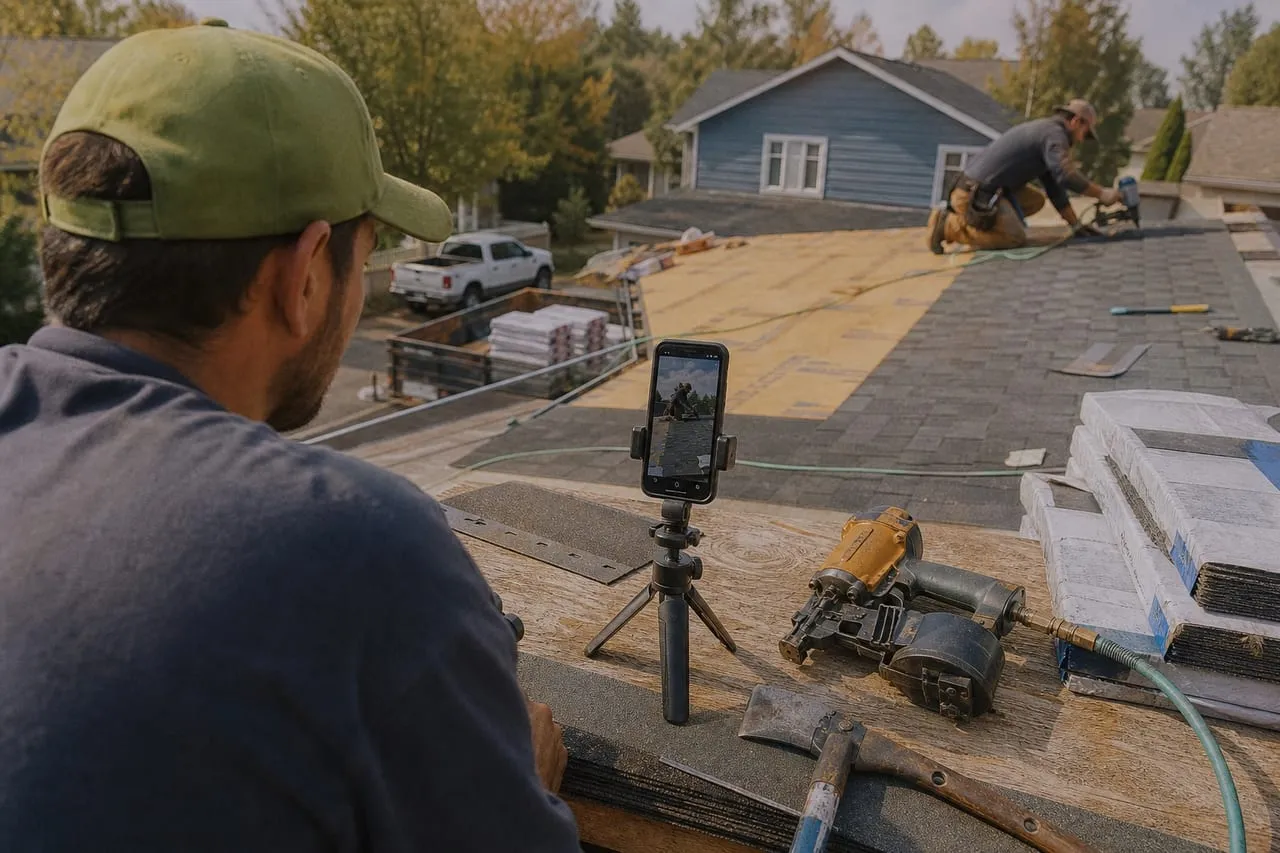
- Time-lapse tear-offs: a 30-second time lapse of an 8-hour tear-off is one of the highest-engagement formats. Set a phone on a tripod in the driveway, let it run.
Supplementary formats:
- Customer review screenshots styled as Instagram graphics.
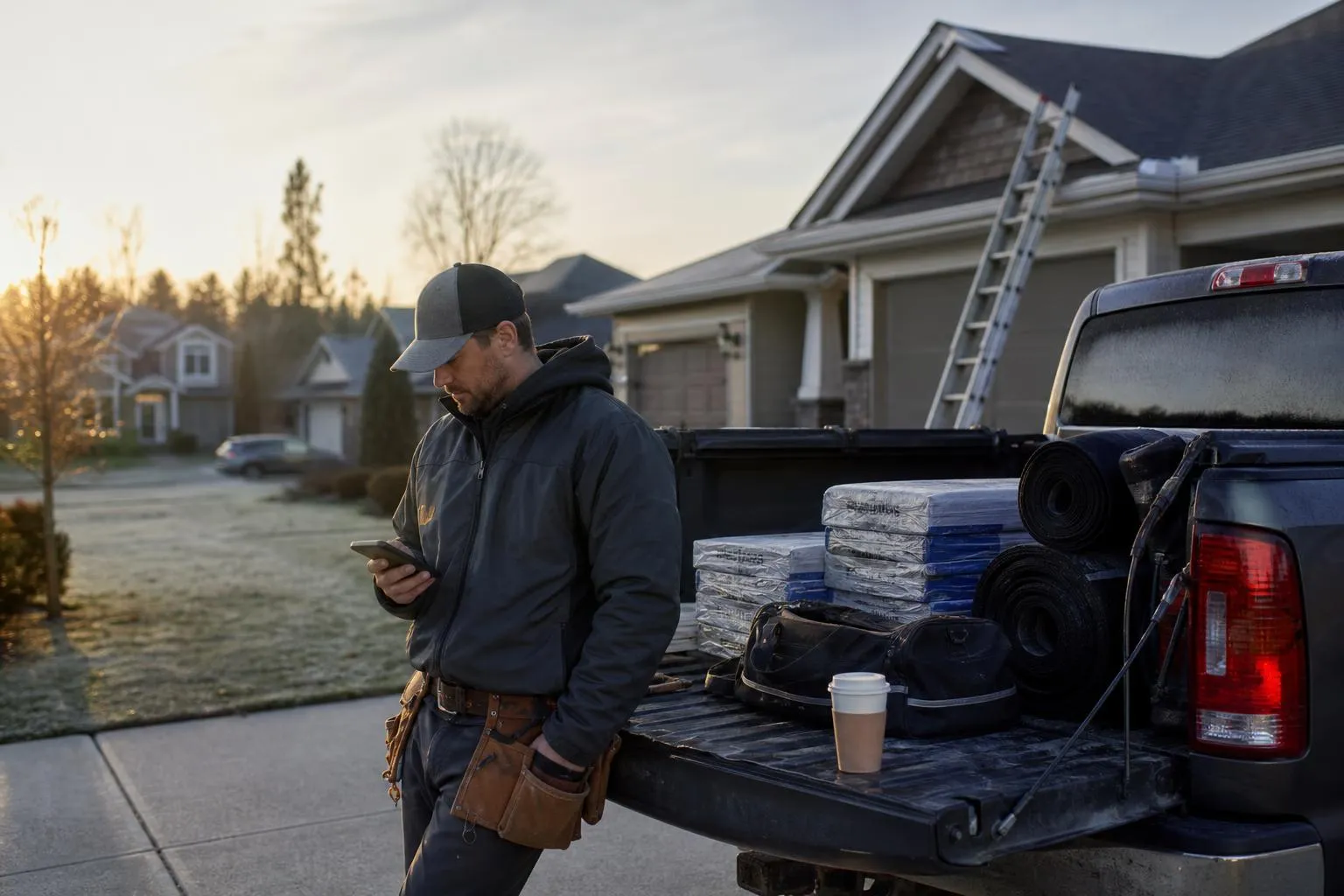
- Crew behind-the-scenes shots (loading the truck, supplier yard, the morning safety briefing).
- Educational content (“Three signs your shingles are failing”).
- Storm response posts in storm-active markets.
Skip stock photos, generic motivational quotes, and any post that screams “ad.”
What unites the three lead formats is that they are evidence, not advertising. A homeowner about to hand someone a five-figure check is looking for proof that real crews do real work in their area, and a drone orbit of a finished roof two streets over is proof in a way no graphic ever is. That is also why polished, agency-styled posts underperform raw jobsite footage on this platform: anything that looks like an ad gets processed as an ad and skipped.
| Format | Time to produce | Why the algorithm pushes it | What it proves to a homeowner |
|---|---|---|---|
| Drone Reel (15-30s) | 20 min flying + 30 min editing | 3-5x the reach of ground footage | Scope and finish quality |
| Before/after carousel | 10 min of shooting per job | High save rate | You document the process, not just the result |
| Time-lapse tear-off | Tripod, set and forget | Strong watch time | Speed and crew discipline |
Film every job like it is content
The owners who sustain an account do not “do Instagram” as a separate activity. They run a capture habit. The content already happens on your roofs every day; the only question is whether someone holds a phone up for ten minutes while it does. Once capture becomes part of the job routine, the posting side takes an hour or two a week from the office.
The handoff matters as much as the checklist. The foreman captures, the office posts, the owner approves in fifteen minutes a week. An account that depends on the owner personally filming and editing dies the first busy month, which is also the month the content would have been best.
Posting cadence and Stories vs. feed
For a roofing business focused on brand presence:
- Feed posts: 2-3 per week. Pick the best from the week’s work.
- Reels: 3-5 per week. Reels are the only realistic discovery surface on Instagram in 2026. Skip Reels and the account dies.
- Stories: daily. Behind-the-scenes, current jobs, customer reviews. Stories build the “real business with real customers” trust signal even if reach is small.
Highlight covers should categorize past work: “Asphalt Shingles,” “Metal Roofs,” “Storm Damage,” “Reviews.” A homeowner deciding whether to call you will browse the Highlights before checking your website.
Daily Stories sound excessive until you understand what a visiting homeowner is checking: whether the business is alive this week. A feed whose last post is five months old reads like a disconnected phone number, and the homeowner quietly moves to the next contractor on the list. A Story from this morning’s tear-off costs five minutes and answers the question before it is asked.
Hashtags and discovery
Roofing-specific hashtags do not get the search traffic that food or fitness hashtags do. Use a small set focused on local discovery:
- 3-5 location hashtags (#DallasRoofing, #DallasContractor, #DFWRoofer)
- 3-5 niche hashtags (#RoofReplacement, #StormDamage, #MetalRoofing)
- 1-2 broad hashtags only if the post is genuinely shareable
Geotag every post with the actual city or neighborhood. Geotag-based discovery is one of the few free distribution mechanisms left on Instagram for local businesses.
The geotag is also how Instagram plugs into the strongest lead source roofing has: the neighbor-magnet job. A reroof is a public event, and the neighbors who watched your crew all day are next quarter’s estimates. When the homeowner shares your finished-roof Reel and a neighbor recognizes the street, that single impression converts better than anything you could buy, because it arrives with social proof attached. Make sharing effortless: tag the homeowner if they consent, and put the neighborhood name in the caption.
Who should run the account
At $500-$2,000 a month, plenty of social agencies will happily take Instagram off your hands. Sometimes that is the right call, but the trade-offs are not what most owners expect.
Keeping it in-house: pros
- Raw jobsite content outperforms polished agency posts on this platform
- Near-zero cash cost; the capture habit costs minutes per job
- The voice stays yours, which is exactly what homeowners come to check
Keeping it in-house: cons
- It dies the first busy month unless one named person owns posting
- Editing is a real skill; the first 20 Reels will look rough
- The owner is usually the bottleneck and the worst person to hold the phone
The working rule: stay in-house until the capture habit is real, then hire help for editing and scheduling, not for content. An agency posting stock photos and generic roofing graphics makes you look like a lead-gen front, which is the exact suspicion an Instagram visitor came to rule out.
How Instagram fits the lead funnel
Instagram is rarely first touch. It is the platform a homeowner checks after seeing your truck, getting your business card, or reading your Google reviews. Their visit asks three questions:
- Are these people real?
- Is their work good?
- Have other people had good experiences?
The account answers those questions in 30 seconds of scrolling or it does not. Optimize for that decision, not for follower count.
Pair Instagram with the direct-lead channels in how to advertise on Google and the brand reach in how to promote on YouTube. For the local layer see how to promote roofing locally, and treat the short-form playbook in how to promote on TikTok as the same capture habit pointed at a different audience.
Should you run Instagram ads yourself, or hand them off?
Organic Instagram genuinely rewards doing it yourself, because the raw jobsite footage that wins here is footage only your crew can shoot. Paid Instagram is the different animal: the targeting, budgets, and retargeting that turn reach into booked estimates are where most owners lose the thread. We wrote an honest breakdown of when that paid side is worth handing off: 6 signs it’s time to hand off your Facebook and Instagram ads. Keep filming either way; the content is yours to own. When you want the ads handled, request a free proposal.
Frequently asked questions
How many followers do I need?
Zero. A roofing Instagram with 300 engaged local followers outperforms one with 50,000 random followers. Optimize for trust signals, not vanity.
Should I run Instagram ads?
If you run Facebook ads, you are already on Instagram (Meta runs them together). Direct Instagram ads alone rarely outperform Facebook lead-gen for roofers. Stick with the Facebook playbook in how to advertise on Facebook.
How much time per week does it take?
3-5 hours including filming, editing, and posting. Most owners hand it to a foreman or office manager once the workflow is set up.
What apps are useful?
CapCut for editing, Canva for graphic posts, Later or Buffer for scheduling, Lightroom mobile for photo edits. Total cost under $30/month.
Do drone shots really matter?
Yes. Drone footage outperforms ground footage 3-5x in roofing because it shows the entire scope of work. A $400 DJI Mini 4 Pro pays for itself in two months of content.
Your move
Reading this does not book a job.
The owners who pull ahead are the ones who change one thing this week. If you want that one thing to be a website that sells and ads that put it in front of the right people, we build and run both for you.
Straight answer on whether we can help, usually the same day.