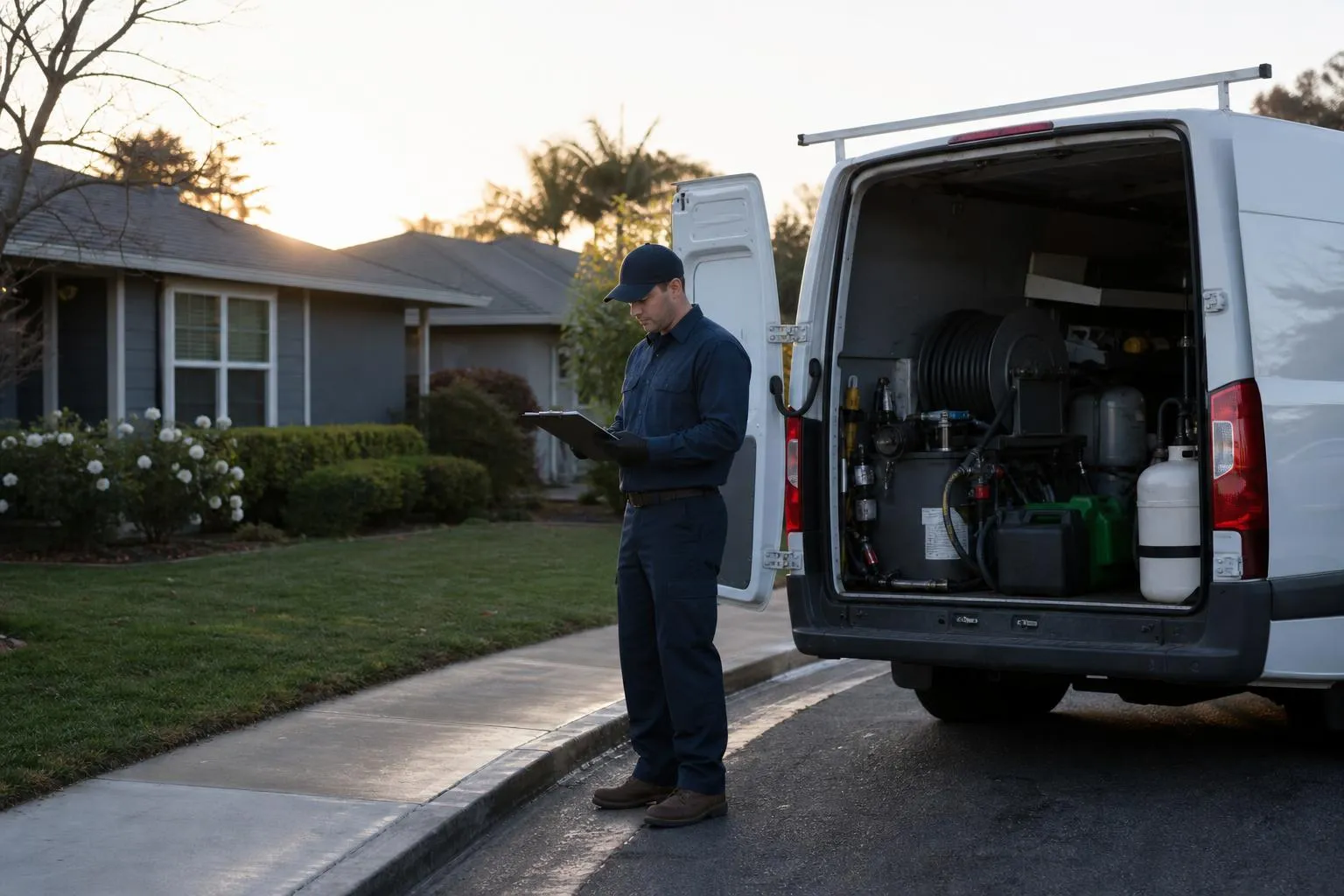
Exterminator Not in Google's Top 3? Terminix Gets the Call Instead
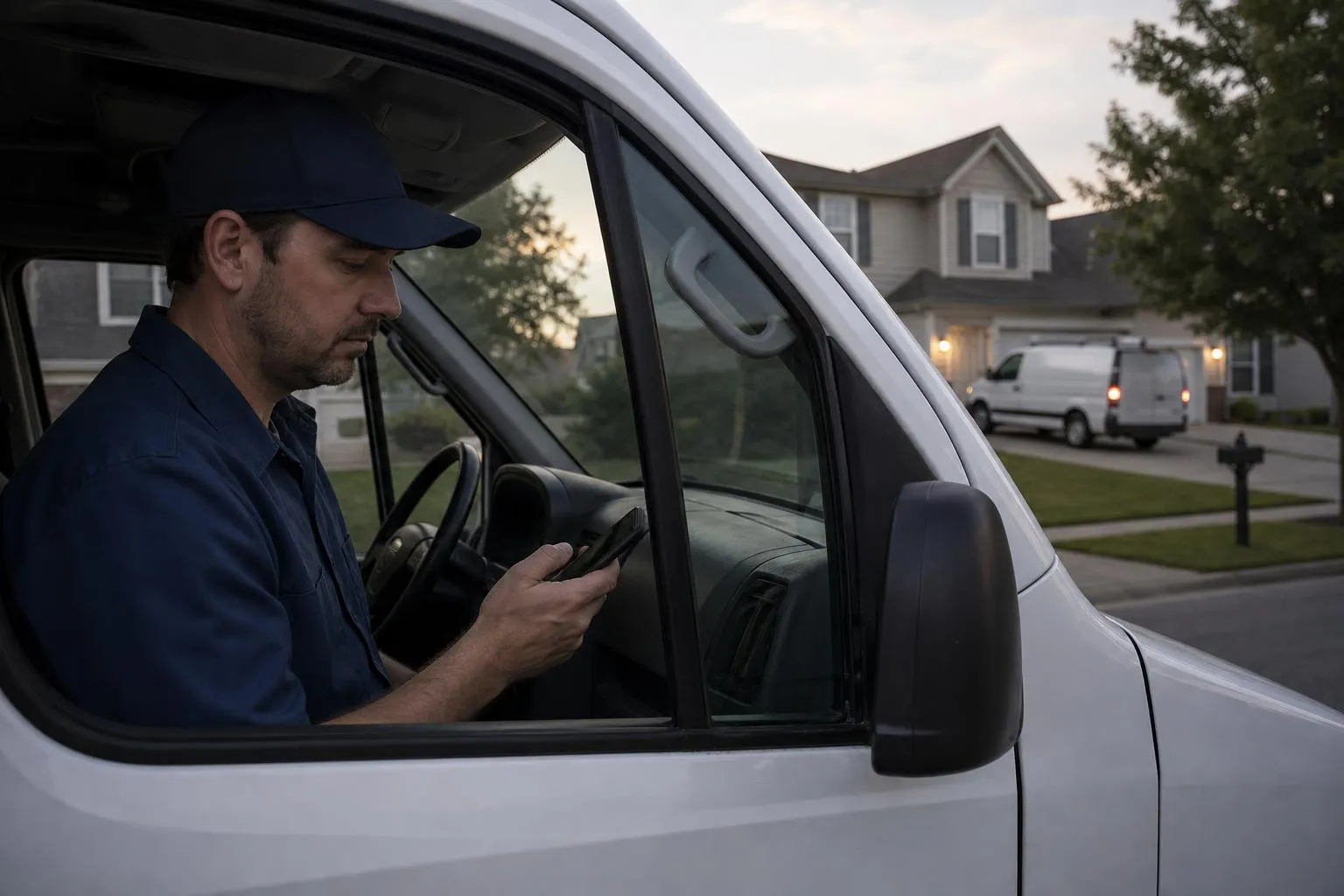
Follow the homeowner who’s about to sign a pest control contract. Not the imagined one from a sales script. The one who just flipped on the kitchen light at 10pm and saw something scurry under the fridge.
She grabs her phone right there and types “exterminator near me” or “pest control” plus her city. Google throws up a map with three companies pinned. She glances at the star ratings, taps into one to check what people say about the follow-up visits, and calls. Voicemail, she calls the next pin.
That’s the entire decision. Under a minute, three names, one signed plan.
She isn’t scrolling to page two. She’s barely scrolling past the map at all. If your company isn’t one of those three pins, you weren’t the pricier option, you were never in the conversation. For the homeowner staring at her kitchen floor tonight, you don’t exist.
Two lists, and the big chains only fight for one of them
Every local search produces two lists that matter, and most independent operators barely understand either.
The map pack is the three pinned businesses at the top, and it runs almost entirely on your Google Business Profile: review count, star rating, how recent those reviews are, correct categories, and a service area matching where you actually treat.
The organic results below it are where your website competes, and it’s where the researched decisions happen, someone comparing quarterly plans, termite bonds, or a bigger commercial contract before they call anyone.
Most independents chase neither seriously, live off scraps from both, and conclude Google favors the national brands, while Terminix and Orkin dump ad budgets that dwarf a local shop’s entire year. You can’t outspend them on advertising on Google, but you can outrank them locally with the free lists, and that visibility keeps paying long after their ad spend runs out for the day.
Your own website is undercutting your rank
Owners treat their website and their ranking as separate issues. They’re not. Google looks directly at your site when deciding placement, and a neglected one actively works against you.
It’s slow. Speed is a ranking factor on its own. Google found 53% of mobile visitors abandon a page taking over 3 seconds, and Portent measured a 4.4% conversion drop per extra second. Google’s own bounce data is blunt about it:
| Mobile load time | Bounce probability vs a 1-second page |
|---|---|
| 1 to 3 seconds | +32% |
| 1 to 5 seconds | +90% |
| 1 to 6 seconds | +106% |
| 1 to 10 seconds | +123% |
The average mobile page loads in 8.6 seconds. A site that loads in about a second wins the single ranking factor entirely inside your control.
It’s not built for a phone. Google ranks your mobile site, not the desktop version somebody approved back in 2019. A clunky phone experience costs you ranking before a single homeowner reads a review.
It’s thin. A homepage that just says “we spray for bugs” gives Google nothing to match against “termite inspection” plus a city name. No dedicated page, no ranking for that service, no matter how good your techs are in the field.
It’s frozen. A site untouched since before the pandemic tells Google, and the homeowner reading it, that the business behind it might be too.
Why “just add SEO” doesn’t fix an old site
The usual move is paying somebody to bolt SEO onto the current site. That’s spraying the baseboards while the termites eat the studs. The site is the actual defect, and Google measures your foundation against Terminix’s marketing machine every single day.
Buying SEO for the old site
- Cheaper this month than a rebuild: local retainers run $500 to $1,500
- No new platform, no design decisions, nothing new to learn
- Keeps your existing URLs and whatever history they carry
- Works fine if the site underneath is already fast and mobile-first
Buying SEO for the old site
- The retainer fights the foundation instead of standing on it
- You cannot retrofit a 1-second load into a bloated 2016 theme
- Twelve months at $750 is $9,000 rented, nothing owned
- Most honest audits quietly end with “you need a new site anyway”
What a top 3 spot is actually worth
Think about what the map pack really is: every homeowner in your territory with an active pest problem and a wallet, sorted into a line and handed to three companies. A signed quarterly plan is worth roughly $42 a month, call it $500 a year in recurring revenue, and the real prize is the customer who stays five years. That line gets divided daily, whether your truck is in it or not.
The companies holding those three spots aren’t running better trucks (see why the worse pest control company wins your customers). Their online foundation just leaves Google no reason to hide them behind the chains.
How you actually get there
Nobody honest can guarantee you the #1 spot. Anyone promising it is selling snake oil with a pest control label on it. But the actual inputs are no mystery:
- A fast, mobile-first website with a real page for every service and city you treat, the raw material Google needs to rank you at all.
- A complete, active Google Business Profile. Correct primary category, real photos, service area set accurately.
- A steady drip of reviews. Asking after every visit beats one panicked push a year, because Google weights recent proof heavily. Reviews also power your local promotion elsewhere.
Two of those are habits you build. The first is a build, full stop, and it’s the one that makes the other two actually pay off.
Get the foundation Google wants to rank
We build pest control websites structured for local search from day one: loading in about a second, mobile-first, a dedicated page for every service and city you cover, click-to-call and plan signup on every screen. The ranking is the setup. The homeowner signing the recurring plan is the point.
Watch the free video walkthrough of a live pest control site and see what a rankable foundation looks like. Pricing is posted right on the page, no contracts, launch in 7 days, changes live within 24 hours, and you own everything. Want the profile and review habit handled too? Ongoing growth services pick that up after launch.
Frequently asked questions
Why isn’t my pest control business showing up on Google?
Almost always three things: an incomplete or miscategorized Google Business Profile, too few recent reviews, and a website that’s slow, thin, or broken on mobile. Fix the first two yourself this week. The website is usually the part that needs a rebuild.
Can anyone guarantee me a top 3 ranking?
No. Anyone promising #1 is selling snake oil. What you control are the inputs: a fast site with real service pages, a complete profile, recent reviews.
Can I actually outrank Terminix and Orkin locally?
Yes, for local searches in your specific service area. You’ll never outspend their national ad budget, but Google rewards a fast, well-built local site with real service pages just as much as it rewards ad spend, sometimes more for “near me” searches.
How much does a website built for local search cost?
Our Standard pest-control build is $2399£1,899 one-time and the Growth tier is $7500£5,900 one-time, both posted right on the page. No contracts, and you own everything. Compare that to a $750-a-month retainer fighting a foundation it can’t actually fix.
Next in this series: Your website looks fine on your laptop. Your customers are standing in their kitchen with a phone.
Your move
Reading this does not book a job.
The owners who pull ahead are the ones who change one thing this week. If you want that one thing to be a website that sells and ads that put it in front of the right people, we build and run both for you.
Straight answer on whether we can help, usually the same day.