Why the Cheaper Exterminator Down the Street Wins Your Customers
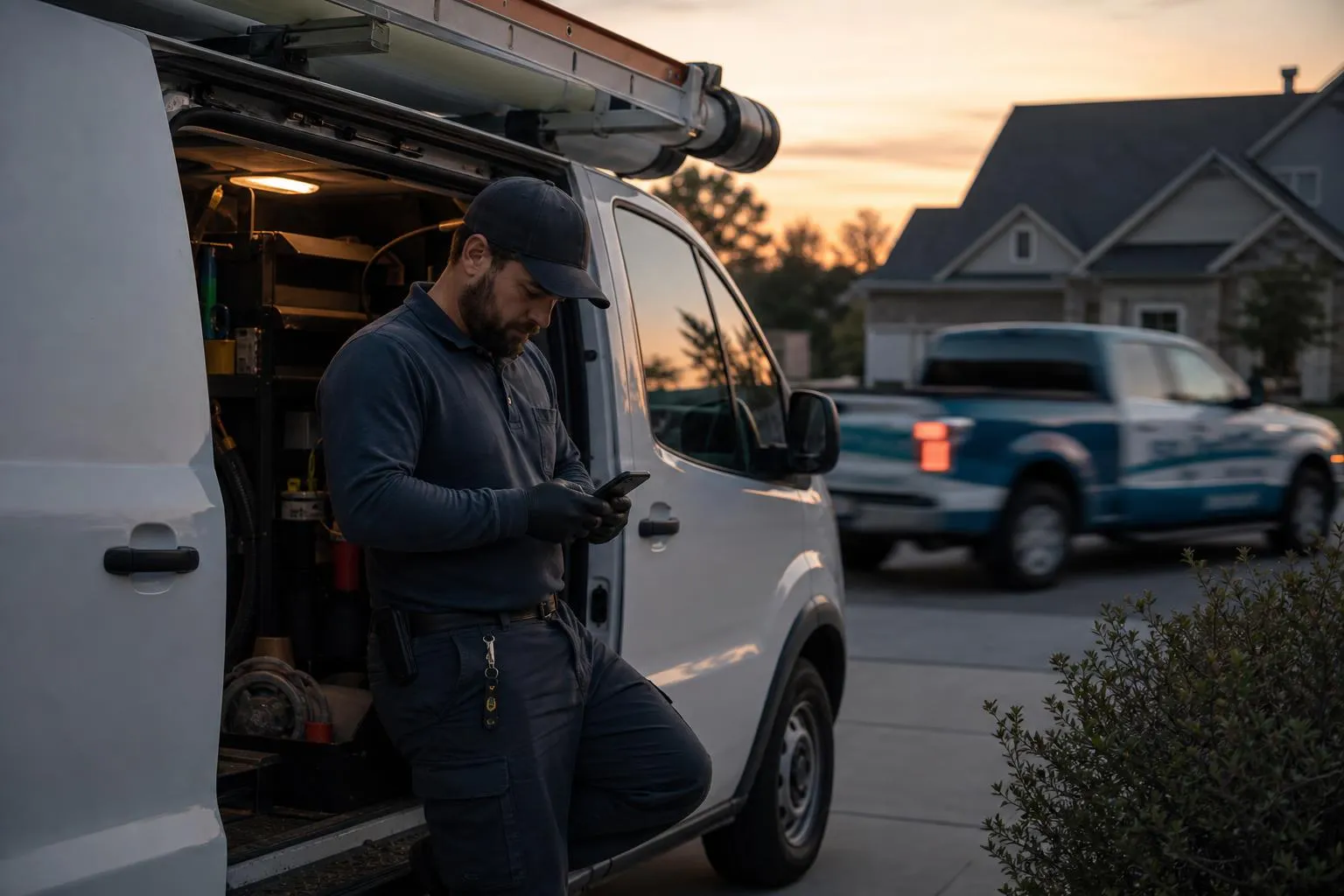
You’ve been the callback. The homeowner who paid another company for a one-time spray, watched the roaches reappear three weeks later, and finally found you. You know your treatment plan is thorough. You know theirs was a can of spray and a receipt.
Their trucks are everywhere anyway. That’s not an accident.
Here’s the uncomfortable part: homeowners don’t hire the most thorough pest control company. They hire whoever looks like the safest bet in the first ten seconds of searching. Those are two different contests, and the second one is the only one a homeowner is actually able to judge.
Nobody can see what’s behind the baseboard
A homeowner with a roach problem can’t tell if you treated the void spaces correctly, used the right bait rotation, or actually sealed the entry points instead of just spraying the kitchen. That work happens where they can’t watch. It’s invisible until the pests either stay gone or come back.
So they judge on what’s visible:
- Whether you showed up in the first three search results
- How many reviews you have, and whether the newest one is from this month
- Whether your site looks like a real, current company and not a template from 2016
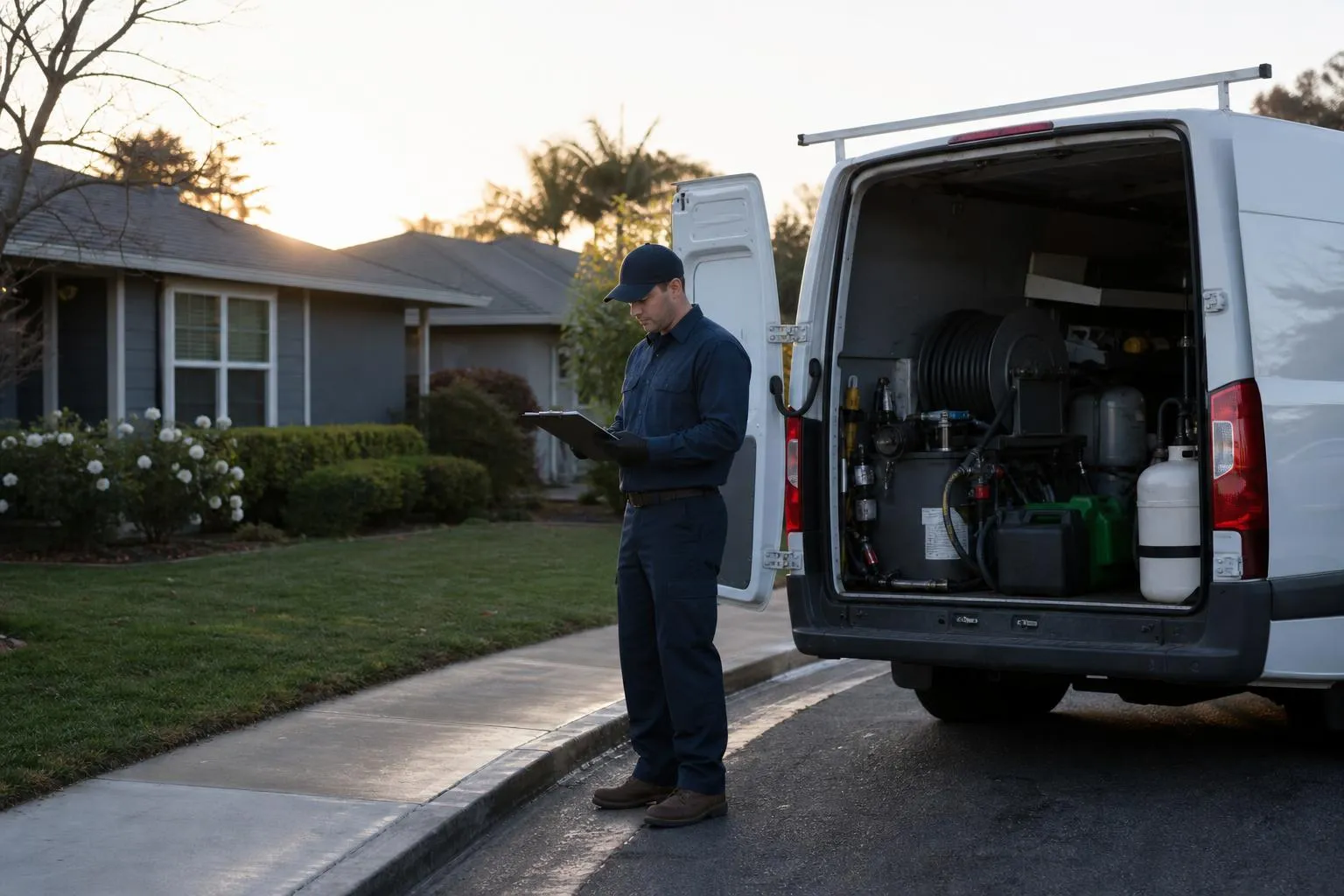
- Photos of technicians actually doing the work, not stock art of a cartoon roach
- Whether they could book online or had to sit on hold while you’re under a crawlspace
None of that is pest control. That’s the whole game. The company beating you to the plan signup isn’t better at IPM, they’re better at looking chosen. Why your pest control website isn’t getting you customers covered the symptoms; this is the mechanism underneath.
The comparison happens before your phone rings
There’s a pest control company for roughly every few thousand households in a typical metro, and the homeowner’s process is brutally short: phone out, search “exterminator” plus their city, open two or three sites, skim each for about ten seconds, book or call one. Less time than it takes you to load the sprayer.
You’re in that lineup either way, and the mechanics are unforgiving:
| What the visitor experiences | The number | Source |
|---|---|---|
| A page takes longer than 3 seconds to load | 53% of mobile visitors leave | Google mobile research |
| Every extra second of load time | Conversions drop about 4.4% | Portent |
| Load time grows from 1 to 10 seconds | Bounce probability climbs 123% | Google/SOASTA |
| Average small-business site on a phone | Loads in about 8.6 seconds | Industry benchmarks |
The typical local pest site loads nearly three times slower than the point where half the visitors have already quit. If Terminix’s page opens in two seconds with a “Get a Free Inspection” button front and center while yours is still loading, the homeowner doesn’t pause to wonder if slow means careful. They’ve already tapped the other button. That’s how a slow site quietly costs you plan signups you never even know existed.
The expensive part: these were your accounts
This isn’t abstract. Every week your service area produces a homeowner who just saw a roach, found ants in the pantry, or wants a termite bond before closing on a house. Someone gets that account. The only question is whose truck rolls, and whether it becomes a recurring customer at all.
You’re not just losing a job. You’re losing the recurring relationship that actually makes this business profitable, because you never got the first call.
The good news: fixable in weeks, not years
You can’t out-advertise Terminix’s ad budget. But the gap costing you the most, that first ten-second impression, closes fast, because it’s built from proof you already have.
Real proof. Your license, your technicians’ certifications, before/after treatment photos, and the reviews sitting unclaimed in happy customers’ heads. You likely hold more raw proof than the chain beating you locally; it’s just not on the page. Putting it to work is the core of getting customers for a pest control business.
A site built to sell the plan, not the spray. Fast on mobile, the quarterly plan explained above the fold, one clear “Book an Inspection” action. What a converting pest control site looks like comes down to one rule: every section either builds trust or gets tapped.
A clean local presence. Your Google Business Profile, service area pages, and reviews all feeding the same engine instead of scattered across three platforms.
Here’s the honest tradeoff on who builds it:
Rebuilding the site yourself
- Cheapest cash outlay: DIY builders run $20-$50 a month
- You control every word and photo
- No waiting on anyone; start tonight
Rebuilding the site yourself
- The real cost is your evenings: 40-60 hours learning a builder, worth roughly $3,000-$4,500 of billable technician time
- Templates rarely nail the ten-second contest: load speed, plan pricing up top, one-tap booking
- Half-built rebuilds tend to stay half-built once mosquito season hits
Take back the accounts that should be yours
The company outbooking you didn’t get better at killing roaches. They got better at being chosen first. That’s solvable, and unlike them, you’ll actually deliver on the follow-up visit when the plan starts.
We build pest control websites designed to win exactly this ten-second contest: the plan explained up top, pages built to rank for “exterminator” plus your city, live in 7 days, done for you start to finish. See one live before spending a dollar: watch the free video walkthrough and compare it side by side with what your customers see today.
You own everything, changes go live within 24 hours, no contracts. If you want reviews, rankings, and updates handled after launch, that’s what our ongoing growth services are for. Stop losing recurring accounts to a company doing one spray and a goodbye.
Frequently asked questions
How can a worse pest control company get more customers than a better one?
Because homeowners can’t inspect treatment quality before hiring; a bad job looks identical to a good one until the pests come back. They choose on visible evidence instead: search rank, review recency, plan pricing, and how fast they can book. Whoever wins those signals wins the account, regardless of who actually does the thorough treatment.
Do reviews or the website matter more?
They do different jobs. Reviews and your Google profile get you onto the shortlist; the website turns that shortlist into a booking. A page with 200 great reviews that takes 7 seconds to load still leaks signups, so fix whichever one is weaker first.
How long does it take to close the gap?
Faster than most owners expect. A review push shows movement in about two weeks, and a purpose-built site can launch in 7 days. Outranking a national chain’s ad spend takes longer, but the ten-second impression deciding most bookings is fixable this month.
How much does a done-for-you pest control website cost?
Standard is $2399£1,899 one-time and Growth is $7500£5,900 one-time, both published on the page. No contracts, changes go live within 24 hours, launch takes 7 days, and you own everything outright.
Should I just undercut the chains on price instead?
No. Chains often charge more, not less, and still win the booking. Price isn’t why you’re losing; visibility and trust signals are. Cutting your rate just subsidizes a problem a better website solves for good.
Next in this series: If your pest control company isn’t in Google’s top 3, you don’t exist
Your move
Reading this does not book a job.
The owners who pull ahead are the ones who change one thing this week. If you want that one thing to be a website that sells and ads that put it in front of the right people, we build and run both for you.
Straight answer on whether we can help, usually the same day.