How to Promote Pest Control Locally

Most pest control owners promote locally by trying to reach everyone in the city. The operators who actually get profitable do the opposite: they pick one neighborhood and own it. Pest control is a route business, and your biggest hidden cost is not chemicals or the truck, it is drive time. Five recurring customers on the same cul-de-sac is a goldmine; five customers scattered across three towns is a part-time job that burns gas. Local promotion is really the art of turning one address into the whole street.
Win the map pack before you spend a dollar on ads
When someone types “exterminator near me,” Google shows three local businesses above everything else with a map. That block, the map pack, gets the majority of the clicks, and getting into it is free. Three things decide it: proximity (where the searcher is), relevance (does your profile say you do this), and prominence (reviews and activity). You cannot move proximity, but you own the other two.
Claim and fully complete your Google Business Profile: correct category (“Pest Control Service”), real service area, hours, your applicator license number, and photos of your actual truck and crew. Then get reviews relentlessly, because review count and freshness are the biggest prominence lever you control. A profile with 60 recent reviews outranks a prettier website with six almost every time.
Farm one neighborhood instead of chasing the whole city
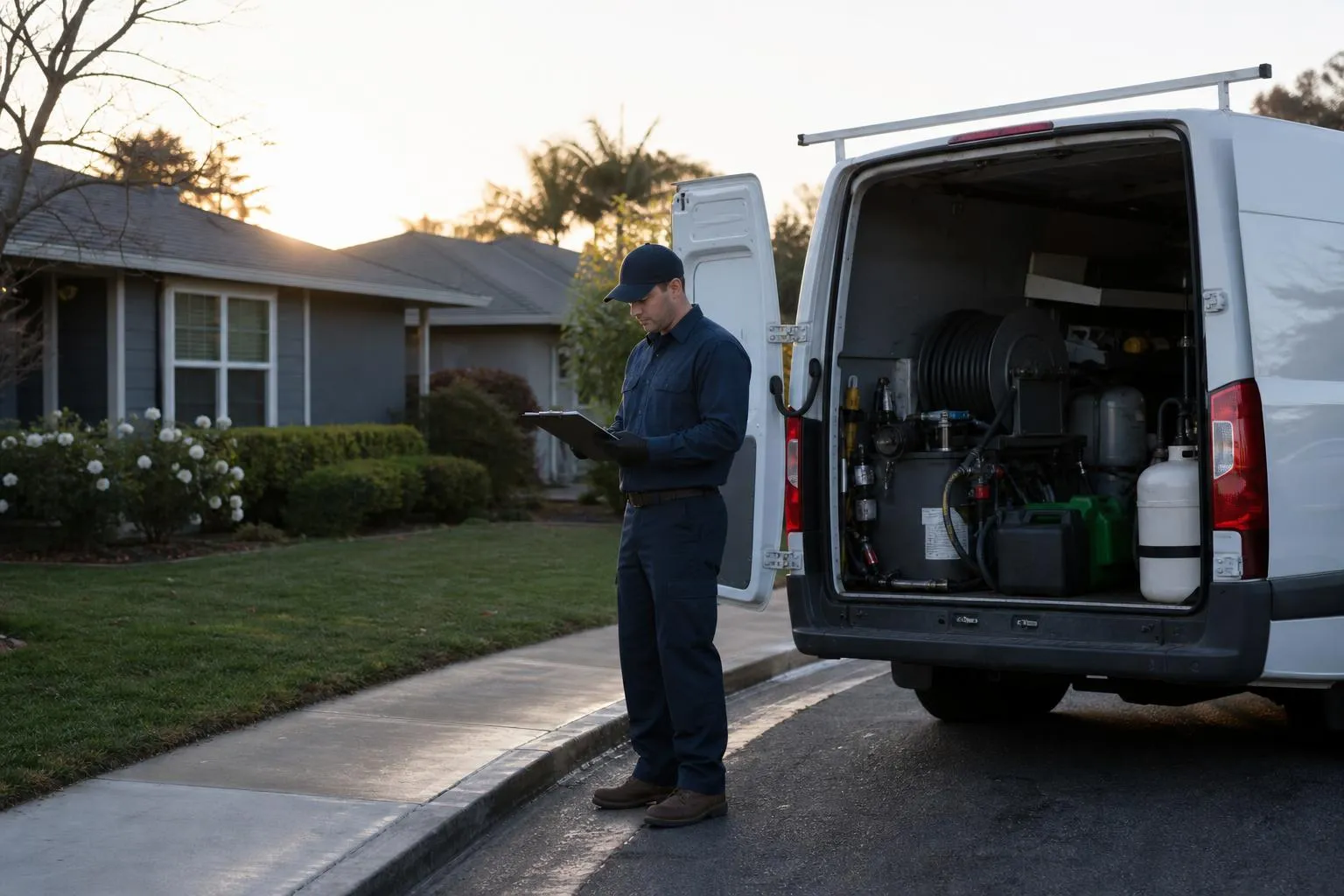
Here is the density play that separates profitable routes from busy ones. Every time you finish a job, you are already parked in a neighborhood with dozens of homes that have the exact same pests: same ants, same termites, same rodents, same builder, same landscaping. Those 40 nearest doors are your warmest, cheapest leads on earth, and you are standing in the middle of them.
Leave a door hanger on the 30 to 40 houses around every job before you drive away: “We just treated a home on your street for [pest]. Same problem? First visit $X.” It is not junk mail; it is a specific, timely, local offer from a truck the neighbors can see. Do this on every job and you compound one customer into a cluster, which collapses your drive time and lifts the profit on every stop.
| Local channel | Rough cost to acquire a customer | Speed | Note |
|---|---|---|---|
| Google map pack (organic) | Near $0 (time + reviews) | Slow to build, then compounds | Highest-trust leads |
| Door hangers around jobs | $30 to $80 per new customer | Immediate | Best route density |
| Google Local Services Ads | $30 to $90 per lead | Fast | Pay per call, “Google Guaranteed” badge |
| Yard signs at active jobs | Under $10 per customer | Slow | Free advertising while you work |
| Nextdoor recommendations | Near $0 | Slow | Neighbors trust neighbors |
Turn every truck and every yard into a billboard
Your service van is a moving billboard that a neighborhood sees for free every time you park it. Wrap it or at least letter it clean with your name, “Licensed & Insured,” and one big phone number, and it earns impressions on every route. If your logo is not sorted yet, fix that first in how to make a logo for pest control, because a branded truck is the cheapest local ad you will ever run.
Yard signs work the same way. Ask permission to leave a small “Protected by [Your Company]” sign at every job for a week. Neighbors walking dogs see that a trusted house on their street uses you, and it converts far above its near-zero cost. Both plays lean on the same truth: local trust is contagious, and proximity sells.
Get reviews on a system, not a whim
Reviews are the currency of local pest control, and the winners treat asking as a routine, not a hope. The moment you finish a job and the customer is happy their ants are gone, that is the peak. Hand them a card with a QR code straight to your Google review page, or text the direct link before you pull out of the driveway. Waiting a week kills your conversion.
Respond to every review, good or bad. A calm, professional reply to a complaint (“Sorry we missed that follow-up, we’ve scheduled a free re-treatment”) reassures the next reader far more than a wall of five stars with no owner voice. Aim for a couple of fresh reviews every week and your map ranking climbs on its own.
Door hangers vs paid Google Local Services Ads
- About $0.10 per door and you are already parked there, so acquisition is dirt cheap.
- Builds tight route density, one street at a time, cutting your drive time per stop.
- No platform, no bidding, no account to manage; you control it completely.
Door hangers vs paid Google Local Services Ads
- Slow drip: 1% to 3% conversion means 40 doors might yield one call.
- No badge or instant credibility the way a “Google Guaranteed” listing carries.
- Manual labor on every job, and it stalls the week you get too busy to hang them.
The rule of thumb: hang doors on every single job for free density, and layer Local Services Ads on top only when you need to fill the calendar faster than organic can. The paid side is covered in how to advertise pest control on Google.
Getting found locally is the part that decides everything
You can wrap the truck and print the hangers and still stall if your Google presence is thin and your reviews are stale. Two things are free and worth doing today, then comes the part worth investing in.
Free, now: fully complete your Google Business Profile with the right category, service area, license number, and real photos, and start texting every happy customer a review link the day you finish. Your first 30 to 50 reviews will do more for local calls than any ad. Then the higher-stakes work: a fast, mobile site that catches those map-pack clicks and books a recurring plan, plus Local Services Ads tuned so you are not overpaying per lead. That is the work we do; get a free video walkthrough of your site, see our Local Services Ads and Google management for ads and SEO, and if you have the company idea but not the plan yet, start at expntl.com.
Should you run your local marketing yourself, or hand it off?
Most of the local playbook here, the profile, the door hangers, the review habit, is yours to run and honestly should stay in-house, because you are the one parked on the street. Where owners hit a wall is the paid layer on top, the Local Services Ads and Google spend, where an untuned account quietly overpays per lead. We wrote an honest breakdown of when that paid side is worth handing to a specialist: the signs your Google and LSA spend needs a pro. Keep hanging the doors regardless. When you want the paid side handled, request a free proposal.
Frequently asked questions
What is the fastest way to promote pest control locally?
Two moves in parallel. Free and slower: fully complete your Google Business Profile and start collecting reviews to climb into the map pack, which sends more calls than anything else. Fast and paid: turn on Google Local Services Ads to pay per call with a “Google Guaranteed” badge. Meanwhile, hang door hangers on every job you complete, because that is the cheapest and most immediate local channel there is.
How do I get my pest control business in the Google map pack?
Claim and fully fill out your Google Business Profile with the exact category “Pest Control Service,” your real service area, hours, license number, and photos of your truck and crew. Then get a steady stream of fresh reviews, because review count and recency are the biggest ranking lever you control. Keep your name, address, and phone identical everywhere online, or Google will distrust your listing and drop you.
Do door hangers actually work for pest control?
Yes, better than almost anything, because of route density. Hanging 30 to 40 hangers on the houses around a job you just finished converts at roughly 1% to 3% and costs about $0.10 a door, and those neighbors have the same pests as the home you just treated. Every new customer you add on the same street cuts your drive time, so the profit per stop climbs as the cluster grows.
How many reviews do I need to compete locally?
Enough to look established and active, and then a steady trickle forever. In most suburban markets, 30 to 60 reviews puts you in the conversation, but recency matters as much as the total, so a business getting two new reviews a week will out-rank one that got 40 two years ago and stopped. Build a routine that texts every happy customer a review link the day the job is done.
Should I pay for ads or focus on free local marketing?
Start free, because the map pack and door hangers cost almost nothing and build the route density that makes you profitable. Layer on paid Google Local Services Ads only when you need to fill the calendar faster than organic can, and expect $30 to $90 per lead there. The paid playbook is in how to advertise pest control on Google; do the free work first so ads amplify a machine that already converts.
Your move
Reading this does not book a job.
The owners who pull ahead are the ones who change one thing this week. If you want that one thing to be a website that sells and ads that put it in front of the right people, we build and run both for you.
Straight answer on whether we can help, usually the same day.