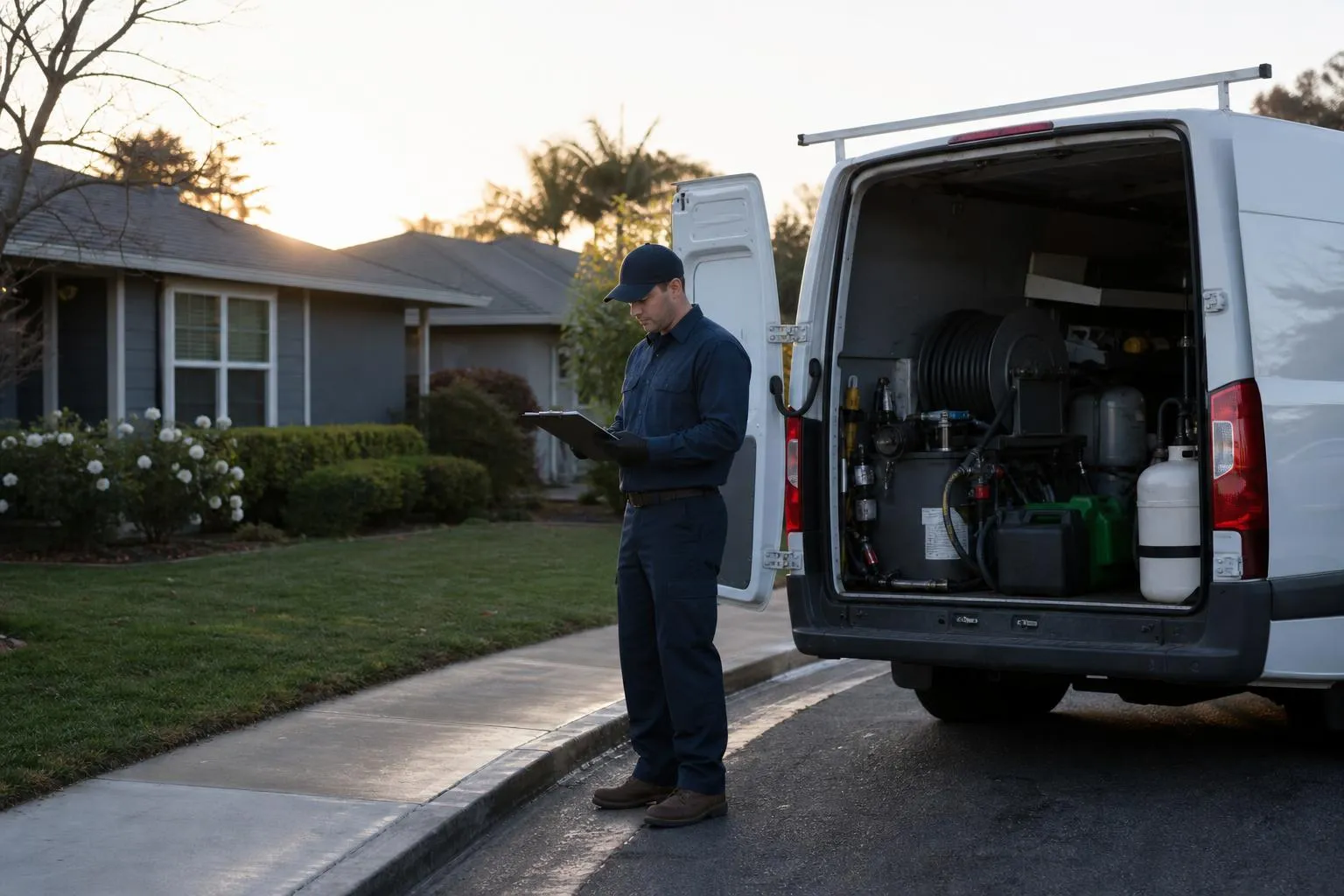
Best way to start and get into pest control

The best way to get into pest control is not to chase the big one-time jobs. It is to sell the boring quarterly service and stack renewals until the route pays you whether you sell anything new this month or not. A one-off ant treatment is $150 you earn once; the same house on a quarterly plan is $480 a year that renews on autopilot. Get licensed, build a route of contracts, and price for recurring revenue, and you own an asset instead of a job.
Get the applicator license before anything else
You cannot legally apply pesticides for hire until a certified commercial applicator is tied to your business license, and in a solo launch that person is you. Every state runs its own program through the department of agriculture (California’s is DPR, Florida’s is FDACS, Texas is TDA), but the shape is the same: pass a general “core” exam on labels, safety, and the law, then pass a category exam for the work you do (usually General Pest / Household, plus Wood-Destroying Organisms if you want termites). Fees run about $150 to $600 all in, and most states make you carry continuing education units every year or two to keep it.
The paper is not optional and it is not slow-walkable. Study the core and category manuals your state publishes, book the exam through PSI or the state directly, and do not advertise a single service until the license number is in hand.
Form the entity and stack the right insurance
Form an LLC before you touch a customer’s house, because you spray chemicals inside people’s homes for a living and a bad mix or a pet exposure is exactly the claim that reaches your personal assets. File articles with your secretary of state ($50 to $500), get a free EIN on irs.gov the same afternoon, and open a real business bank account so nothing commingles.
Then insure it like a pesticide business, not a generic handyman. General liability at $1M/$2M is the floor and runs roughly $500 to $1,500 a year for a solo op. The piece owners forget is a pesticide/herbicide applicator endorsement, because a plain GL policy can exclude the pollution and chemical claims that are the entire point of your risk. Add commercial auto on the truck, and workers comp the moment you hire.
The full registration walkthrough is in how to set up and register a pest control business, and the money side is broken down in how much you need to start.
Buy the truck and the sprayer, not a warehouse of chemicals
New owners overspend on product and underspend on the things that actually let them work. Concentrate is cheap; a bottle of Temprid FX makes 100+ gallons and treats dozens of homes. What costs money is a reliable vehicle, a good B&G or Chapin backpack sprayer, a termite rig if you go that route, and the license itself. Buy the working kit lean and let jobs pull the specialty gear in.
| Item | Lean cost | Note |
|---|---|---|
| Applicator license + core/category exams | $150 to $600 | Cannot operate without it |
| LLC + EIN + business license | $150 to $600 | Entity and local registration |
| GL insurance w/ applicator endorsement (first installments) | $500 to $1,500 | Chemical claims must be covered |
| Reliable used truck or van | $5,000 to $12,000 | Your biggest real line item |
| B&G / Chapin backpack + hand sprayers | $200 to $900 | The daily tool |
| Starter chemical + bait + PPE | $600 to $1,500 | Concentrate stretches far |
| Website + Google Business Profile | $500 to $2,000 | Where the calls come from |
That is a lean solo opening around $8k to $20k. The line-by-line list of tools is in buying equipment and supplies.
Sell the contract, because MRR is the entire business
Here is the fork that decides whether you build a company or buy yourself a job. Sell one-time treatments and you are a commodity: you re-sell every customer every time, you compete on price, and your revenue resets to zero on the first of every month. Sell recurring quarterly or bi-monthly plans and every closed customer keeps paying, your route compounds, and a slow sales month still collects.
One-time treatment vs recurring contract
- One-time jobs are an easier yes: no commitment, the customer just wants the wasps gone today.
- Higher ticket per visit, since a single heavy treatment can bill $200 to $500.
- Zero obligation to return, so your schedule stays fully open for new sales.
One-time treatment vs recurring contract
- Revenue resets to zero every month; you are only as good as this week’s phone.
- You compete purely on price against every guy with a sprayer and a truck.
- No asset to sell at the end, because a one-time customer list is worth almost nothing.
The decision rule is simple: lead with the plan on every call. Price the recurring service so the first visit covers your setup and the quarterly visits print margin, and only sell a one-time treatment when a customer flatly refuses the plan. How to structure the pricing so contracts stay profitable is in setting best prices and billing.
Getting found is the part that decides everything
You can be perfectly licensed, insured, and priced and still starve if the phone does not ring. A couple of pieces are free and worth doing this week; the rest is high-stakes work where doing it badly costs more than not doing it.
The free pieces, now: claim and fully complete your Google Business Profile, add real photos of your truck and yourself in uniform, and text every satisfied customer a review link before you pull out of the driveway. In pest control, “exterminator near me” is a near-emergency search, and the map pack with 30+ reviews wins most of those calls. The local playbook is in how to promote pest control locally, and the client-acquisition side is in how to get clients and customers.
Now the high-stakes part. A pest control site is not a brochure. Good means it loads in under three seconds on a phone, ranks for “exterminator near me,” and turns a homeowner who just found a roach at 9pm into a booked appointment with one thumb tap on a click-to-call button. The gap between a site that converts and a pretty one that does nothing is invisible until you compare lead numbers: a site converting 2% instead of 6% of visitors quietly loses two-thirds of its calls. Google Ads and Local Services Ads are the same, where a badly built campaign trains the platform to send you worse leads. That is the work we do. To have the site handled instead of guessed at, get a free video walkthrough. For ads, SEO, and Local Services Ads, see our services. If you have the idea but not the plan yet, start at expntl.com.
Frequently asked questions
Do I need a license to start a pest control business?
Yes, in every state. A certified commercial applicator must be tied to the business, and in a solo launch that is you. You pass a core exam and at least one category exam through your state department of agriculture, usually for $150 to $600 total, and many states also require a separate company license and annual continuing education.
How much money do I need to start?
A lean solo launch runs about $8k to $20k out of pocket. The two big lines are a reliable truck ($5k to $12k) and the license plus insurance; chemicals are surprisingly cheap because concentrates make dozens of gallons. You can start even leaner from home with a used vehicle, covered in starting with no money.
Should I sell one-time treatments or recurring plans?
Lead with recurring plans on every call. One-time jobs reset your revenue to zero each month and force you to compete on price, while quarterly contracts stack into recurring revenue that renews on its own and builds a sellable asset. Offer a one-time treatment only when the customer flatly refuses the plan.
What is the most profitable way to grow early?
Density. Cluster your accounts in a few zip codes so a tech can do 10 to 14 stops a day instead of driving an hour between jobs; route density is the difference between a $60/hour and a $150/hour effective rate. How margins actually scale is in how much profit a pest control can make.
Do I really need a website, or is Google Business Profile enough?
A complete Google Business Profile with 30+ reviews beats an expensive site with none, so start there. But the gap between a site that turns a panicked 9pm searcher into a booking and one that just looks fine is invisible until you compare lead numbers, so if you would rather have it done right, get a free video walkthrough.
Your move
Reading this does not book a job.
The owners who pull ahead are the ones who change one thing this week. If you want that one thing to be a website that sells and ads that put it in front of the right people, we build and run both for you.
Straight answer on whether we can help, usually the same day.