Landscaper Missing from Google's Top 3? That's Where Every New Client Stops Looking
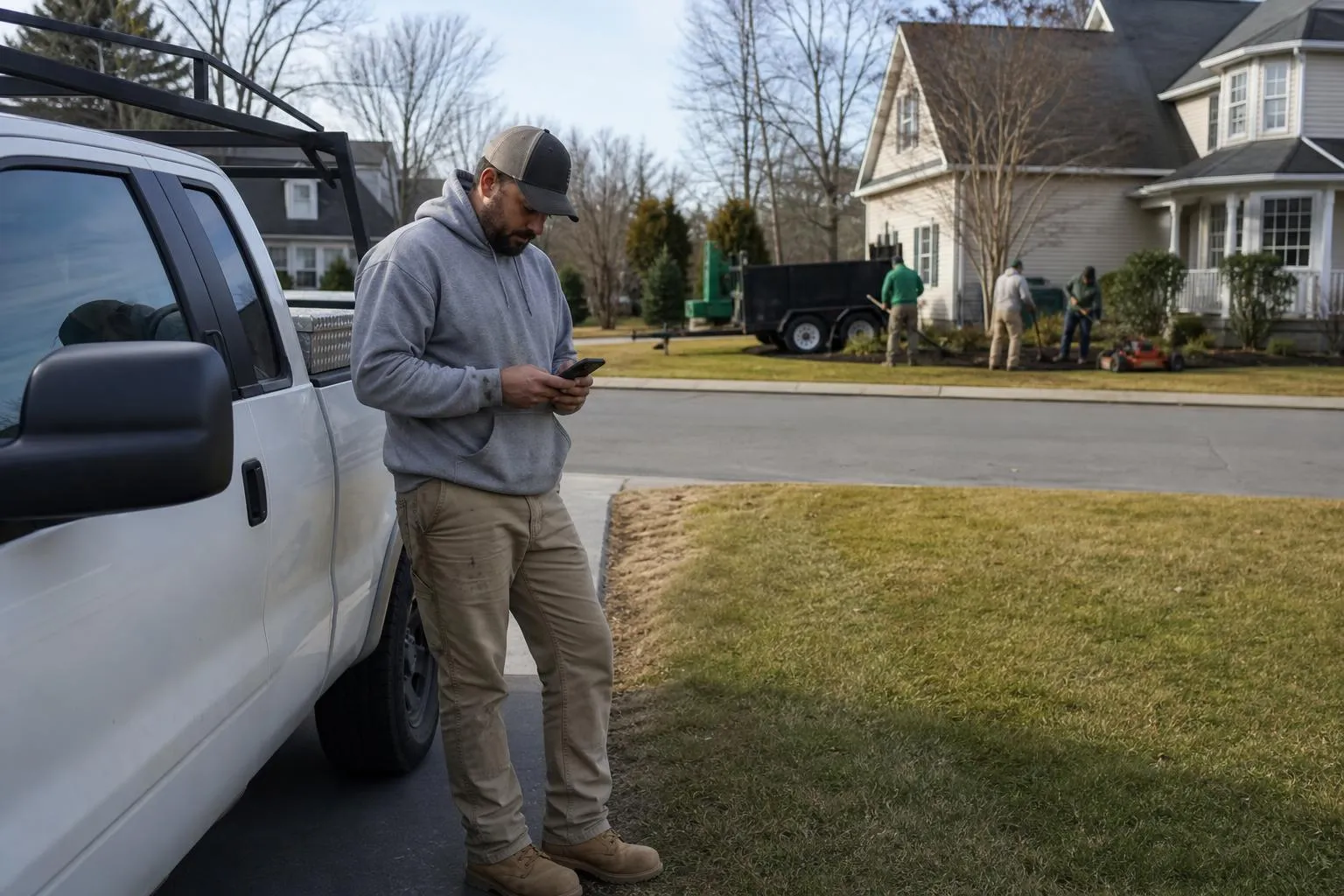
Picture the homeowner who actually becomes your next client. Not the mythical one from a marketing deck. The real one, standing in her backyard on a Saturday morning deciding the patchy lawn has to go.
She pulls out her phone and types “landscaper near me” or “backyard patio installer” plus her town. Google drops a map with three businesses pinned on it. She skims the star ratings, taps into one profile to eyeball the photos, and calls. If nobody picks up, she calls the next pin down.
That’s the whole decision. About a minute, three names, one contract.
She isn’t scrolling to page two. She’s barely scrolling past the map. If your business isn’t one of those three pins, you didn’t lose the bid, you were never in the running. For the homeowner staring at her yard today, you don’t exist.
The two rankings fighting for your calendar
Every local search throws up two separate lists, and most landscapers only half understand either one.
The map pack is the trio of pinned businesses at the top, and it’s driven almost entirely by your Google Business Profile: review count, rating, recency, correct categories, and a service area that actually matches where you work.
The organic results underneath are where your website competes, and it’s where the big install jobs come from, patios, retaining walls, full yard redesigns that a homeowner researches for a week before calling anyone.
Most landscapers chase neither seriously, pick up scraps from both, and decide Google “doesn’t work for this business,” while one crew across town quietly dominates the map pack every single week. You can rent your way into visibility with advertising on Google, but that spend stops producing the moment you stop paying. The organic list keeps working as long as you hold the spot.
Your website is quietly sinking your rank
Owners treat “my website” and “my Google ranking” as two separate problems. They’re the same problem. Google evaluates your site directly when it decides where to place you, and a tired site actively works against you.
It’s slow. Speed is a ranking signal on its own. Google found 53% of mobile visitors abandon a page that takes over 3 seconds to load, and Portent measured a 4.4% conversion drop for every additional second. Google’s own bounce data spells it out:
| Mobile load time | Bounce probability vs a 1-second page |
|---|---|
| 1 to 3 seconds | +32% |
| 1 to 5 seconds | +90% |
| 1 to 6 seconds | +106% |
| 1 to 10 seconds | +123% |
The average mobile page loads in 8.6 seconds. A site that loads in roughly one second wins the single ranking lever you fully control.
It’s not built for a phone. Google indexes and ranks the mobile version of your site, not the desktop layout your nephew built you five years ago. A clunky phone experience tanks your ranking before a single homeowner even reaches your gallery.
It’s thin. A five-page site that just says “we do landscaping” gives Google nothing to match against “paver patio installation” plus a town name. No dedicated page, no ranking for that service, no matter how good the crew is.
It’s frozen in time. A site last touched in 2019, no fresh project photos, no recent reviews pulled in, tells Google (and the homeowner) this business might not be either.
Why “just add some SEO” doesn’t fix an old site
The default fix here is hiring somebody to bolt SEO onto the existing site. That’s fresh mulch over a dead root system. The site itself is the problem, and Google is comparing your foundation against the best-built competitor’s site in your town every single day.
Buying SEO for the old site
- Cheaper this month than a rebuild: local retainers run $500 to $1,500
- No new platform, no design decisions, nothing to relearn
- Keeps your existing URLs and whatever link history they carry
- Works fine if the underlying site is already fast and mobile-first
Buying SEO for the old site
- The retainer is fighting the foundation instead of standing on it
- You cannot retrofit a 1-second load time into a bloated 2016 theme
- Twelve months at $750 is $9,000 spent renting, nothing owned
- Most honest audits end with “you actually need a new site”
What a top 3 spot is really worth
Think about what the map pack actually is: every homeowner in your service area with a real project and a budget, sorted into a line and handed to three businesses. Install jobs carry real margin. A paver patio averages around $9,000. A full backyard redesign runs well into five figures. That line gets divided daily, whether your crew is in it or not.
The landscapers holding those three spots aren’t running better crews (see why the worse landscaper wins your jobs). Their online foundation just gives Google no excuse to bury them.
How you actually get there
Nobody honest can promise you the #1 spot. Anyone guaranteeing it is selling you mulch dye and calling it topsoil. But the real inputs aren’t a secret:
- A fast, mobile-first website with a dedicated page for every service and town you cover, the raw material Google needs in order to rank you at all.
- A complete, active Google Business Profile. Right primary category, real project photos, service area set to match reality.
- A steady trickle of reviews. Asking after every install beats one panicked push a year, since Google weights recent proof heavily. Reviews also fuel your local promotion elsewhere.
Two of those are habits you build. The first is a build, full stop, and it’s the one that makes the other two actually pay off.
Build the foundation Google actually wants to rank
We build landscaping websites structured for local search from the first page: loading in about a second, mobile-first, a dedicated page for every service and town, click-to-call and quote buttons on every screen. Ranking is the setup. The client calling you is the payoff.
Watch the free video walkthrough of a live landscaping site to see what a rankable foundation actually looks like. Pricing is posted right on the page, no contracts, launch in 7 days, changes live within 24 hours, and you own everything. Want the profile and review habit handled for you too? Ongoing growth services pick that up after launch.
Frequently asked questions
Why isn’t my landscaping business showing up on Google?
Almost always three things: an incomplete or miscategorized Google Business Profile, too few recent reviews, and a website that’s slow, thin, or broken on mobile. Fix the first two yourself this week. The website is usually the part that needs a full rebuild.
Can anyone guarantee me a top 3 ranking?
No. Anyone promising #1 is selling something else. What you actually control are the inputs: a fast site with real service pages, a complete profile, and recent reviews.
How long before I’m in the map pack?
Profile fixes and fresh reviews often move the needle within weeks, while competitive metro areas take a few months. The website is the slowest input to fix and the fastest to replace: ours launch in 7 days.
How much does a website built for local search cost?
Our Standard landscaping build is $2399£1,899 one-time and the Growth tier is $7500£5,900 one-time, both posted right on the page. No contracts, and you own everything. Compare that to a $750-a-month retainer trying to patch a foundation it can’t actually fix.
Next in this series: Your website looks fine on your laptop. Your customers are standing in their driveway with a phone.
Your move
Reading this does not book a job.
The owners who pull ahead are the ones who change one thing this week. If you want that one thing to be a website that sells and ads that put it in front of the right people, we build and run both for you.
Straight answer on whether we can help, usually the same day.