How to Promote a Landscaping Business Locally

Local marketing for a landscaper is not really about getting the most leads. It is about getting the right leads, close together. Eight lawns spread across a metro means half your day is windshield time you cannot bill for; eight lawns on one cul-de-sac means you mow all morning and never move the trailer. So the smartest local promotion does two jobs at once: it makes the phone ring, and it makes your route tighter. Chase visibility without density and you will be busy, broke, and burning gas.
Win the map pack, because that is where the calls are
When a homeowner searches “lawn care near me,” Google shows three businesses in a box above the regular results. That box, the map pack, gets the majority of the clicks and calls. Ranking in it comes down to three things you can control: a complete Google Business Profile, proximity to the searcher, and reviews. You cannot move your shop, but you can dominate the two you control.
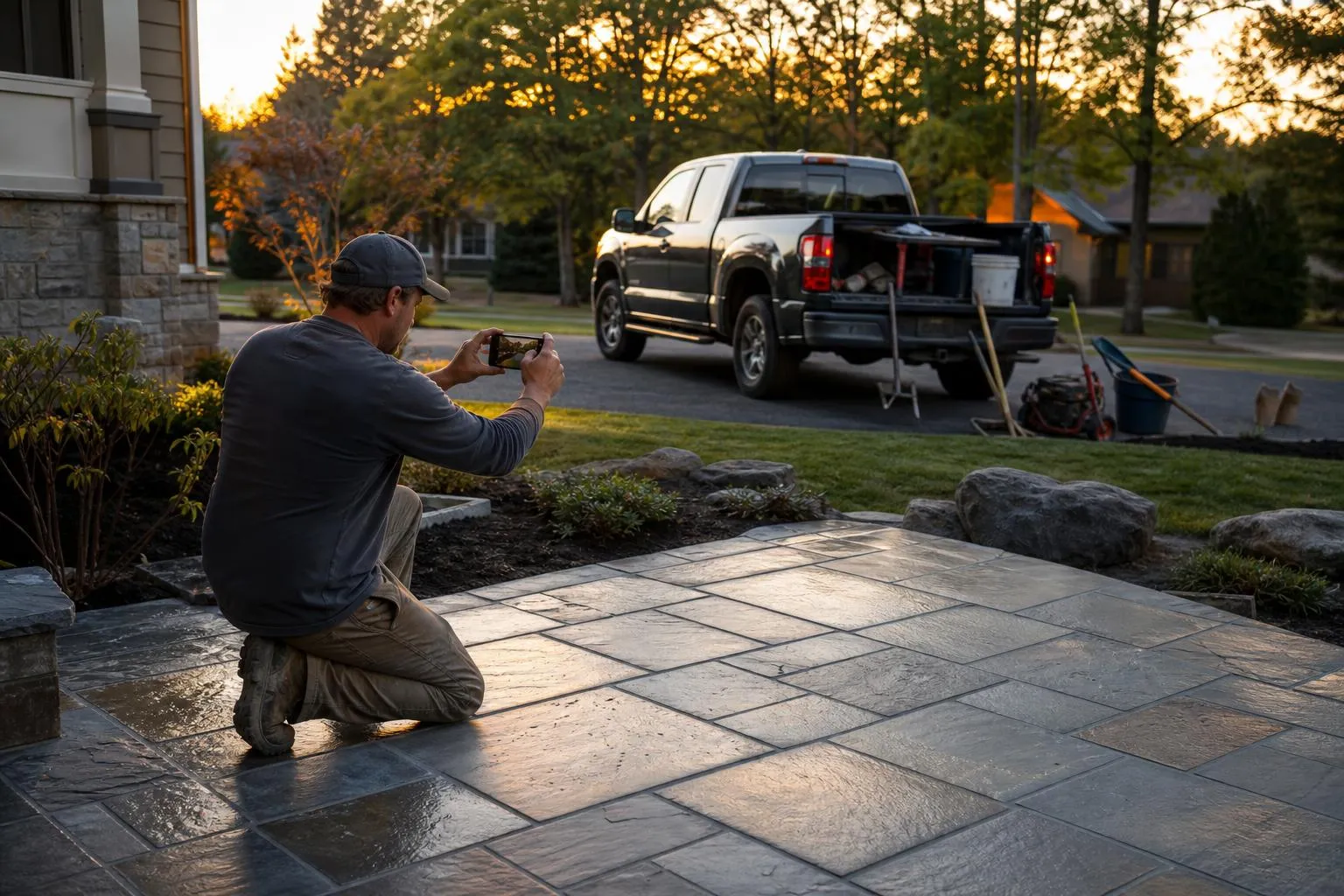
Fill out the profile completely: every service, your real service area, hours, and a dozen real photos of finished work and your crew. Then post before/after photos to the profile weekly, because an active profile outranks a dormant one. The photo work doubles as content for your Instagram and website, so you shoot once and use it three times.
Reviews are the whole ballgame
Between two landscapers, the homeowner almost always calls the one with more and better reviews. Your first 30 reviews will pull more first-time calls than any flyer, and they directly lift your map-pack rank. Yet most landscapers have five reviews because they never ask. The fix is a system, not hope.
Text every happy customer a direct review link the day the job wraps, while the fresh-cut lawn is right in front of them. Not next week, not “sometime”, the same afternoon. A short text with your Google review link, sent from the truck before you pull away, converts far better than a business card that says “review us.” Respond to every review, good or bad, because prospects read your replies to see how you handle problems.
Farm the streets you are already on
Here is the highest-leverage local tactic almost nobody runs: when your crew is on a job, hang door hangers on the 10 to 20 houses immediately around it. You are already there, the trailer is proof you work the neighborhood, and the freshly cut lawn next door is your best advertisement. Door hangers run about 12 to 20 cents each printed, versus a mailer that costs far more and lands in zip codes you would rather not drive to.
Compare your local channels honestly by what they cost to produce a booked job and whether they tighten your route.
| Channel | Rough cost | Builds route density? | Notes |
|---|---|---|---|
| Google Business Profile + reviews | Free | Yes | Highest ROI; the foundation |
| Door hangers around active jobs | $0.12 to $0.20 each | Yes, strongly | Farm the two streets you are on |
| Yard signs staked at each job | $4 to $8 each | Yes | Free advertising 3 days per lawn |
| Referral offer to current clients | ~$25 credit per referral | Yes | Neighbors refer neighbors |
| Nextdoor local recommendations | Free | Yes | Neighborhood-level trust |
| Blanket EDDM postal mailers | $0.20 to $0.50 each + design | No | Scattered leads across a wide area |
| Local fair or festival booth | $75 to $300 per event | No | Slow, low intent, occasional |
The pattern is obvious once you see it: the cheap channels that also tighten your route (profile, door hangers, yard signs, referrals) beat the expensive ones that scatter you. Put your effort where the two columns both say yes.
Turn one lawn into a whole street
Referrals are the cheapest lead a landscaper ever gets, and neighbors are the easiest referral there is, because they see your work from their own driveway. Make the offer two-sided and specific: “$25 off your next service for you, and $25 off their first service for anyone you send.” A dollar amount beats “a discount,” and rewarding both sides removes the awkwardness of asking.
Stake a yard sign at every job (with permission), leave a couple of extra door hangers with the customer to pass to neighbors, and mention the referral offer when you hand over the invoice. This is how a single new client on a street becomes three by the end of the season, and all three are on the same route. For the systems that keep those clients on recurring service, see how to get and keep clients and how to grow a landscaping business.
Getting found is the part that decides everything
Two free moves do most of the work, so do them this week. First, fully complete your Google Business Profile and start the review text-a-thon above, because in landscaping that profile plus 30 reviews outranks competitors with prettier sites. Second, print a stack of yard signs and door hangers and farm every job you run; it is nearly free and compounds with your map-pack proximity.
The higher-stakes piece is the site those local efforts point to and the paid campaigns that scale them, where doing it badly costs more than not doing it, because you pay to send neighbors to a page that does not book them. Your door hangers and profile all funnel to a website, and if that site does not convert searchers into estimates, the local work leaks out the bottom. If you would rather have that handled than guess at it, get a free video walkthrough of your site. For local SEO, Google Ads, and paid social, see our Google Ads and Local Services Ads service. If you have the business idea but not the plan yet, start at expntl.com.
Should you run local marketing yourself, or hand it off?
The highest-return local moves here, the Google Business Profile, the review texts, the door hangers around jobs you are already on, are free and squarely yours to run, and plenty of crews build a full route on them alone. Where it gets harder is the paid layer that scales it: Local Services Ads and Google Ads held to a real cost per booked job, tuned every week. We wrote an honest breakdown of when the paid local push is worth handing to a specialist and when to keep grinding it yourself: signs your business needs a Google Ads agency. When you want the paid side handled, request a free proposal.
Frequently asked questions
How do I show up in the Google map pack for landscaping?
Complete your Google Business Profile fully, list every service and your real service area, add a dozen photos of finished work, and gather reviews consistently. Ranking comes down to profile completeness, proximity to the searcher, and review volume and quality. Since you cannot move your shop, reviews and clustering your jobs (which improves proximity in the areas you work) are the levers you actually control.
What is the cheapest way to get landscaping clients locally?
Referrals and door hangers farmed around jobs you are already on. A two-sided “$25 off for both of you” referral turns one client into several neighbors, and door hangers at 12 to 20 cents each convert far better than blanket mailers because the fresh-cut lawn next door does the selling. Both tactics also tighten your route, which protects your margin.
How many reviews do I need to compete?
Aim for a steady climb past 30, because that is roughly where a landscaper starts to consistently outrank rivals in the map pack and win the two-way coin flip between similar companies. More important than the total is recency and your responses; a profile getting a few new reviews a month reads as active and busy. Text every happy customer a review link the day the job wraps.
Are postal mailers worth it for a landscaping business?
Usually not as a first move, because blanket EDDM mailers scatter leads across a wide area at $0.20 to $0.50 a piece with sub-1% response, which wrecks your route and your budget. That money goes much further as door hangers you farm around actual jobs. Targeted mail to a specific high-value neighborhood you already work can make sense, but carpet-bombing a zip code rarely does.
How does local marketing tie into my route?
This is the part most owners miss: tight routes cut unbilled drive time and improve your Google proximity ranking in the zip codes you work, so density is both an operations win and a marketing one. Prioritize channels that cluster jobs, door hangers around current work, yard signs, and neighbor referrals, over channels that scatter you. The goal is not the most leads; it is the most leads close together.
Your move
Reading this does not book a job.
The owners who pull ahead are the ones who change one thing this week. If you want that one thing to be a website that sells and ads that put it in front of the right people, we build and run both for you.
Straight answer on whether we can help, usually the same day.