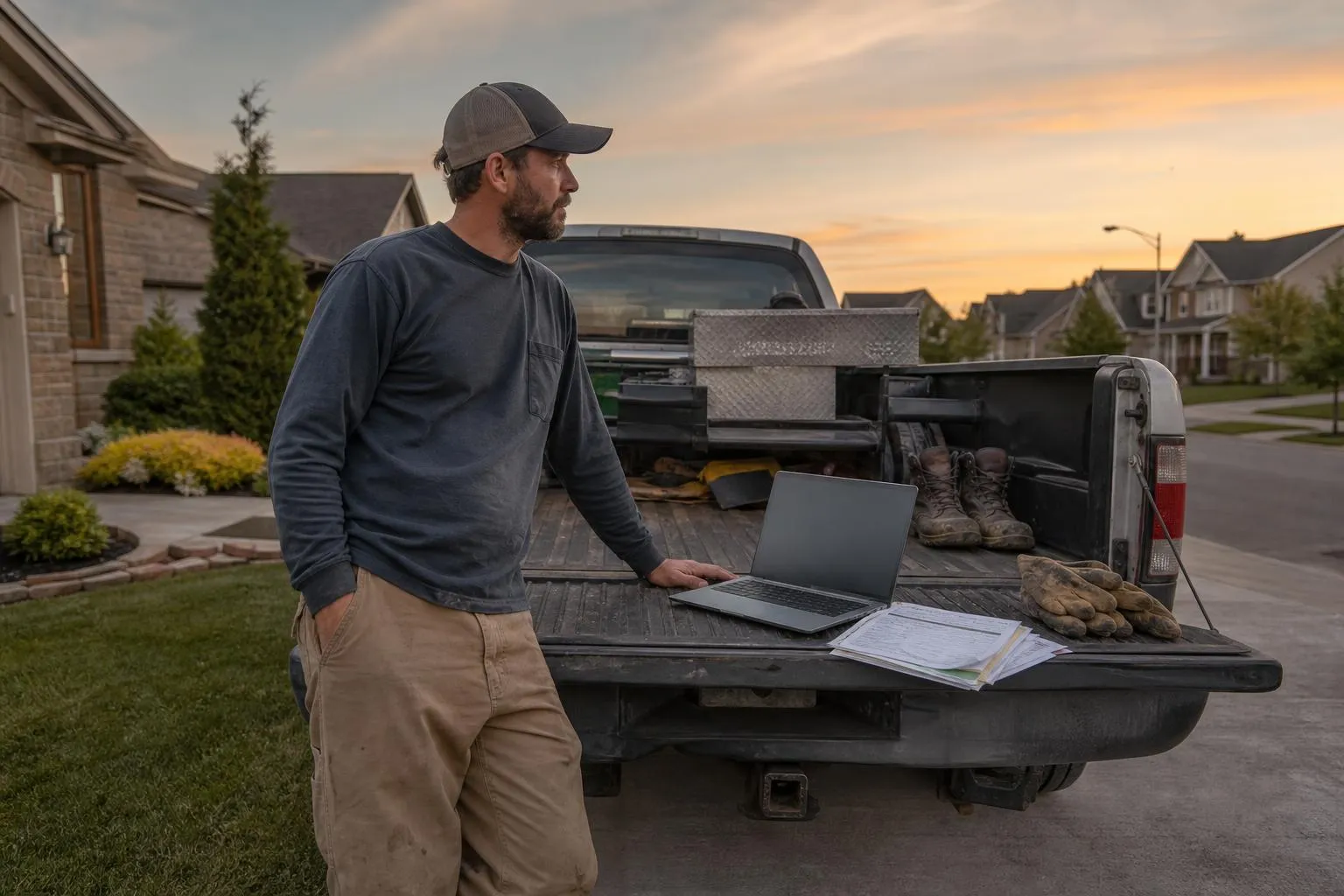
Best way to start and get into a landscaping business

The best way to get into landscaping is not to finance a truck, a trailer, and a zero-turn and then go looking for lawns. It is to sell one tight route of recurring mowing accounts first, then buy the iron the route already pays for. The trade rewards density, not horsepower: the operator with twelve lawns on one street out-earns the one with twelve lawns across the county, and he does it on cheaper equipment. Here is how to start lean, stack recurring revenue, and let the route fund every upgrade.
Sell the route before you buy the mower
Most people get the order backwards. They spend $12k on a truck-and-trailer package, then panic-bid every lawn in a 20-mile radius to cover the payment. Reverse it. Before you own anything but a push mower, go door-knock one neighborhood and sign recurring weekly-mow accounts until you have eight to twelve on a single loop. That loop is your business. The equipment is just the tool that services it, and a signed route makes financing the tool trivial because now you have revenue to point at.
The reason this works is unbilled windshield time. A 25-lawn week spread across a metro means you spend two hours a day driving between jobs that pay you nothing. Twelve lawns on one street means you park once, walk mower to mower, and bill nearly every hour you work. Same revenue, half the day. The step-by-step startup path walks the sequence, and ideal locations shows how to pick the neighborhood before you knock.
Watch how a starter route turns into predictable monthly revenue as it fills in on one loop:
| Accounts on the loop | Avg weekly ticket | Monthly recurring revenue | Annual MRR value |
|---|---|---|---|
| 5 (first month) | $55 | ~$1,190 | ~$14,300 |
| 12 (full starter route) | $55 | ~$2,860 | ~$34,300 |
| 25 (solo ceiling) | $55 | ~$5,960 | ~$71,500 |
Start with the cheapest kit that actually works
You do not need a $9,000 zero-turn to mow suburban lawns. A used commercial-grade 21-inch push mower (Honda HRC or Toro Commercial, $400 to $900 used), a two-cycle string trimmer (Stihl FS 91 or Echo SRM-2620, $250 to $350), a backpack blower (Stihl BR 600, $350 to $450), and a cheap open trailer or even a truck-bed ramp will service a starter route all season. That is a $1,500 to $3,000 kit that pays for itself in three or four weeks of a full route.
Buy the zero-turn when the math forces it, not before. A 48- or 60-inch ZTR (Scag, Exmark, Ferris; $8k to $13k new) makes sense the day your lawns are big enough or numerous enough that push-mowing is the bottleneck, usually somewhere north of 15 to 20 accounts. Buy it too early and you have a payment with no route to feed it. The full breakdown of what to buy first is in buying equipment and supplies.
Get legal before the first invoice, not after
Landscaping looks like a trade you can run out of a truck with a handshake, and plenty do, right up until a rock kicks out from under the mower deck and cracks a client’s picture window or a neighbor’s windshield. Form an LLC, get an EIN, open a business bank account, and bind general liability before you touch a paying lawn. If you apply any fertilizer, weed control, or pest control for hire, most states require a commercial pesticide applicator license, and spraying without one is a real fine, not a formality. The full registration walkthrough is in how to set up and register.
Price so a full route actually pays you
The rookie mistake is pricing per lawn to win the job and discovering in July that a full schedule nets almost nothing. Price for your hourly, not against the cheapest guy on the block. A standard quarter-acre suburban lawn runs $45 to $65 per weekly mow-trim-blow in most US markets; bill for the mow, the edge, the trim, and the cleanup as one price, and never quote by the hour to the customer. Weekly beats biweekly for you because the grass is shorter, the cut is faster, and the monthly revenue is smoother. The complete method is in setting prices and billing, and once the route is stable you can raise the average ticket by growing the business into cleanups and installs.
Solo owner-operator to start
- Every dollar of revenue is yours; no wages, no payroll tax, no comp premium eating margin.
- You control quality on every lawn, which protects the reviews that feed your next accounts.
- Overhead is a used mower and gas, so you hit break-even inside the first month of a full route.
Solo owner-operator to start
- You are the bottleneck: rain, injury, or a broken mower stops all revenue at once.
- You can physically service maybe 25 to 35 lawns a week solo, which caps your ceiling.
- Selling, invoicing, and mowing all land on you, so admin happens at 9pm after a full day.
The rule: stay solo until the route is consistently full and you are turning work away, then hire your first helper the month demand outruns your two hands. Hiring early, with a half-full route, is how you turn a profitable one-man operation into a break-even two-man one. The timing is covered in when and how to hire.
Getting found is the part that decides everything
You can run the cleanest route in town and still stall if nobody new can find you. Two pieces are free and worth doing this week: claim and fully fill out your Google Business Profile with real photos of finished lawns and your truck, and text every happy client a review link the day you finish. Your first 15 to 20 reviews pull more calls than any flyer, and the local promotion checklist shows how to stack them.
The paid part is where it gets high-stakes. A landscaping website is not a brochure; it loads in under three seconds on a phone, ranks for “lawn care near me,” shows reviews and a click-to-call button up top, and turns a searching homeowner into a booked estimate. The gap between a site that converts and a pretty one that does nothing is invisible until you compare the numbers. That is the work we do. To have the site handled instead of guessed at, get a free video walkthrough. For ads and SEO, see our services. If you have the idea but not the plan yet, start at expntl.com.
Frequently asked questions
What is the cheapest way to start a landscaping business?
Start solo with a used commercial 21-inch push mower, a string trimmer, and a backpack blower, roughly $1,500 to $3,000 of kit, and sell recurring weekly mow accounts on one tight neighborhood before you buy anything bigger. Skip the zero-turn until the route is full enough to justify it. Add the business license, LLC, and liability insurance up front, which runs a few hundred dollars more, and you are legal and operating for well under $5,000.
Do I need a license to start a landscaping business?
For mowing, trimming, and cleanups you generally need only a local business license and an LLC. The moment you apply fertilizer, weed control, or any pesticide for pay, most states require a commercial pesticide applicator license, and operating without one carries real fines. Confirm your state’s rule with its department of agriculture before you advertise chemical applications.
How many lawns do I need to make a living?
A solo operator can service roughly 25 to 35 lawns a week and, at a $50 to $60 average weekly ticket, gross somewhere around $5,000 to $8,000 a month before expenses. Cluster them on tight routes and that same headcount takes far fewer hours, which is what lets you add accounts or take home more per lawn. The exact number depends on lot size and your market’s pricing.
Should I buy a zero-turn mower to start?
Usually not on day one. A used commercial push mower services a starter suburban route for a fraction of the cost, and a $9k-to-$13k zero-turn is a payment with nothing to feed it until your route is full. Buy the ZTR when push-mowing becomes the bottleneck, generally past 15 to 20 accounts or when you take on larger properties.
How long until a landscaping business is profitable?
Solo, with low overhead and a route you sold before buying equipment, you can be ramen-profitable in 60 to 90 days because your only real costs are gas and a used mower. Reaching a full living wage depends on how fast you stack recurring accounts and how tightly you route them. Density is what pulls that timeline in.
Your move
Reading this does not book a job.
The owners who pull ahead are the ones who change one thing this week. If you want that one thing to be a website that sells and ads that put it in front of the right people, we build and run both for you.
Straight answer on whether we can help, usually the same day.