Bakery website conversion rate: same Instagram traffic, more wedding cake inquiries
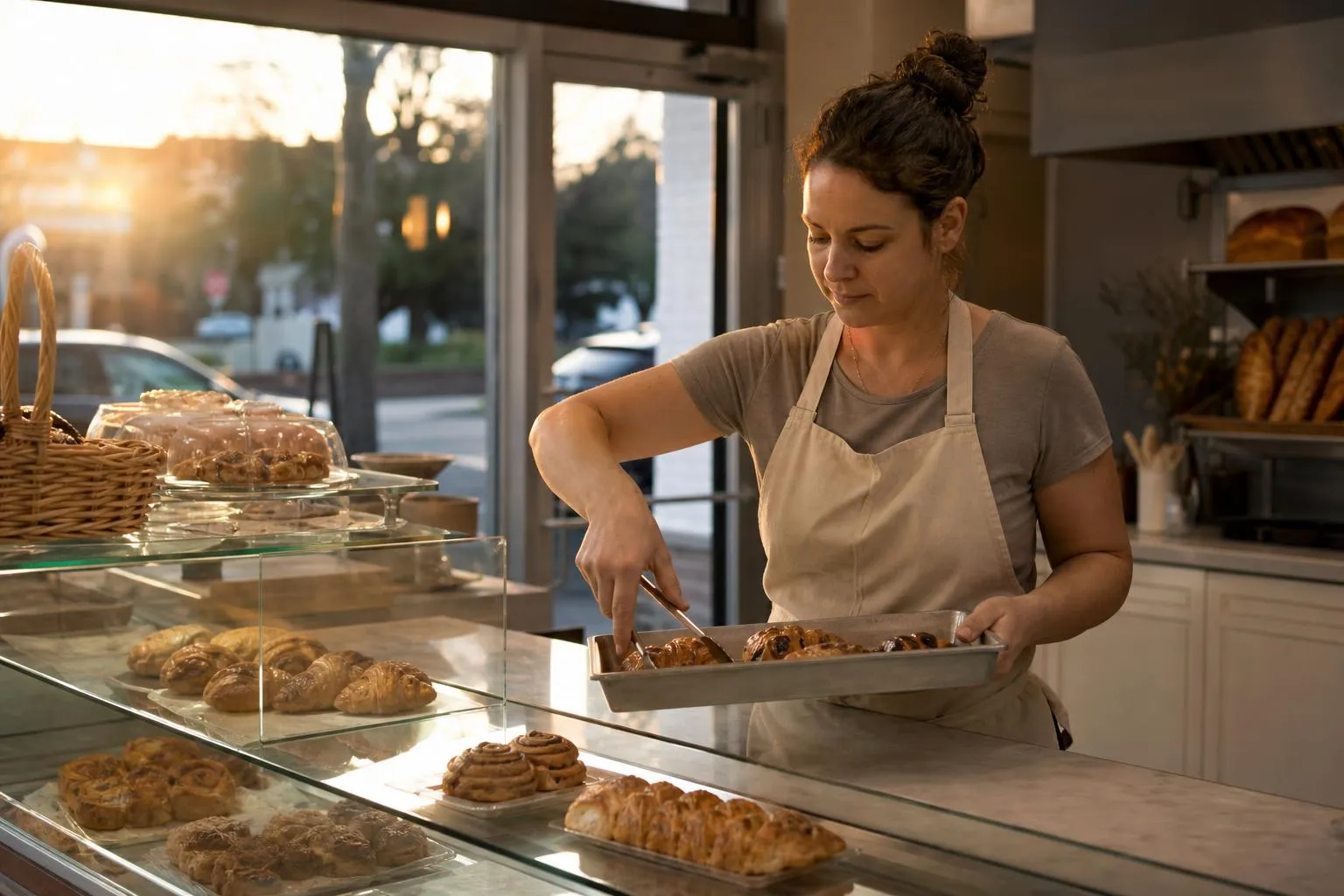
Picture the bride scrolling cake photos in bed at 11pm, three tabs open, credit card thoughts already forming. She lands on your site fourth. She leaves in nine seconds.
You never see that moment. No notification tells you a $1,800 wedding order almost had your name on it. The only trace of what happened is a number buried in your analytics that almost no bakery owner has ever opened: your conversion rate, the share of visitors who turn into an inquiry, a pickup order, a booked date.
That single number decides whether your bakery website earns its keep or quietly bleeds orders you never knew existed.
The arithmetic nobody runs behind the counter
Say 400 people find your site in a given month (an example figure, so swap in your own) once you add Google Business Profile clicks, Instagram bio taps, and couples checking you out before they ever call. What each of them does next is the entire game.
| Conversion rate | Inquiries from 400 visitors | Booked orders (1 in 4) | Revenue at $1,800 avg order |
|---|---|---|---|
| 2% (aging brochure site) | 8 | 2 | $3,600 |
| 4% (decent modern site) | 16 | 4 | $7,200 |
| 8% (conversion-built site) | 32 | 8 | $14,400 |
Nobody added a single visitor between those rows. Same traffic, same season, same Instagram following. Just less of it walking out the digital door unconvinced.
The leak you cannot hear
This is what makes conversion so sneaky: nothing about it looks broken.
A burnt batch smells like a burnt batch. A slow month shows up on the register tape. But a site converting at 2% instead of 8% throws no alarm at all. Orders still trickle in, the site “loads fine,” and there’s no side-by-side to show you what the month should have looked like. You could run a mediocre bakery site for five wedding seasons and never catch the leak. A dead site is at least obvious; that’s covered in why your bakery website isn’t getting you customers. A 2% site is worse in a way, because it looks like it’s working.
So most owners chase the wrong fix: more posts, more boosted ads, a harder push for local Google rankings. The cheaper fix sits under their nose: the audience is already arriving. The site just isn’t catching them.
Where the extra orders actually come from
A high-converting bakery site isn’t prettier fonts or a trendier color palette. It’s a short, repeatable list of mechanical decisions, each one catching visitors the brochure site loses.
Real photo galleries, not four photos from 2018. Wedding shoppers want to scroll through dozens of real cakes before they trust anyone with a $1,800 order. A thin gallery reads as inexperience even when the opposite is true.
Ordering built for the pickup habit. Plenty of customers decide on their phone and expect to tap straight through to a pickup slot. If the homepage can’t take that order, they finish it at the next bakery’s site instead.
Proof before claims. Star rating, review count, a few named testimonials, real client cakes front and center rather than buried on an About page nobody clicks. Shoppers scan for reasons to trust you before they read a word of copy.
Answers to the three silent questions. Do you do my style of cake? Can you deliver my date? What does a cake like mine actually cost? Sites that answer these above the fold get the inquiry. Sites that make people hunt lose it.
Speed. A wall of full-size cake photos is the heaviest thing a bakery site carries, and on a phone it can stall long enough that the visitor never sees the first tier. Google’s 2016 research found that 53% of mobile visitors leave a page that takes longer than 3 seconds to load, and a bride-to-be scrolling cake photos on her phone at lunch is exactly that visitor.
Stack those five and the 2% row can start to look like the 8% row. Treat that as a scenario, not a guarantee: the rows are a model with a low end and a high end, and where a bakery lands depends on its photos, its prices and how many other bakeries serve the same town. Nothing about the cakes changed. It is the same oven, the same buttercream and the same people, with fewer of them leaving before the inquiry form.
Patching won’t get you there
Could you nudge the old site toward these numbers with a few fixes? Sure, a little.
Patching the old site
- Cheap to start: a new gallery plugin and an order button cost a few hundred dollars.
- No relaunch, no new URL, your existing content and reviews stay put.
- Small real wins exist: a pickup-order button on the homepage catches some of the phone shoppers who would have given up.
Patching the old site
- The template caps you: a slow, image-heavy WordPress theme stays slow no matter what widget you bolt on.
- Every change is a developer invoice and a two-week wait, not a same-day fix.
- The developer invoices add up over a wedding season and the theme still sets the limit, because conversion is structure, not decoration.
Adding an order button to a slow, cluttered template is icing on a cake that never rose. Conversion isn’t a feature you sprinkle on later. It gets decided the day the site is built.
See the difference before you commit to it
The honest pitch here matches the headline: you won’t know what your traffic is worth until it runs through a site actually built to convert it. But you can watch the mechanics work before you spend a dollar. The free video walkthrough tours a real bakery site so you can compare it to yours screen by screen: where the gallery sits, where the pickup button lives, what real proof looks like above the fold.
Like the gallery-first layout? We make it for your bakery: $2399£1,899 for the Standard website, or $7500£5,900 for the Growth website with custom branding and a page per cake style, both one-time with no contract. It goes live in 7 days and belongs to you. After launch, ads or conversion optimization have a page that already turns a cake-gallery browser into an order.
Frequently asked questions
What is a good conversion rate for a bakery website?
There is no industry figure worth trusting, so measure your own: traceable inquiries and online orders divided by site visitors, over a full month. The 2% and 8% in this article are a worked scenario, not a promise. A site built around a real gallery, tap-to-order pickup and visible proof will usually turn more of the same visitors into inquiries than a brochure page, but how many more depends on your photos and your prices.
Can I fix conversion without rebuilding the site?
You can buy small gains with a better gallery plugin and a pickup-order button. But a slow, image-heavy template caps how far those tweaks can go, and each new widget adds weight to a page that was already slow. Conversion comes from the structure underneath, not the widgets on top.
How much does a conversion-built bakery website cost?
We charge $2399£1,899 for the Standard website and $7500£5,900 for the Growth website, once, with no contract. Two wedding cakes at the $1,800 in the table more than cover the Standard website. The bakery is live 7 days after kickoff, a new flavor or a sold-out date goes up within 24 hours of your message, and the site is yours.
Should I fix conversion before spending more on ads?
Yes. A boosted post that doubles traffic to a 2% site brings 8 more inquiries; the same 400 visitors on an 8% site bring 24 more without a cent of boost budget. Fix the gallery and the order flow first, then pay to send people to them.
Next up for bakers: Every extra second your bakery website takes to load is costing you orders, and why a cake gallery is the heaviest thing on your page.
Your move
Reading this does not book a job.
The owners who pull ahead are the ones who change one thing this week. If you want that one thing to be a website that sells and ads that put it in front of the right people, we build and run both for you.
Straight answer on whether we can help, usually the same day.