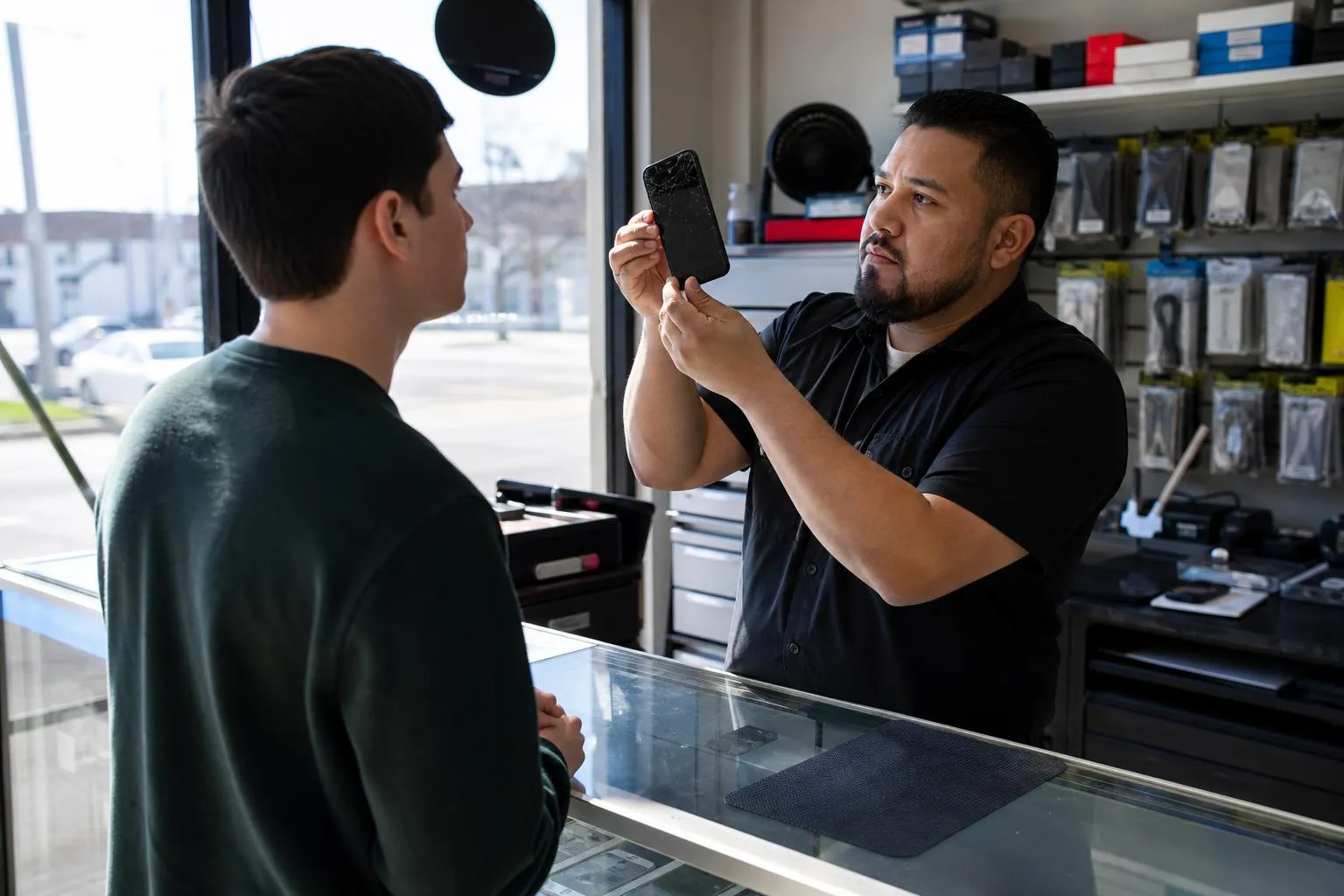
Your Phone Repair Website Looks Fine on a Computer. Your Mobile Customers Are Reading It on a Cracked Screen

Friday, 12:20 p.m. A screen just went from a clean rectangle to a spiderweb of cracks, dropped face-down on concrete outside a lunch spot. The owner is squinting through the fractures, using a coworker’s phone to search for someone who can fix it before the afternoon meeting.
There’s a strange twist to this moment that no other trade deals with: the device with the problem is often the same device being used to search for the fix, or a borrowed one held at an awkward angle. Either way, this is the exact moment your website was built for.
Here’s what happens on thousands of searches like this one. She taps a result. The page crawls. Half loaded, it’s a shrunken desktop layout: a services list with no prices, a “contact us” form instead of a quote, a phone number buried three scrolls down. She can’t tell if you even fix her model, let alone what it costs or how long it takes.
Back button. Next result. A shop that says “$99, 30 minutes, in stock today” gets the walk-in instead.
You’ve never squinted through a cracked screen at your own site
Here’s what keeps this failure invisible: you and your customers have never looked at the same website.
You reviewed it on a shop laptop or an office monitor, probably during setup, on a screen with no cracks in it. It looked clean. It still does, there.
Your customers meet it on a phone, where roughly 92% of repair searches happen, sometimes literally through a shattered display. Not browsing casually: annoyed, in a hurry, squinting, often on a borrowed device. The research puts numbers on exactly how little patience survives that combination.
| Mobile reality | The number |
|---|---|
| Visitors gone if the page takes over 3 seconds to load | 53% (Google) |
| Conversion lost per extra second of load time | about 4.4% (Portent) |
| Rise in bounce probability from a 1-second load to 10 | 123% (Google) |
| Average mobile page load time | 8.6 seconds |
The average page takes 8.6 seconds; the cracked-screen customer’s patience runs out well before that. Most repair shop sites, built as a static services list, live on the wrong side of that gap, which is why site speed gets its own breakdown later in this series.
So you see a decent-looking site and a slow Friday, and never connect the two. There’s no error message when a customer gives up mid-search. It happens quietly, over and over, on a version of your site you’ve never tried to read through a broken display.
The cracked-screen customer is the least patient shopper you’ll meet
For most local businesses, a clumsy mobile site loses a browser. For a repair shop, it loses a customer standing thirty feet from your competitor with the exact same walk-in.
Your highest-value traffic (someone who needs a fix today, sometimes in the next hour) hits your site on a phone with a cracked screen of their own, comparing you against uBreakiFix or Apple in real time. This is the closest thing to a guaranteed sale you have, and also the person least willing to dig for a price. Someone planning to mail in a device next week might tolerate a vague site. Someone standing outside with a shattered screen will not. She wants a number and a time, and she’ll pick whoever gives her both fastest.
The math is unforgiving: the more urgent the crack, the more likely she pays full price without shopping around, and the faster a vague mobile site loses her to the shop that quotes instantly. Even shops that rank in Google’s local top three still lose the walk-in when the page behind that ranking makes her guess at pricing.
What “built for the broken screen” actually means
A mobile-first repair shop site isn’t the desktop services page squeezed down. It’s built for someone squinting through cracks with one working thumb:
- Loads in a couple of seconds on cellular, not just your shop Wi-Fi.
- An instant quote calculator in the first screen: pick the model, see the price, no phone call needed to get “how much.”
- The essentials above the fold: turnaround time, “in stock today,” and proof: stars, review count, a real counter photo.
- A tappable call button that survives a bad crack, big enough to hit through a distorted digitizer.
- No decoration ahead of the quote. Sliders and stock photography cut in front of the one thing she came for and quietly wreck your conversion rate.
None of it is exotic. It’s a site designed around someone’s worst five minutes instead of the owner’s undamaged office screen.
Can you just add a price list and call it mobile-ready?
Sometimes. Rarely well. Here’s the honest trade.
Adding a static price list for mobile
- Cheapest fix upfront: a PDF or basic table costs almost nothing to add.
- You keep the existing site and don’t touch the build.
- Live the same afternoon, no project to manage.
Adding a static price list for mobile
- The 8-second load usually survives the addition: the theme bloat and stock images causing it stay put.
- A static table still forces scanning through models instead of an instant, tappable quote.
- You keep paying the invisible bill: at 53% abandonment, a slow page with a price list buried in it loses the same cracked-screen walk-ins the vague one did.
A price list looks helpful in a screenshot. Someone reading through a spiderweb of cracks doesn’t scroll a table, she taps the first thing that gives her a number.
The test that ends the guessing
Earlier in this series we made the case that your website isn’t broken, it’s just not doing its job. Mobile is where that becomes obvious fastest. The regulars who found you anyway are on your books. The walk-ins your site lost never left a trace.
Built for the customer with a cracked screen and one thumb
We build repair shop sites mobile-first: someone squinting through a shattered display is the design brief, and the desktop layout is the adaptation. An instant quote calculator sits in the first screen, pages load in about a second on cellular, and turnaround time and reviews sit above the fold.
Watch the free video walkthrough of a live quote calculator on an actual phone, next to yours. The gap explains itself in about two minutes. Once mobile finally converts cracked screens into booked jobs, your ad spend and repeat business compound, which is what our ongoing growth services are built for.
Frequently asked questions
What does a mobile-first repair shop website cost?
Our Standard build is $2399£1,899 one-time, and the Elite package is $7500£5,900 one-time, with pricing published on the get-website page. No contracts, you own everything, and it’s live within 7 days.
We already list our prices somewhere on the site. Isn’t that enough?
Not if it takes more than a couple of taps to find, or if the page takes 7 to 9 seconds to load first. Mobile-first means an instant quote is the first thing a phone-holding customer sees, not something buried under a menu.
How many of our customers really search on a phone?
Around 92% of phone repair searches happen on mobile, and a meaningful share happen on the exact device that’s broken. Check your analytics device report: repair-intent pages typically run 85% or higher mobile.
Will a faster mobile site help us beat the big chains on Google?
Yes for local searches. Google uses mobile-first indexing, ranking the mobile version of your site. Speed and usability feed the same local rankings that decide who shows up for “iPhone screen repair near me,” where local trust and speed can beat a chain’s ad budget.
Next in this series: The trust tax: how an outdated website kills the referrals you already earned
Your move
Reading this does not book a job.
The owners who pull ahead are the ones who change one thing this week. If you want that one thing to be a website that sells and ads that put it in front of the right people, we build and run both for you.
Straight answer on whether we can help, usually the same day.