Phone Repair Website Conversion Rate: Same Traffic, Triple the Customers
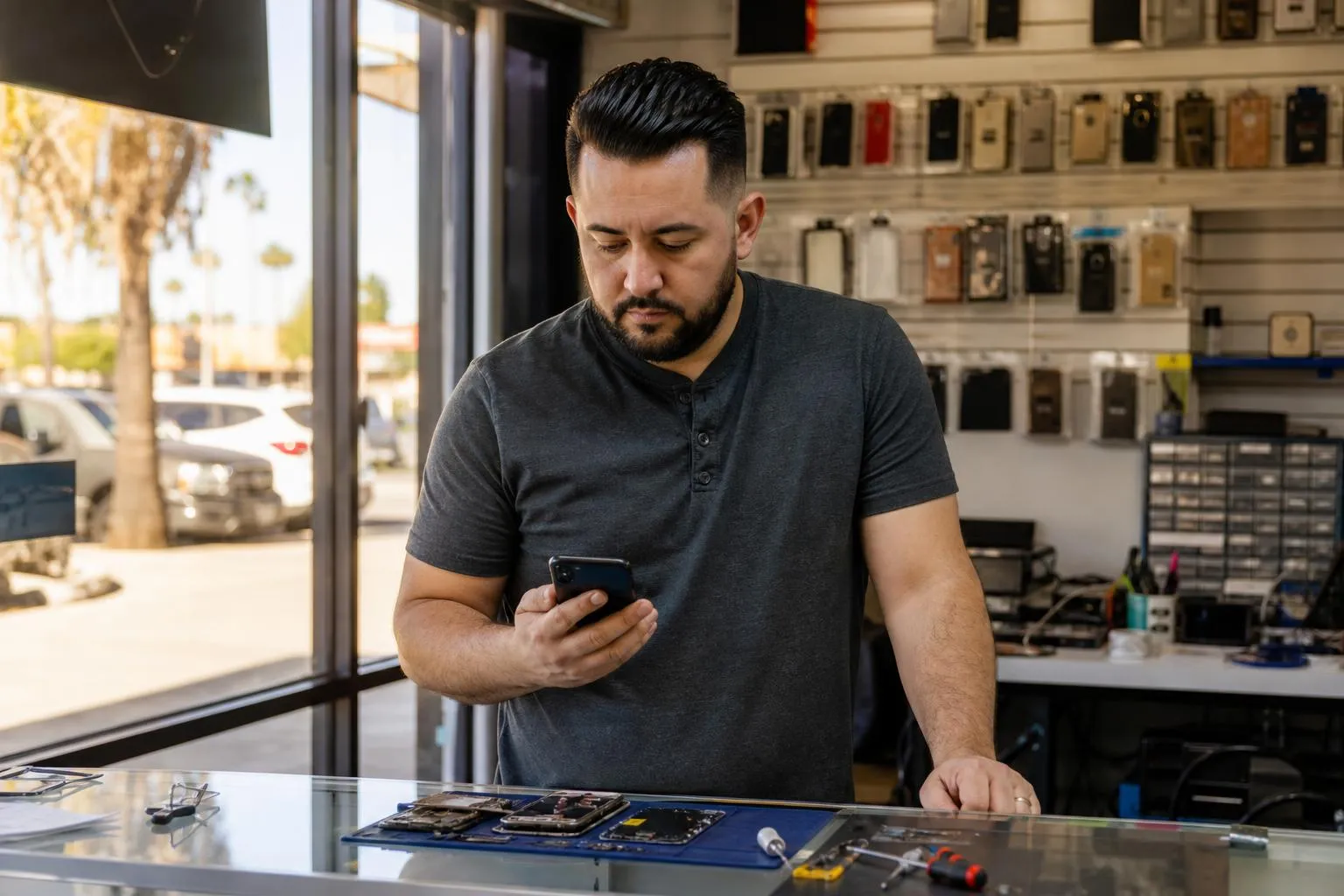
Picture forty people last month, each one standing somewhere with a cracked screen in their hand, pulling up your website to see if you’re worth the drive. Thirty-seven of them closed the tab and never called.
You’d want to know why. Was the price hidden? Did the page take too long to load on their own broken phone? Here’s the part that stings: something close to that happens every month to almost every repair shop site in the country, and you never hear about it. A visitor who leaves without calling doesn’t leave a trace. No missed-call notification, no angry review, nothing. The only record is a number most shop owners have never once looked at: conversion rate, the share of visitors who turn into a call, a form, or a walk-in.
That single number decides whether your site is pulling its weight or quietly bleeding customers you already paid to attract.
The arithmetic most shop owners skip
Say 400 people land on your site in a given month. A lot of shops hit that without much effort: Google Business Profile clicks, “iPhone screen repair near me” searches, people checking you out before they walk in. What happens after they land is entirely up to the page.
| Conversion rate | Customers from 400 visitors | Booked repairs (1 in 2) | Revenue at $95 avg ticket |
|---|---|---|---|
| 2% (aging brochure site) | 8 | 4 | $380 |
| 4% (decent modern site) | 16 | 8 | $760 |
| 8% (conversion-built site) | 32 | 16 | $1,520 |
No extra visitor shows up in that table. No new ad spend, no viral TikTok. Just the same crowd, walking away less often.
Why the leak never shows up on the register
This is what makes conversion so sneaky: it produces no symptom. A cracked screen announces itself the second it happens. A slow week shows up on the P&L. But a website converting at 2% instead of 8% just quietly runs, phone still rings sometimes, walk-ins still happen sometimes, and nothing ever reveals what the same 400 visitors would have produced on a better page. That’s different from a site that’s outright dead, which we covered in why your phone repair website isn’t getting you customers. A 2% site produces just enough activity to feel fine.
So most owners chase the wrong lever: more Google Ads, more Instagram posts, a bigger push for the map pack. The cheaper fix sits right in front of them: the traffic is already arriving. It’s just not converting.
Where the extra customers actually come from
A high-converting repair shop site isn’t flashy design. It’s a handful of mechanical fixes, each one catching visitors the old site was losing.
Instant quote up front. Someone with a shattered screen doesn’t want to call and describe their phone. They want to tap “iPhone 14, screen, cracked” and see “$129, ready today” in five seconds. Brochure sites make them call and wait on hold to find out.
The call button is everywhere. Tap-to-call in the first screen, repeated as the page scrolls, with the quote form as the backup for people who’d rather not talk. Nearly every one of these searches happens on the very phone that’s broken, so every screen needs to be able to start the call.
Proof before the pitch. Star rating, review count, turnaround time, genuine parts, shown immediately instead of buried three scrolls down. A stressed customer isn’t reading your story. They’re scanning for a reason to trust you in the next ten seconds.
Model-specific pages. One page for iPhone screen repairs, a separate one for Samsung battery swaps, each answering exactly what that customer typed into Google. A single “we fix phones” page convinces nobody of anything.
Speed. A page that takes four seconds to load on a phone with a spiderwebbed screen converts nobody, because that visitor gives up before your quote even appears. Google’s own research found that 53% of mobile visitors abandon a page that takes longer than 3 seconds. That deserves its own article, and it’s coming next in this series.
Stack all five and 2% becomes 8%, sometimes more. Nobody had to find your shop harder. The people who already found it just stopped leaving.
Why patching the old site doesn’t get you there
Could you nudge the existing site toward these numbers with a few tweaks? Some, yes.
Patching the old site
- Cheap up front: adding a click-to-call button or a reviews widget costs a few hundred dollars.
- No rebuild project, no new URL, nothing to relearn.
- Real small gains exist: putting the phone number above the fold can lift 2% toward 2.5%.
Patching the old site
- The old template caps how far you can go: a heavy desktop-first build stays slow on the exact phones customers are using.
- Every change is a freelancer email and a week’s wait, billed by the hour.
- A year of patchwork can cost $1,200 and still leave you under 3%, because conversion isn’t a widget, it’s the frame the widgets sit inside.
Bolting an instant-quote button onto a slow, unresponsive template is like putting a new screen on a phone with a cracked logic board. It looks fixed. It isn’t. Conversion gets decided on day one, in the architecture, not added in afterward.
See what your traffic is actually worth
You can’t know what your 400 monthly visitors are worth until they hit a page built to convert them, but you can see the architecture before committing to anything. The free video walkthrough tours a real repair shop site so you can compare it against yours screen by screen: where the quote calculator sits, where the reviews sit, what a model-specific page looks like.
If it convinces you, the rebuild is done for you start to finish: $2399£1,899 one-time for Standard, $7500£5,900 for Growth, prices published openly on the page, no contracts, live in 7 days, edits live within 24 hours, and you own everything. Once the site converts, anything you spend later, whether on ads or growth services, compounds on top of an 8% machine instead of leaking into a 2% one.
Frequently asked questions
What is a good conversion rate for a phone repair website?
Older brochure-style sites usually land at 1-3%. A decent modern site reaches 4-5%, and conversion-built repair shop sites are engineered toward an 8%+ benchmark, the gap between 8 and 32 customers on identical traffic.
Can I fix conversion without rebuilding the site?
You can pick up small gains with a visible phone number, real reviews, and a click-to-call button. But a slow, desktop-era template limits how far those tweaks can carry you, which is why patched sites rarely clear 3%. The architecture decides the ceiling, not the accessories.
How much does a conversion-built phone repair website cost?
$2399£1,899 one-time for the Standard build or $7500£5,900 for Growth, both prices published openly. No contracts, launch in 7 days, edits live within 24 hours, and you own everything. A handful of recovered repairs pays for it.
Should I fix conversion before spending more on ads?
Yes. Doubling traffic into a 2% site adds 8 customers; lifting the same 400 visitors to 8% adds 24 with zero new ad spend. Fix the leak first, and every ad dollar you spend afterward works roughly four times harder.
Next in this series: Every extra second your website takes to load is costing you customers
Your move
Reading this does not book a job.
The owners who pull ahead are the ones who change one thing this week. If you want that one thing to be a website that sells and ads that put it in front of the right people, we build and run both for you.
Straight answer on whether we can help, usually the same day.