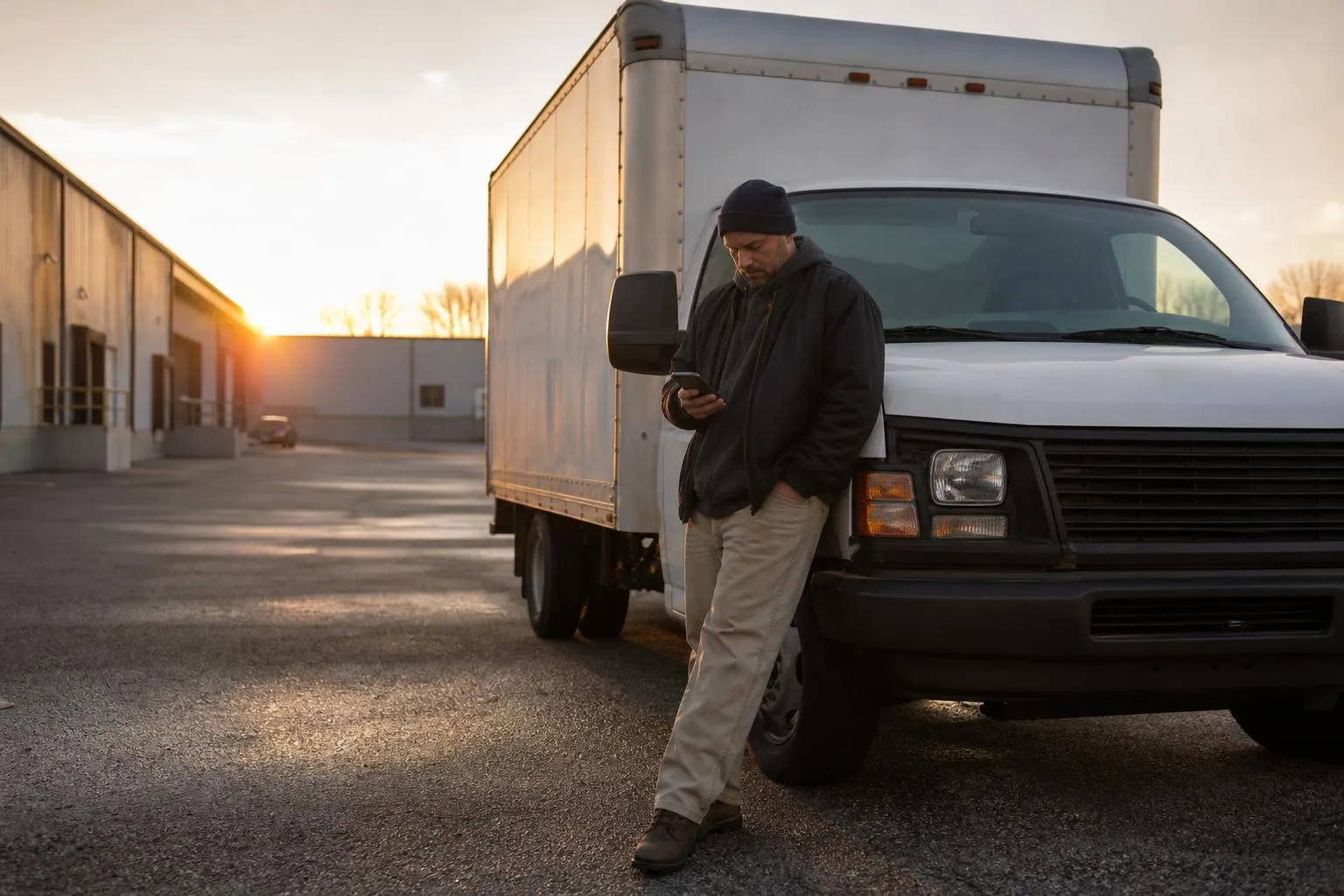
Why the Less Reliable Delivery Company Keeps Winning Your Contracts

Your drivers actually call before arrival. Your damage rate on furniture deliveries is close to zero. You carry the insurance coverage the sloppier outfit across town probably doesn’t, and you know it because you’ve seen their claims history secondhand from a shared warehouse.
They still landed the coffee roaster’s weekly delivery contract you quoted on.
Here’s the uncomfortable part: merchants don’t sign the most reliable delivery partner. They sign whichever one looked like the safest, most established operation during the five minutes they spent reading a website before the meeting. That’s a separate contest from the one your drivers win on the road every day, and it’s the only one a merchant can actually judge before trusting you with their customers’ orders.
A merchant can’t test-drive your reliability before signing
A furniture store owner considering a delivery partner cannot ride along to see whether your drivers actually call ahead, or whether a couch makes it up three flights without a scratch. They will never see your real on-time rate before the contract is signed. That only shows up after the first month of deliveries.
So they judge on what they can verify from a screen:
- Whether the site loaded fast enough to actually read anything
- Whether pricing is shown as a ballpark, or hidden behind “contact us”
- Whether insurance certificates and fleet size are stated, not implied
- Whether there are real photos of real vans and drivers, not stock art
- Whether starting a conversation takes one form, or a cold call to a stranger
None of that measures how carefully your driver handles a dining set. That’s the real contest, and why your delivery website isn’t getting contracts covered the symptoms; this is the mechanism underneath them.
The vetting happens before you ever get the meeting
A merchant shopping for a last-mile partner typically looks at three or four operators before reaching out. Here’s the pattern: they search “same-day delivery” plus their city or get a referral, open each site, skim for pricing and legitimacy signals, close the ones that feel like a guy with a Sprinter, then email whoever felt like a real operation.
You’re being vetted in that skim whether you know it or not, and the mechanics are unforgiving:
| What the merchant experiences | The number | Source |
|---|---|---|
| A page takes longer than 3 seconds to load | 53% of visitors leave | Google mobile research |
| Every extra second of load time | Conversions drop about 4.4% | Portent |
| Load time grows from 1 to 10 seconds | Bounce probability climbs 123% | Google/SOASTA |
| Average small-business site on a phone | Loads in about 8.6 seconds | Industry benchmarks |
The typical delivery operator site loads nearly three times past the point where half the visitors have already left. If the less careful outfit’s page opens in two seconds with a ballpark rate and a fleet photo while yours is still loading, the merchant doesn’t think “the slow site means the careful operator.” They think nothing. They’ve already emailed the other company. That’s exactly what site speed quietly costs a delivery company in contracts is describing.
The expensive part: these should have been your routes
This isn’t abstract. Every merchant searching for a delivery partner in your metro this quarter is a real recurring route, worth real monthly revenue for as long as you hold the contract.
You aren’t just losing revenue. Merchants in your metro are trusting their customers’ orders to a less reliable fleet, because the more reliable one never looked established enough to sign with.
This gap closes faster than adding a van to your fleet
You can’t out-fleet a bigger competitor by next week. But the part costing you the most, the five-minute vetting window, is built from documents and numbers you likely already have.
Real proof, sitting unused. Insurance certificates, actual fleet size, driver headcount, and honest merchant testimonials. Most reliable operators hold more proof than the outfit winning contracts; it’s just never posted where a merchant can find it fast. That’s the core of getting clients for a delivery business.
A site built for a rushed vetting pass. Fast to load, a ballpark rate table, insurance and fleet facts up front, a driver-application pipeline running alongside the merchant funnel. What actually converts a delivery website visitor comes down to answering the “is this a real operation” question in the first ten seconds.
A clean local B2B presence. Your Google Business Profile, service-tier pages, and reviews all pointing at the same story.
The honest question is who builds it:
Rebuilding the site yourself
- Cheapest option upfront: DIY builders run $20-$50 a month
- Full control over rates, copy, and every update
- Nothing to wait on, you could start tonight
Rebuilding the site yourself
- The real cost is your dispatch time: 40-60 hours learning a builder, worth $2,000-$3,000 in missed route-planning time
- Generic templates rarely handle a merchant rate table plus a separate driver-applicant pipeline
- Half-finished rebuilds tend to stay half-finished once route volume picks up
Win the contracts your reliability already earns
The delivery operator winning your merchant routes didn’t get more reliable. It got easier to trust in a five-minute read. That’s solvable, and unlike them, you’ll actually keep the contract once packages start arriving on time.
We build delivery company websites designed to win exactly that vetting window: ballpark rate tables, insurance and fleet facts up front, a 24/7 driver-application pipeline, live in 7 days, done for you start to finish. See one live before spending a dollar: watch the free video walkthrough and compare it against what a merchant sees on your site today.
You own everything, updates go live within 24 hours, no contracts. If you want ongoing help with reviews, local rankings, and merchant-specific landing pages, that’s what our ongoing growth services cover. Stop letting a shakier operator win contracts your fleet was built to hold.
Frequently asked questions
How does a less reliable delivery company win more merchant contracts than mine?
Because a merchant can’t observe your on-time performance before signing; it’s invisible until deliveries start. They vet on visible signals instead: site speed, posted pricing, and proof of insurance and fleet size. Whoever wins that five-minute read gets the contract, regardless of who actually delivers with more care.
Do fleet size or the website matter more for winning routes?
They do different jobs. A real fleet backs up your capacity claims; the website is what actually communicates that fleet size to a merchant who will never see your lot in person before signing. A large fleet undersold on a vague, slow site still loses contracts, so fix whichever is weaker first.
How fast can I close this gap?
Faster than most operators expect. Posting rates, insurance proof, and fleet facts can happen in days, and a full site rebuild can go live in 7 days. Outgrowing a bigger competitor’s fleet takes longer, but the five-minute vetting window that decides most contracts is fixable this month.
What does a done-for-you delivery company website cost?
Standard is $2399£1,899 one-time and Elite is $7500£5,900 one-time, both published on the page with no hidden fees. No contracts, changes go live within 24 hours, launch takes 7 days, and you own everything outright.
Should I just underprice the route to win the contract?
No. The operator winning the route often charges a similar rate while performing less reliably, so price isn’t the deciding factor. Merchants are choosing whoever looked most established and easiest to trust; underpricing just subsidizes a visibility problem a better website fixes for good.
Next in this series: If your delivery business isn’t in Google’s top 3, you don’t exist
Your move
Reading this does not book a job.
The owners who pull ahead are the ones who change one thing this week. If you want that one thing to be a website that sells and ads that put it in front of the right people, we build and run both for you.
Straight answer on whether we can help, usually the same day.