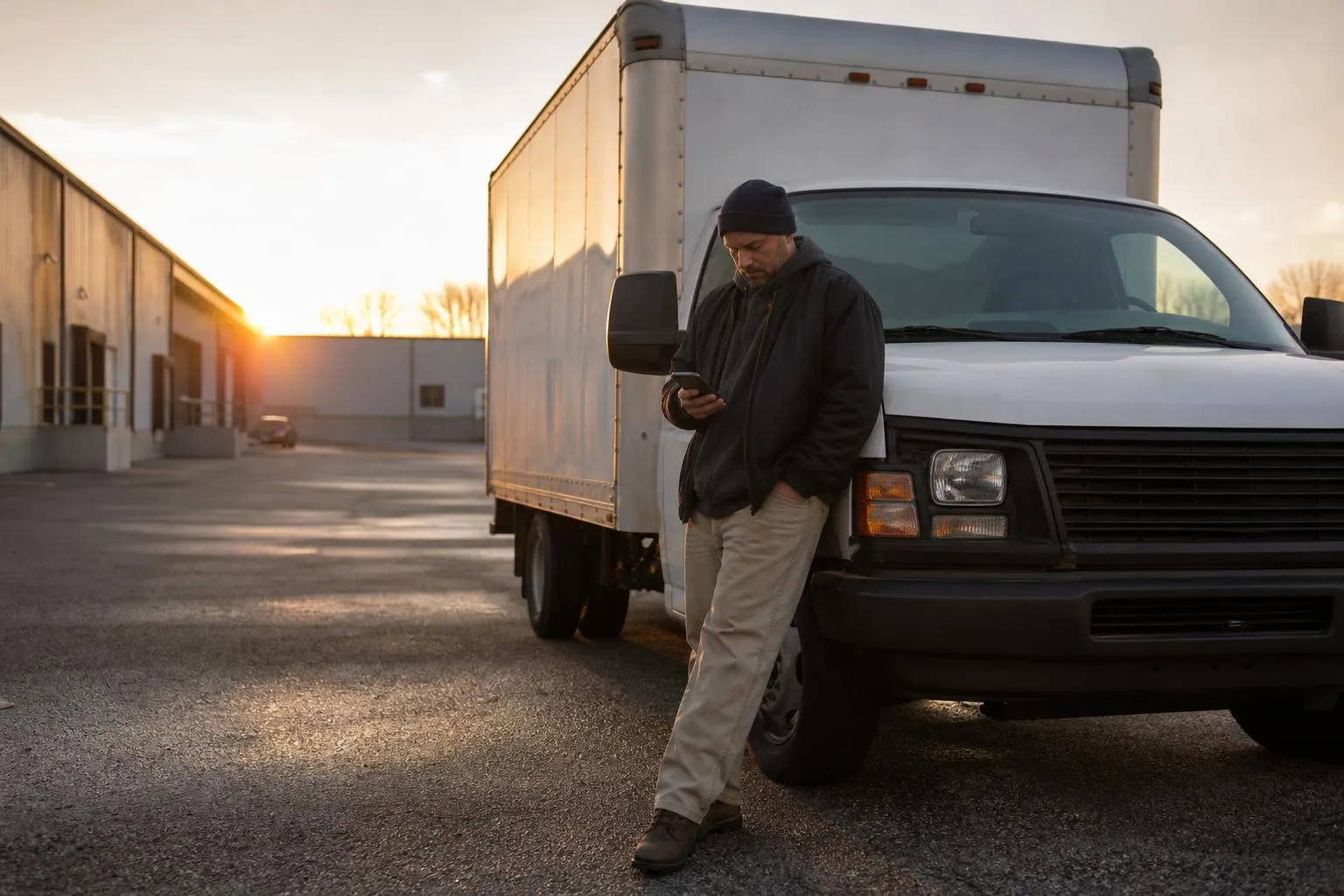
Your Delivery Website Looks Fine on a Monitor. Merchants Are Vetting You From a Stockroom Phone

Tuesday, 11:20 a.m. A furniture store owner is standing in the stockroom between two pallets, trying to decide who’s going to handle weekend deliveries once his in-house van finally gives out. He’s got a phone in one hand and three delivery company sites open, none of them a name he already knows.
This is exactly the moment your website is supposed to close. Not after a callback next Tuesday: right now, while he’s still standing there deciding.
Here’s what happens on searches like his, over and over. He taps a result. The homepage takes its time loading on the stockroom’s spotty signal. What arrives is a desktop layout squeezed onto his screen: a hero photo of a branded van, vague language about “reliable last-mile solutions,” and no pricing, no fleet size, no way to request a quote without filling out a contact form and waiting. He backs out and taps the next name.
Somebody else’s driver just picked up his account.
The site you signed off on isn’t the one merchants judge you by
Here’s the part that keeps this failure invisible: you reviewed your website on a desktop, and merchants are almost never judging it on that screen.
You looked at it in the office, probably right after launch, and it read as legitimate, established, worth trusting with a $5,000 monthly route. It still does, on that screen.
Merchants meet it on a phone, usually standing in a stockroom or behind a counter between customers, deciding in a few short minutes whether you’re worth a follow-up call. The numbers behind that window are specific.
| Mobile reality | The number |
|---|---|
| Visitors gone if the page takes over 3 seconds to load | 53% (Google) |
| Conversion lost per extra second of load time | about 4.4% (Portent) |
| Rise in bounce probability from a 1-second load to 10 | 123% (Google) |
| Average mobile page load time | 8.6 seconds |
The average site takes 8.6 seconds to load; a merchant with three tabs open is gone by 3. Most delivery company websites sit on the wrong side of that gap, one reason site speed gets its own breakdown later in this series.
So the owner sees a decent-looking site and fewer merchant inquiries than expected, and never connects the two. There’s no alert when a stockroom lead closes the tab mid-load. It just happens quietly, week after week, on a version of the site the owner has likely never opened on cellular.
Merchants vetting delivery partners move fast and forgive nothing
For most local businesses, a clunky mobile site is a trickle of missed leads. For a delivery operator competing for the routes that actually pay the bills, it’s the contract that would have covered a driver’s salary for a year, gone before you knew it existed.
Merchants rarely commit to the first name they find. They pull up your site next to two or three competitors, on the same phone, in the same coffee break, and whoever shows fleet size, service zones, and a ballpark rate without a phone call gets the follow-up. He isn’t loyal to any of them yet. He’s eliminating options as fast as the pages let him, and a vague, slow-loading site is the fastest way to get eliminated.
The math is not small. A steady merchant route runs $3,000 to $8,000 a month, often renewing for years once trust is established. Even operators who have worked their way into the local top three on Google lose that account when the page behind the ranking makes a busy merchant wait or guess at pricing.
What “built for the stockroom phone” actually means
A mobile-first delivery site isn’t your desktop site squeezed onto a smaller screen. It’s designed for a merchant with a few spare minutes and one thumb:
- Loads in a couple of seconds on a stockroom’s weak signal, not just on the office router.
- A visible rate range and a “Request a Quote” button in the first screen. No vague “call for pricing,” no hunting for a contact page.
- Proof above the fold: fleet size, service zones, insurance, and real merchant logos, not stock photography of an unmarked van.
- A driver-application link that works on a phone too, since hiring drivers is often your real bottleneck, not merchant leads.
- No decorative slideshow ahead of the quote form. Every second spent scrolling past a stock hero image is a second closer to losing the follow-up, which is exactly what drags down your merchant-lead conversion rate.
None of this is complicated. It’s just what a site looks like when it’s built for the merchant’s coffee-break decision instead of the owner’s office monitor.
Can you just patch what you already have?
Honestly, only partway. Here’s the real trade-off.
Patching the old site for mobile
- Cheapest fix on the table: a responsive theme swap can run a few hundred dollars.
- You keep the fleet photos and merchant testimonials you already collected.
- No rebuild project to run, live again within days.
Patching the old site for mobile
- The 8-second load usually survives the patch: the oversized fleet photography and stock video causing it typically come along unchanged.
- The pricing stays vague, and the quote request often still routes to a slow contact form instead of an instant calculator.
- You keep paying the invisible bill: at 53% abandonment, a patched-but-slow site still loses merchant leads the way the old one did.
A patch will pass a screenshot review. The merchant standing in his stockroom isn’t grading screenshots; he’s picking whoever answers his pricing question first.
The test that will change how you see your own site
We opened this series arguing that your website isn’t broken, it just isn’t doing its job. Mobile is where that claim gets literal. Every route that came through a referral arrived despite this version of your site. The merchants who bounced off a slow, vague page never left a trace.
Built for the merchant deciding on a coffee break
We build delivery company websites mobile-first: the merchant standing in a stockroom with a few spare minutes is the design brief, and the desktop version is the adaptation. A visible rate range and a “Request a Quote” button sit in the first screen, the page loads in about a second on cellular, and fleet size, service zones, and merchant proof sit above the fold where a scrolling thumb actually stops.
Watch the free video walkthrough of a live delivery site on a phone screen next to yours; the gap makes its own case in about two minutes. Once mobile stops leaking merchant leads, the outreach you’re already doing to local retailers starts compounding instead of stalling out, which is exactly what our ongoing growth services are built for.
Frequently asked questions
What does a mobile-first delivery website cost?
Our Standard build runs $2399£1,899 one-time, and the Growth package is $7500£5,900 one-time, both listed in full on the get-website page. No contracts, you own the site outright, it goes live within 7 days, and edits land within 24 hours.
Isn’t a responsive theme the same thing as mobile-first?
No. Responsive means the layout squeezes to fit a small screen; mobile-first means the phone experience is designed first and the desktop version adapts from it. A responsive patch on a heavy site can still load in 7 to 9 seconds and still leave your pricing vague behind a contact form.
How many of my merchant leads are actually browsing on phones?
A strong majority, even in B2B logistics. Open your analytics and check the devices report; delivery-partner searches often run 70 to 85% mobile, especially for small business owners researching between customers.
Will fixing mobile actually help me rank on Google?
Yes. Google uses mobile-first indexing, meaning it ranks the mobile version of your site, not the desktop one. Speed and usability on mobile feed directly into the same local rankings that decide who shows up for “last-mile delivery near me” on a Tuesday morning.
Next in this series: The trust tax: how an outdated delivery website kills the referrals you already earned
Your move
Reading this does not book a job.
The owners who pull ahead are the ones who change one thing this week. If you want that one thing to be a website that sells and ads that put it in front of the right people, we build and run both for you.
Straight answer on whether we can help, usually the same day.