Why the Worse Contractor Down the Road Wins Your Projects
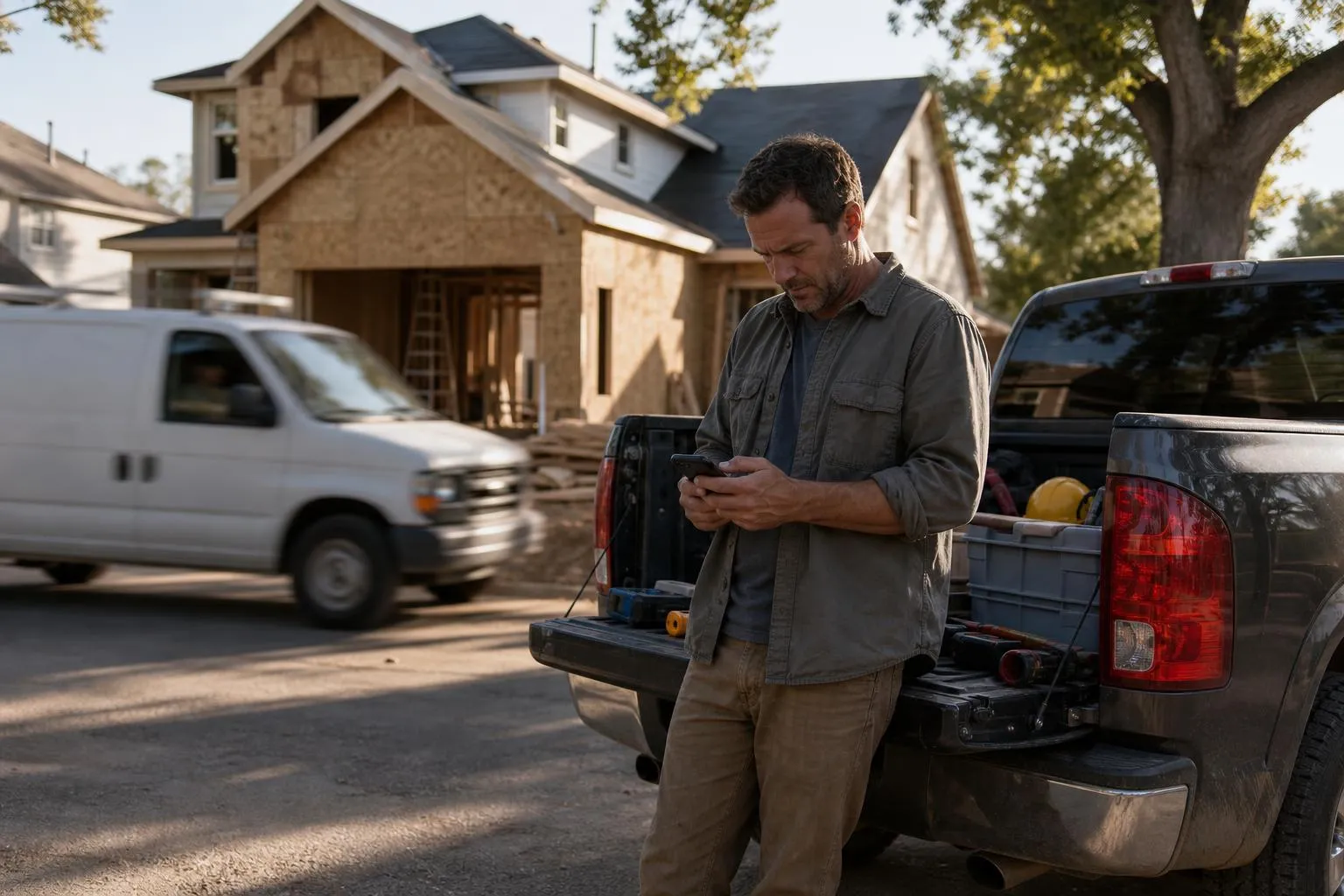
You’ve walked through his finished jobs. You’ve seen the mitered corners that don’t quite meet, the punch list nobody closed out, the change orders that ballooned past the estimate. You know your crew builds tighter, cleaner, and on schedule.
His calendar is booked eight months out anyway. His trucks are on three job sites in your town right now. This isn’t chance.
Here’s the part that stings: homeowners and developers don’t hire the best builder. They hire the builder who looks most like the safe bet during the first few minutes of research. Those are separate contests, and only one of them is something a prospect can actually judge from a phone.
A remodel buyer can’t judge your framing
Someone shopping a $200,000 kitchen and addition cannot tell whether your load calculations are right, whether your subs pull permits properly, or whether your punch-out actually gets closed. That’s buried in the walls, the schedule, and six months they haven’t lived through yet.
So they judge what they can see:
- How fast they found you and how the first page looked
- Whether your portfolio shows real, finished, photographed work, not phone snapshots
- License, insurance, and bonded status stated plainly, not implied
- Testimonials tied to actual project values, not vague five-star blurbs
- Whether the inquiry form feels like it’s for a $200,000 decision or a $20 one
None of that is craftsmanship. That’s the game your competitor is actually winning. Why your construction website isn’t landing projects covered the symptoms; this is what’s driving them.
The shortlist forms before you know it exists
In most metro service areas there are dozens of general contractors competing for a limited pool of six-figure remodels and builds each year. A serious prospect narrows that field fast: phone out, search “general contractor” plus their neighborhood, open two or three sites, scroll for maybe thirty seconds each, fill out one form. The whole vetting pass takes less time than a site walk.
You’re in that comparison whether you know it or not, and it’s unforgiving:
| What the prospect experiences | The number | Source |
|---|---|---|
| A page takes longer than 3 seconds to load | 53% of mobile visitors leave | Google mobile research |
| Every extra second of load time | Conversions drop about 4.4% | Portent |
| Load time grows from 1 to 10 seconds | Bounce probability climbs 123% | Google/SOASTA |
| Average small-business site on a phone | Loads in about 8.6 seconds | Industry benchmarks |
That’s nearly three times slower than the point where half your prospects have already left. If a competitor’s portfolio loads in two seconds with finished photos and a clear “Request a Consultation” button while yours is still rendering the hero image, the buyer doesn’t pause to wonder if your slowness means careful attention to detail. They just fill out his form. That’s how a slow site quietly bleeds project leads.
The expensive part: these are six-figure jobs
This isn’t a rounding error. Every kitchen gut, every second-story addition, every ground-up build in your area gets awarded to somebody. The only open question is whose crew shows up.
You’re not just losing revenue. Your market is losing its strongest builder on a shortlist where he’s invisible.
The good news: this closes in weeks, not a rebrand
You can’t out-history a decade of someone else’s referral network overnight. But the gap that costs you the most, the first-impression scroll, closes fast, because you already own the raw material.
Real proof. Your license, insurance, bonded status, finished project photos sitting in your phone, and testimonials from clients who’d gladly write one if asked. Most contractors have far more proof than their flashier competitor; it’s just not displayed. Putting it to work is the core of getting clients for a construction company.
A site built to convert a big decision. Fast on mobile, a portfolio organized by project type, financing and process explained, one clear next step. Not a brochure, a closer. What a converting contractor site actually does comes down to one rule: every section either builds trust or moves the prospect toward the form.
A clean local footprint. Your Google Business Profile, service-area pages, and reviews all reinforcing the same story.
The real question is who builds it:
Rebuilding the site yourself
- Cheapest upfront: DIY builders run $20-$50 a month
- Full control over every photo and word
- Start tonight, no vendor calls
Rebuilding the site yourself
- The true cost is your time: 40-60 hours learning a builder, worth $6,000-$9,000 at a contractor’s billable rate
- Generic templates aren’t built for a six-figure-decision buyer: portfolio structure, bonded badges, lead-time capture
- Half-finished DIY sites tend to stay half-finished once the next job starts
Win the shortlist you’re already qualified for
The contractor beating you isn’t building better. He’s presenting better. That’s fixable, and unlike him, you’ll have the work to back it up once the calls start coming your way again.
We build contractor websites designed to win exactly this first-impression contest: portfolio galleries that show the work, license and bonding front and center, forms that capture real project timelines, live in 7 days, done for you start to finish. Watch the free video walkthrough and compare it directly with what your prospects see when they land on your site today.
You own everything, changes go live within 24 hours, no contracts locking you in. If you want reviews, rankings, and updates handled after launch, that’s what our ongoing growth services cover. Stop letting a weaker builder win a contest you never actually entered.
Frequently asked questions
How can a worse contractor land more projects than a better one?
Because buyers can’t inspect framing, scheduling discipline, or how cleanly a punch list gets closed before they hire. They choose on visible signals: portfolio, license and bonding, site speed, ease of requesting a consultation. Whoever wins those signals wins the project regardless of who builds tighter.
Does the portfolio or the license info matter more?
They serve different purposes. License, insurance, and bonded status clear the trust bar; the portfolio and testimonials close the sale. A bonded contractor with four blurry photos still loses to a competitor with forty organized ones, so fix whichever is thinner first.
How fast can I close this gap?
Faster than most owners assume. Organizing a real photo gallery can happen in a weekend, and a purpose-built site can launch in 7 days. Outranking a decade of referrals takes longer, but the first-impression scroll that decides most shortlists is fixable this month.
What does a done-for-you construction website cost?
Standard runs $2399£1,899 one-time and the elite tier is $7500£5,900 one-time, both listed on the page. No contracts, changes go live within 24 hours, launch takes 7 days, and you own the site outright.
Should I just quote lower instead?
No. Many buyers award to a higher bid that simply looked more trustworthy online, so price isn’t the deciding factor you think it is. Undercutting yourself subsidizes a trust problem that a properly built site solves permanently.
Next in this series: If your construction company isn’t in Google’s top 3, you don’t exist
Your move
Reading this does not book a job.
The owners who pull ahead are the ones who change one thing this week. If you want that one thing to be a website that sells and ads that put it in front of the right people, we build and run both for you.
Straight answer on whether we can help, usually the same day.