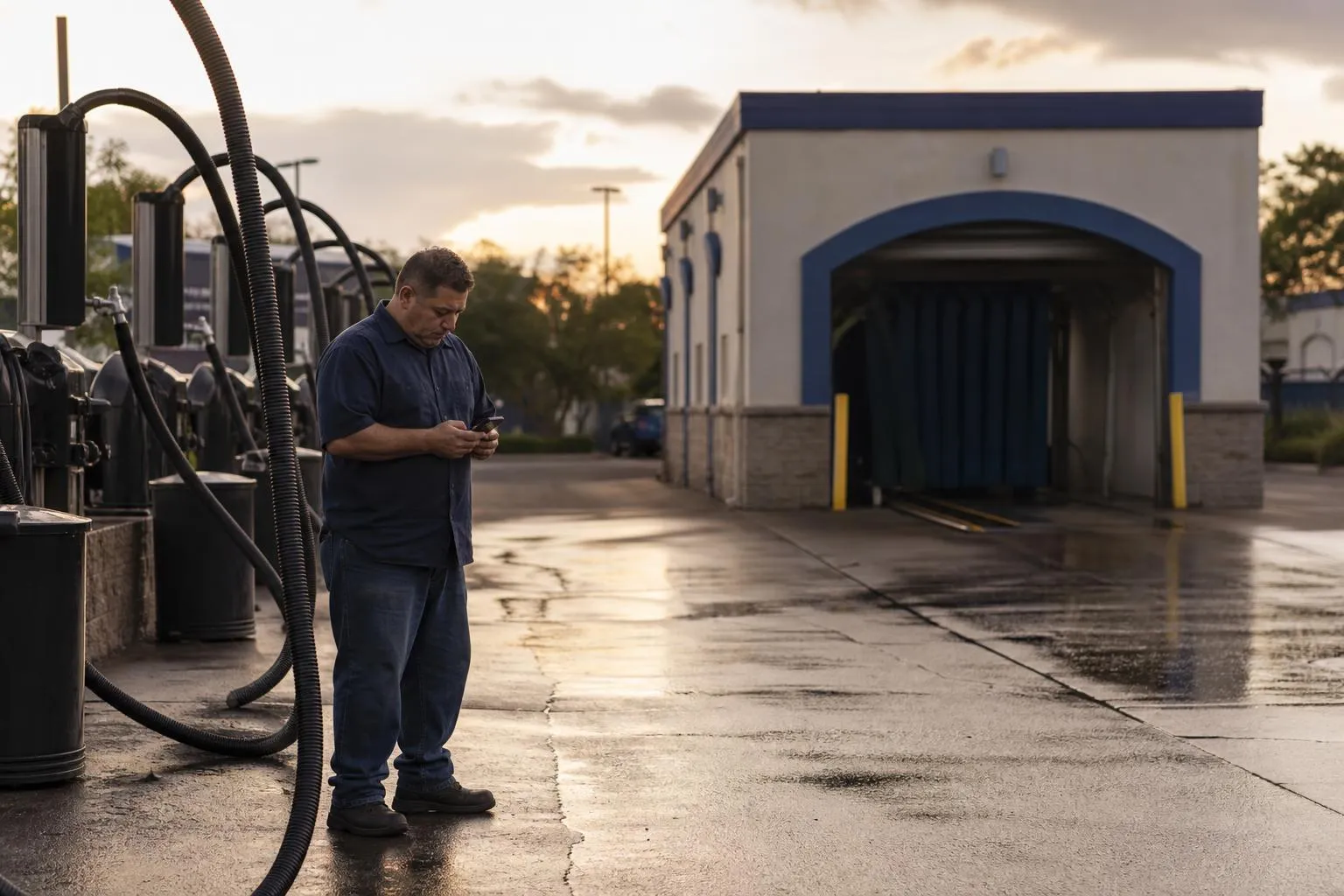
Your Car Wash Website Looks Fine on a Computer. Your Mobile Customers Are Deciding From the Driver's Seat

Monday, 7:55 a.m. A driver is stopped at a red light in a truck still caked in last weekend’s mud, a client meeting on the calendar in twenty minutes. She pulls up your name on her phone at the light, meaning to check if you have a plan worth signing up for before she becomes a regular.
This isn’t a flooded kitchen or a dead AC unit. Nobody’s in danger. But it’s still the moment your website was built for: a real customer, ready to commit, with about fifteen seconds of attention before the light turns green.
Here’s what happens on thousands of glances like this one. She taps your site. The page crawls. Half loaded, it’s a shrunken desktop layout: an eight-tier pricing grid built for a wide monitor, tiny text nobody can read at a glance, a “sign up” button that opens a form with a scroll bar. The light turns green. She drives off having learned nothing.
She never comes back to finish reading. Some other wash’s unlimited plan gets her card number instead.
You’ve never scanned your own pricing page in fifteen seconds
Here’s what keeps this failure invisible: you and your customers have never looked at the same website.
You reviewed the pricing table on an office monitor, probably with plenty of time to read every tier. It made sense. It still does, on that screen.
Your customers glance at it from a driver’s seat, at a red light, in a drive-thru line, where roughly 88% of local car wash searches happen on a phone. Not comparing spreadsheets: skimming for one number and one button before traffic moves. The research quantifies how little patience that glance allows.
| Mobile reality | The number |
|---|---|
| Visitors gone if the page takes over 3 seconds to load | 53% (Google) |
| Conversion lost per extra second of load time | about 4.4% (Portent) |
| Rise in bounce probability from a 1-second load to 10 | 123% (Google) |
| Average mobile page load time | 8.6 seconds |
The average page takes 8.6 seconds; the driver’s window of attention closes well under that. Most car wash sites, built around a wide pricing grid, live on the wrong side of that gap, which is why site speed gets its own breakdown later in this series.
So you see a professional-looking site and a subscriber count that isn’t growing, and never connect the two. There’s no alert when a driver bounces at a red light. It happens silently, dozens of times a day, on a version of your site you’ve never actually squinted at from behind a wheel.
The plan-curious driver is your least patient prospect
For most local businesses, a clumsy mobile site loses a browser. For a car wash, it loses the one thing that actually makes the business work: the recurring subscriber.
Your highest-value traffic isn’t the one-time $12 wash, it’s the driver deciding, right now, whether monthly unlimited is worth it. She hits your site on a phone with maybe fifteen seconds before she has to drive, park, or merge. This is the person closest to becoming your most profitable customer, and also the one least willing to decode an eight-option pricing grid. Someone who already loves your wash will forgive a clunky page. A first-timer at a red light will not. She’ll remember whichever wash’s site told her the price and the value in one glance.
The math adds up fast: at even a modest $25/month plan, a handful of lost sign-ups a week is real annual recurring revenue walking to a competitor because the page took too long to make sense. Even washes that rank in Google’s local top three still lose the sign-up when the page behind that ranking confuses a driver in a hurry.
What “built for the red light” actually means
A mobile-first car wash site isn’t the desktop pricing grid squeezed down. It’s built for someone with fifteen seconds and one thumb:
- Loads in a couple of seconds on cellular, not just your office router.
- One clear plan front and center, not eight tiers competing for attention. The best plan wins the glance.
- A tappable “start unlimited” button in the first screen, connected straight to Stripe checkout, not a multi-page form.
- The essentials above the fold: nearest location, hours, and proof: stars, review count, a real photo of the tunnel or bay.
- No decoration ahead of the sign-up. Autoplay video and rotating banners cut in front of the one action that matters and quietly wreck your conversion rate.
None of it is exotic. It’s a site designed around fifteen seconds at a red light instead of the owner’s unhurried office monitor.
Can you just simplify the pricing grid and call it done?
Sometimes. Rarely well. Here’s the honest trade.
Trimming the old pricing page for mobile
- Cheapest fix upfront: dropping a couple of confusing tiers costs nothing but a content edit.
- You keep the existing site and checkout flow you already paid for.
- Live the same day, no rebuild project.
Trimming the old pricing page for mobile
- The 8-second load usually survives the edit: the theme, image sizes, and script bloat causing it stay put.
- Sign-up still routes through a form built for a desktop, not a two-tap mobile checkout.
- You keep paying the invisible bill: at 53% abandonment, a trimmed-but-slow page loses the same red-light drivers the cluttered one did.
Trimming the grid helps the eye. It doesn’t fix the eight seconds it takes the page to even show up, and that’s what actually loses the sign-up.
The test that ends the guessing
Earlier in this series we made the case that your website isn’t broken, it’s just not doing its job. Mobile is where that gets obvious fast. The subscribers who found you anyway are on your books. The drivers your site lost never even got to the light where they’d have signed up.
Built for the driver with fifteen seconds and one thumb
We build car wash sites mobile-first: the driver at a red light is the design brief, and the desktop layout is the adaptation. One clear plan and a tap-to-subscribe button sit in the first screen, pages load in about a second on cellular, and location, hours, and reviews sit above the fold.
Watch the free video walkthrough of a live signup flow on an actual phone, next to yours. The gap explains itself in about two minutes. Once mobile finally converts drivers into subscribers instead of losing them at a red light, your recurring revenue compounds, which is what our ongoing growth services are built for.
Frequently asked questions
What does a mobile-first car wash website cost?
Our Standard build is $2399£1,899 one-time, and the Elite package is $7500£5,900 one-time, with pricing published on the get-website page. No contracts, you own everything, and it’s live within 7 days.
We already simplified our pricing tiers. Isn’t that enough?
Fewer tiers helps, but it doesn’t fix load speed or checkout friction. A site can show one clean plan and still take 7 to 9 seconds to load and route sign-up through a desktop-style form. Mobile-first fixes the speed and the tap count, not just the copy.
How many of our customers really decide on a phone?
Around 88% of local car wash searches happen on mobile, often within minutes of driving past a location. Check your analytics device report for pricing-page traffic: it typically runs 80% or higher mobile.
Will a faster mobile site actually grow our subscriber count?
Yes, indirectly and directly. Faster, clearer mobile pages convert more drive-by visitors into sign-ups, and Google’s mobile-first indexing means a faster mobile site also ranks better for “car wash near me” and “unlimited car wash [city],” which brings more of those drivers in the first place.
Next in this series: The trust tax: how an outdated website kills the referrals you already earned
Your move
Reading this does not book a job.
The owners who pull ahead are the ones who change one thing this week. If you want that one thing to be a website that sells and ads that put it in front of the right people, we build and run both for you.
Straight answer on whether we can help, usually the same day.