Your Car Wash Website Isn't Broken. It's Just Not Selling Memberships: 7 Signs It's Costing You Customers

Imagine a sign-up counter that never closes, standing right at your entrance around the clock, ready to pitch every driver on the unlimited plan. Now ask yourself how many of last month’s members actually signed up through it, on their own, without a staff member walking them through the form.
That counter is your website. It’s the first thing a driver checks before deciding whether to pull in, and if you’re honest, you probably can’t remember the last member it signed up unassisted. Nothing about it looks broken. The plans are listed. A price grid sits there somewhere. That’s exactly the problem: a site that quietly underperforms never forces you to fix it. Here are six signs yours already is.
You can’t name a member the site actually signed up
Sign 1: no online signup comes to mind from the past month. Not someone who mentioned the plan to an attendant and paid inside. A driver who found your site, compared the options, and subscribed on their own. If nobody comes to mind, the site isn’t converting washers into members, it’s just displaying a menu.
Sign 2: your own crew tells people to sign up inside instead of online. When a regular asks how the monthly plan works, does your attendant say “check the site,” or do they just wave them toward the kiosk because everyone knows the online flow is more trouble than it’s worth? If your own team routes around the site, customers will too.
Walk-up washes are covering for a site that isn’t selling the plan
Sign 3: most of your revenue is still one-time $12 washes instead of $25 to $35 monthly memberships. One-time washes keep the lights on, but they cap your revenue at whoever happens to drive by that day. A working site turns that same driver into recurring revenue, the kind that shows up whether or not they remember you exist next month. Getting customers for a car wash business covers the full acquisition picture, but the membership page is where a stranger becomes a subscriber.
A driver can’t sign up in five seconds
Sign 4: someone pulling up outside can’t see the plans and subscribe in a few taps. Open your own site the way a driver idling at the entrance would. Time it from landing on the page to a confirmed membership. If the comparison grid has eight confusing tiers, if Stripe checkout takes six fields, if there’s no single obvious “start unlimited” button, that driver just pays for the one-time wash and moves on.
The average visitor gives your page about 8.6 seconds before deciding whether to stay. A driver already in the queue isn’t going to study a pricing table; they need the decision made obvious immediately.
The site looks abandoned and gives no reason to trust it
Sign 5: the plans, hours, or locations on the site are out of date. A driver who shows up to a listed location that closed, or finds a price that changed months ago, doesn’t come back to check again. A stale site reads as neglected, and neglected doesn’t earn a recurring payment.
Sign 6: there’s no proof anywhere that builds confidence before checkout. A driver can’t test the wash quality from a photo, so they judge what’s visible: reviews, real photos of the tunnel or the bay, a clear cancel-anytime policy. Roughly 88% of people trust online reviews as much as a personal recommendation, so the wash showing 50 real Google reviews wins the signup over the one showing stock photos of a generic tunnel, which signals the opposite: nothing here has been vouched for.
You’ve never signed up on your own site the way a customer does
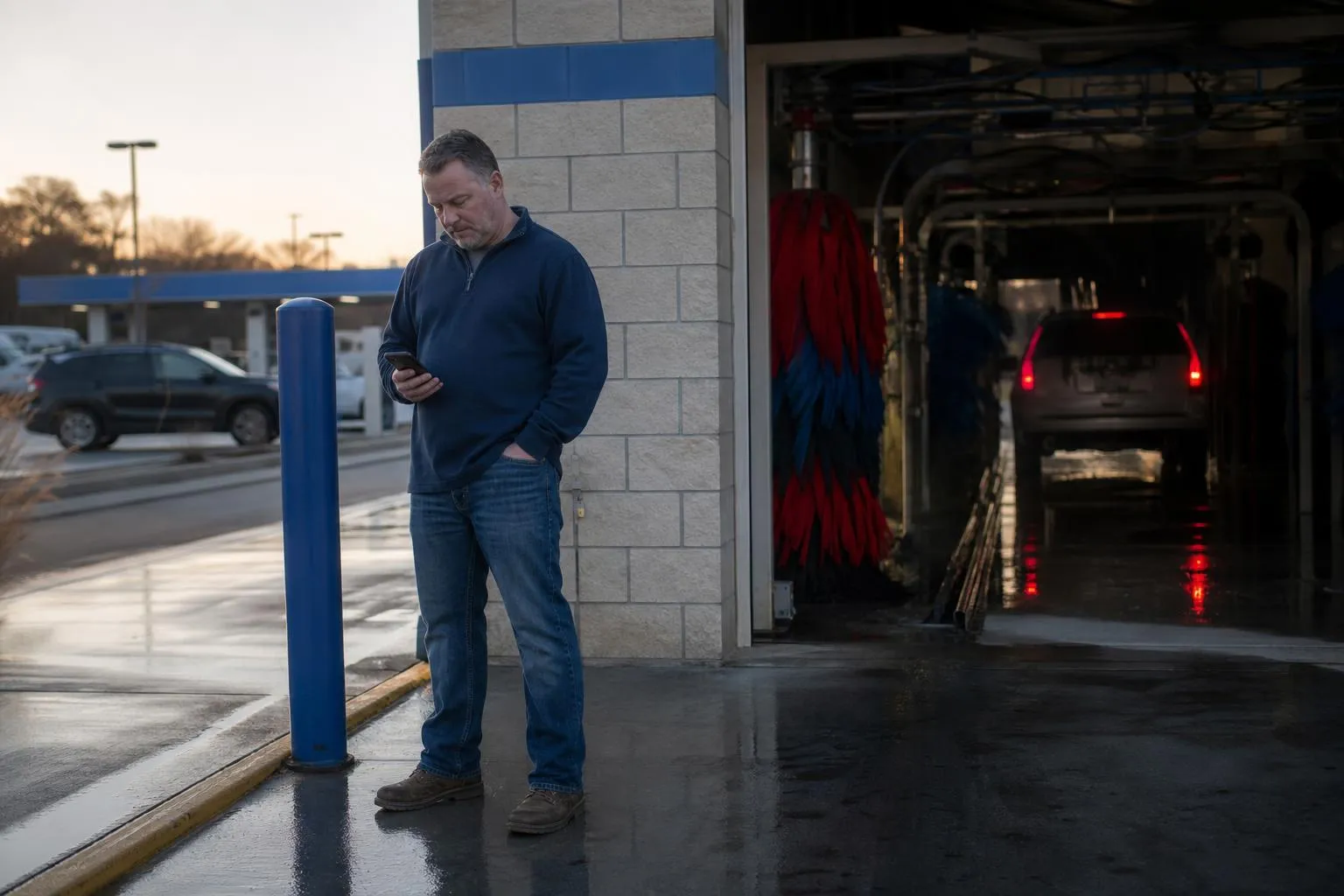
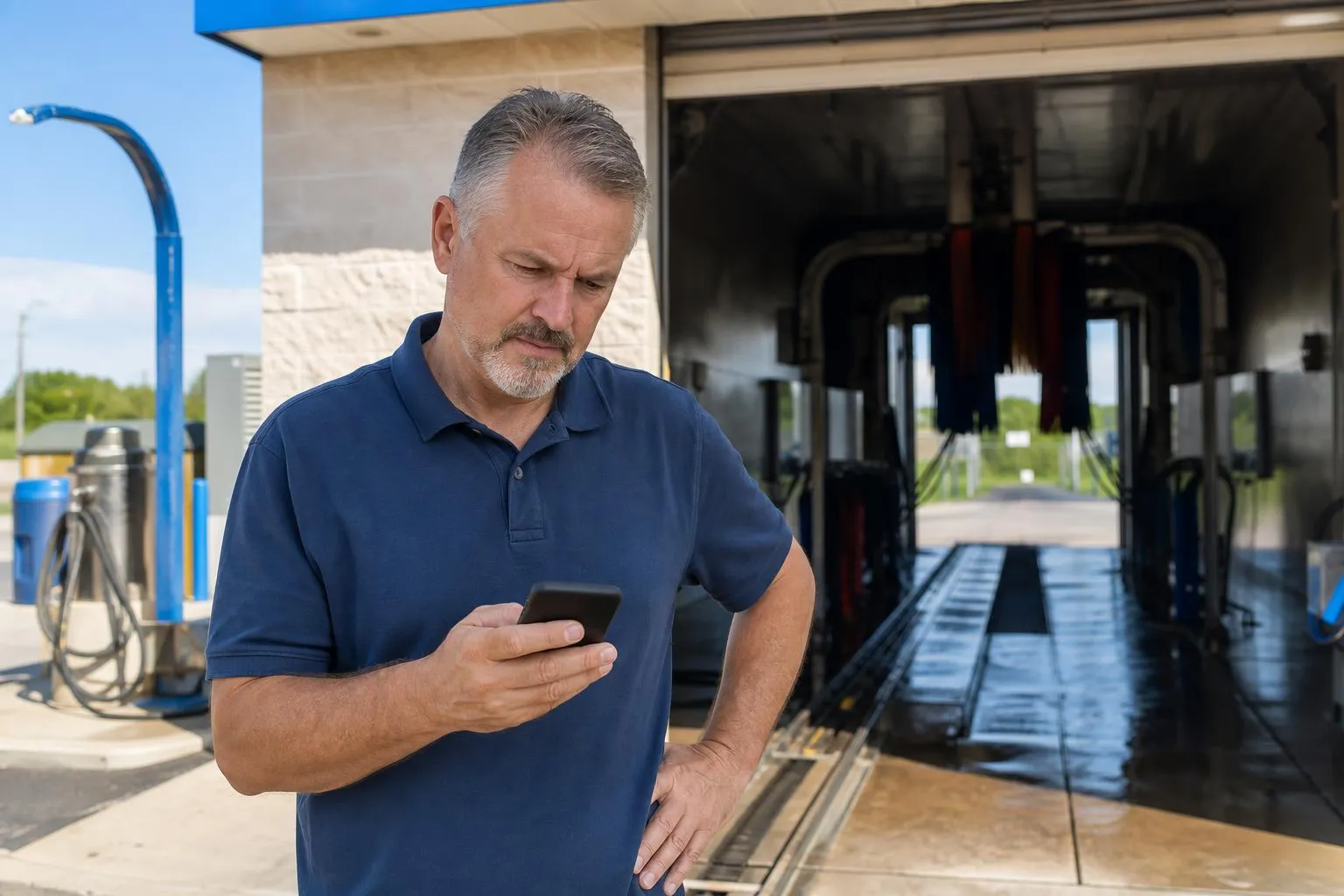
Sign 7: your customers decide on a phone, often mid-drive. Most membership decisions happen on mobile, glancing at a phone while idling at the entrance or comparing you to the wash across the street. If you’ve only ever checked the site on an office desktop, you and your customers are looking at two different products, and theirs decides whether they subscribe. That gap is worth its own read: how mobile customers actually use car wash websites.
Mobile is also where slow-loading plan pages lose the most members. The numbers are direct:
| Page load time | What it does to your visitors |
|---|---|
| Over 3 seconds | 53% of mobile visitors abandon the page (Google) |
| Each extra second from 0 to 5 | Conversions drop about 4.4% per second (Portent) |
| 1 second slips to 5 seconds | Bounce probability rises 90% (Google) |
| 1 second slips to 10 seconds | Bounce probability rises 123% (Google) |
If your membership page takes 7 seconds to load at the entrance, most drivers just pay the one-time price and drive off. How a slow car wash website loses customers breaks down exactly where those seconds go.
What a car wash site that actually converts does
None of this is about a flashier homepage. Flashy isn’t the job. A working car wash site does three things without fail: it ranks when locals search “car wash near me” (the fight for the Google top 3 map results), it makes the unlimited plan the obvious choice in seconds instead of one option among eight, and it turns a driver into a subscriber with a single tap through Stripe. That’s the whole spec. Rotating hero images and paragraphs about “the ultimate shine experience” are decoration.
So, patch the current site or replace it?
Patching the current site
- Cheap this month: a clear “start unlimited” button and Stripe checkout can go live within days
- You keep your URL and whatever local ranking it has already earned
- No rebuild disrupting signups during a busy season
Patching the current site
- An old builder caps your page speed no matter how much you trim
- The mobile checkout flow is fixed in place, and that’s where most decisions happen
- Every fix still runs through whoever built the original site, on their schedule
- You keep paying hosting fees on an asset that keeps losing subscribers to a confusing price grid
The gap between a price list and a real growth engine doesn’t show up from the outside, which is why plenty of solid operators sit on an underperforming site for years without noticing. It shows up in one place: how many drivers subscribe online before they even pull up to the entrance. If two or more of these signs sounded familiar, take ten minutes and watch the free video walkthrough of a live car wash site built to convert: one-tap Stripe signup, plan comparison that actually clarifies instead of confuses, done for you start to finish, live in 7 days, and you own it outright. Pricing is posted, no contracts required. Once signups pick up, ongoing growth services can push the volume further.
Frequently asked questions
How do I know if my car wash website is actually costing me members?
Count online signups, not page views. If you can’t name one customer in the last 30 days who subscribed through the site without an attendant walking them through it, the site isn’t producing. Track it for two weeks and the pattern becomes obvious.
Can’t I just keep signing people up in person?
In-person signups should stay part of the mix, but they only capture the drivers who already stopped and asked. A working site captures the ones comparing you to the wash down the street before they ever pull in.
How much does a car wash website that actually converts cost?
The Standard build is $2399£1,899 one-time, and the Elite package is $7500£5,900 one-time, pricing posted openly with no contracts. Launch takes 7 days, and you own everything outright.
Should I fix my current site or replace it?
If the plan structure is solid and the bones are decent, simplify the pricing grid and add real reviews this week. If it fails the 3-second phone test and checkout takes six fields, patching is paying rent on a dead asset.
Next in this series: why the worse car wash across town keeps winning the customers you deserve
Your move
Reading this does not book a job.
The owners who pull ahead are the ones who change one thing this week. If you want that one thing to be a website that sells and ads that put it in front of the right people, we build and run both for you.
Straight answer on whether we can help, usually the same day.