How to Start a Pest Control Business Step by Step
The order you do things in decides whether your launch takes three months or nine. Most people starting a pest control business get the sequence exactly wrong: they buy a truck and a logo first, then discover the applicator license they can’t legally spray without takes months to earn. The license is the long pole, so it goes first, on day one, while everything cheaper and faster happens alongside it. Do it in the right order and you’re spraying paid accounts inside a season. Here is that sequence, start to first recurring customer.
Step 1: Start the applicator license the very first day
Nothing else matters if you can’t legally treat. Every state requires a commercial pesticide applicator license (or certified applicator + business license), issued by the state department of agriculture, and it’s the slowest thing on the list. You’ll study a general standards manual plus category modules (usually “general household pest” and often “termite/wood-destroying organism” separately), pass a state exam, and in many states log supervised hours or hold a set amount of experience first. Start to finish this runs two to six months depending on the state, so the day you decide to do this, order the study manuals and book the exam window. Everything below happens while you study.
Step 2: Form the entity and get your tax IDs
While the license processes, stand up the business. Form an LLC with your secretary of state ($50 to $500 depending on the state) so a liability claim can’t reach your house, then get a free EIN on irs.gov in about ten minutes. The EIN unlocks a business bank account, a business credit card for chemical purchases, and your insurance and supplier applications. Keep the money separate from day one, the LLC only shields you if you actually run it as its own company. The full paperwork walkthrough lives in how to set up and register a pest control business.
Step 3: Bind insurance before you buy chemicals
General liability is the non-negotiable policy, running roughly $1,500 to $3,000 a year for a new owner-operator, and many states require it on file for your business license. Add commercial auto on the service vehicle ($1,200 to $2,500), and once you hire your first W-2 tech, workers comp becomes mandatory in nearly every state. If you handle termite/WDO work, expect carriers to ask about it specifically because of the higher claim severity. Pick an agent who can issue a certificate of insurance the same day, because property managers and commercial accounts will demand a COI naming them before they’ll sign.
Step 4: Buy the working kit, not the warehouse
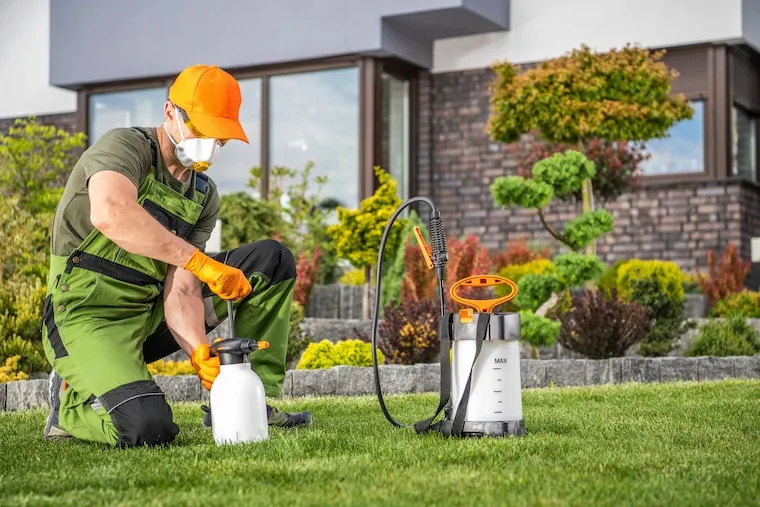
You need far less gear than you think. The owner-operator starter kit is a reliable used truck or van, a B&G or Chapin sprayer, a granule spreader, a bait gun, a dust applicator, a moisture meter and telescoping pole for inspections, PPE (respirator, gloves, eye protection), and a starter chemical shelf from a distributor like Veseris (formerly Univar) or DoMyOwn. That’s a working business, not a $150k buildout. The full purchasing list is in buying equipment and supplies for pest control, and if cash is tight, starting with little or no money shows what to defer.
| Step | Do it when | Typical cost | Why the order |
|---|---|---|---|
| 1. Applicator license | Day 1 (2 to 6 mo to earn) | $150 to $600 exams/manuals | Long pole; can’t legally spray without it |
| 2. LLC + EIN | Week 1 | $50 to $500 | Gates the bank account and insurance |
| 3. General liability + auto | Weeks 1 to 3 | $2,700 to $5,500/yr | State license often requires it on file |
| 4. Truck + sprayer + chemicals | While studying | $8,000 to $18,000 | Useless until licensed, so buy last |
| 5. Website + Google Business Profile | Weeks 2 to 6 | $0 to $3,000 | Needs to be live before you advertise |
| 6. First leads + first jobs | On license approval | Ad budget varies | Only legal once 1 to 3 are done |
Step 5: Get found before you’re licensed, so day one has a pipeline
The single biggest mistake new operators make is waiting until the license clears to think about marketing, then sitting by a silent phone. Build the demand engine while you study. Claim and fully complete your Google Business Profile (free, and the number-one local lead source for pest control), get a fast website live, and line up your first reviews from friends, family, and any pre-launch free treatments you can legally do for practice on your own or a relative’s property. That way the week your license posts, you flip on advertising into a business that already looks established. The lead playbook is in how to get clients and customers and promoting pest control locally.
Step 6: Sell recurring plans from your very first quote
Here’s the decision that determines whether you build a business or a treadmill: one-off sprays versus recurring quarterly plans. A one-off job pays once and you have to re-earn every customer forever. A quarterly plan (typically $40 to $75 a visit, billed 4x a year or monthly) turns one closed sale into predictable revenue for years and is what makes a pest control company actually worth something when you sell it.
One-off treatments vs recurring quarterly plans
- Immediate cash: a single ant job might bill $150 to $300 today with no commitment.
- Simpler to sell to a panic customer who just wants the roaches gone now.
- No scheduling obligation, so you’re not locked into routes while you’re still learning.
One-off treatments vs recurring quarterly plans
- You re-earn every customer from zero, so marketing cost never stops climbing.
- No predictable revenue, so every slow week is a genuine cash scare.
- A book of one-offs has almost no resale value; a book of recurring accounts sells for a multiple of revenue.
The rule: offer the one-off to solve the emergency, then convert it on the spot to a quarterly plan with the first-visit discount baked in. The customer who called about roaches becomes a $200-a-year recurring account, and doing that from day one is the whole difference. How to operate that book once it grows is covered in how to successfully run a pest control company.
A worked example: the 90-day launch that opened with 12 recurring accounts
Getting found is the part that decides everything
You can nail every step above and still stall if the phone doesn’t ring the week your license clears. Two free moves to make while you study: fully complete your Google Business Profile (photos, service list, hours, service area), and collect a pre-launch waitlist from local Facebook and Nextdoor groups so day one isn’t a cold start.
The high-stakes part is the website and the ads. A new operator with a slow, generic site loses the searching homeowner to the established competitor, and ad budget spent without a converting page and tracking is money set on fire. The gap between a launch that opens booked and one that opens silent is mostly the quality of the demand engine, and that’s the work we do. To have the site handled instead of guessed at, get a free video walkthrough. For ads and local SEO run properly from day one, see our services. If you have the company idea but not the business plan yet, start at expntl.com. And for the money side of the decision, how much you need to start breaks down the numbers.
Frequently asked questions
What’s the very first thing I should do to start a pest control business?
Start the pesticide applicator license, because it’s the longest step (two to six months) and you legally cannot treat without it. Order the study manuals and book the exam window on day one, then do everything else, entity, insurance, gear, marketing, while you study. Getting the sequence right, slow thing first, is what turns a nine-month launch into a three-month one.
How much does it cost to start a pest control business?
A lean owner-operator launch runs roughly $10k to $25k: exam and license fees, LLC filing, first insurance installments, a used truck or van, a B&G sprayer and applicators, a starter chemical shelf, and a website. You don’t need a warehouse, a fleet, or employees to begin. The full breakdown is in how much you need to start a pest control business.
Do I need a license to start, or can I begin and get it later?
You must have it before you take a single paid job. Applying pesticides commercially without a license is a violation your state department of agriculture enforces, with fines commonly $1,000 to $5,000 per incident. The workaround isn’t skipping it; it’s starting the license on day one and building the entity, insurance, gear, and marketing pipeline during the months it takes to earn.
What equipment do I actually need on day one?
A reliable truck or van, a B&G or Chapin sprayer, a granule spreader, a bait gun, a dust applicator, an inspection kit (moisture meter, telescoping pole, flashlight), and PPE, plus a starter chemical shelf from a distributor like Veseris or DoMyOwn. That’s a real business. Add specialty gear like termite rigs as those jobs come in; the full list is in buying equipment and supplies.
How soon can I actually make money?
If you sequence it right, you can be treating paid accounts the same month your license clears, often within three to four months of starting, provided you built a Google Business Profile, a website, and a pre-launch waitlist during the study period. Operators who wait until the license is in hand to start marketing typically don’t book their first job until months later, because demand takes time to build.
Your move
Reading this does not book a job.
The owners who pull ahead are the ones who change one thing this week. If you want that one thing to be a website that sells and ads that put it in front of the right people, we build and run both for you.
Straight answer on whether we can help, usually the same day.