When and How to Hire and Train Staff for HVAC
Hiring the first HVAC tech is the single most stressful move a solo operator makes. Hire too early and cash flow tanks. Hire too late and you’re turning down 8 calls a week, burning out, and missing the growth window. Here’s the signal to hire, who to look for, where to find them, and how to train them so they stick past 90 days.
When to Hire the First Tech
There’s no magic revenue number. The signal is operational, not financial.
- You’re turning down 8+ qualifying service calls per week for 3 consecutive months. Not random weeks, sustained.
- You’re working 55+ hour weeks and skipping invoicing/marketing. The backlog is showing in your books.
- You have $20k-$35k of cash reserves. Enough to cover 60 days of payroll if the new tech ramps slowly.
- You’re in peak season (cooling May-September, heating October-February). Hire 60-90 days before peak so they’re ramped when calls explode.
- Your maintenance plan base is over 80 plans. Recurring revenue underwrites payroll on slow weeks.
Hire too early without these signals and you’ll burn through cash. Wait too long and you’ll lose your best customers to faster competitors. See how to grow.
A turned-down call is not one lost ticket; it is usually a lost household. The caller you decline in July books with a competitor, joins that competitor’s maintenance plan in September, and buys their $11,000 replacement three years later. Over a decade, a retained HVAC household is worth $8,000-15,000 across service calls, plan revenue, and one changeout. Eight declined calls a week is eight households a week handed to the shop across town, which is why the hiring trigger is operational volume, not a revenue milestone.
The 80-plan threshold earns its place on that list because plans underwrite the scary part of payroll: the quiet weeks. A new tech’s wage is due every Friday whether the phone rings or not. Eighty auto-charged members at $15-35/mo is $1,200-2,800 of revenue that arrives no matter what, plus a tune-up backlog you can schedule into any slow day of the ramp. The plan base converts “I hope we stay busy” into a payroll floor.
Who to Hire First and Where to Find Them
Service tech first, not CSR, not dispatcher. Your bottleneck is hands, not phones. Specifically:
| Hire profile | Base pay | Runs calls solo | The catch |
|---|---|---|---|
| Apprentice or 2nd-year tech you train up | $18-26/hr | In 6-12 months | Slowest ramp; your training hours are the real cost |
| Mid-level service tech (3-7 years) | $26-38/hr | In 30-60 days | Arrives with the last shop’s habits, good and bad |
| Senior tech with replacement experience | $35-48/hr + spiff | Immediately, including changeout quotes and installs | Highest cost, and the best ones want a path up |
The senior tier looks expensive until you price what it unlocks: a tech who can quote and install changeouts pays the wage premium back fast in install revenue. The apprentice looks cheap until you count your own hours riding along for a year. Most first hires should be the middle row.
Where to find them:
- Trade schools. Lincoln Tech, ITT, local community college HVAC programs. Best for apprentices. Build relationships with instructors who refer.
- ESCO Institute. Apprentice pathway listings, certified curriculum, registry of certified techs.
- Indeed and ZipRecruiter. $300-$700 for a 30-day featured listing. Aggressive applicant flow but variable quality.
- Facebook trade groups + local HVAC subreddit. Slow but high-quality referrals from techs who know the local talent pool.
- Your existing customer base. “Anyone know a tech looking for a new shop?” SMS campaign. Top-1% leads.
- Instagram and TikTok. Young techs follow shops with good content. See Instagram strategy.
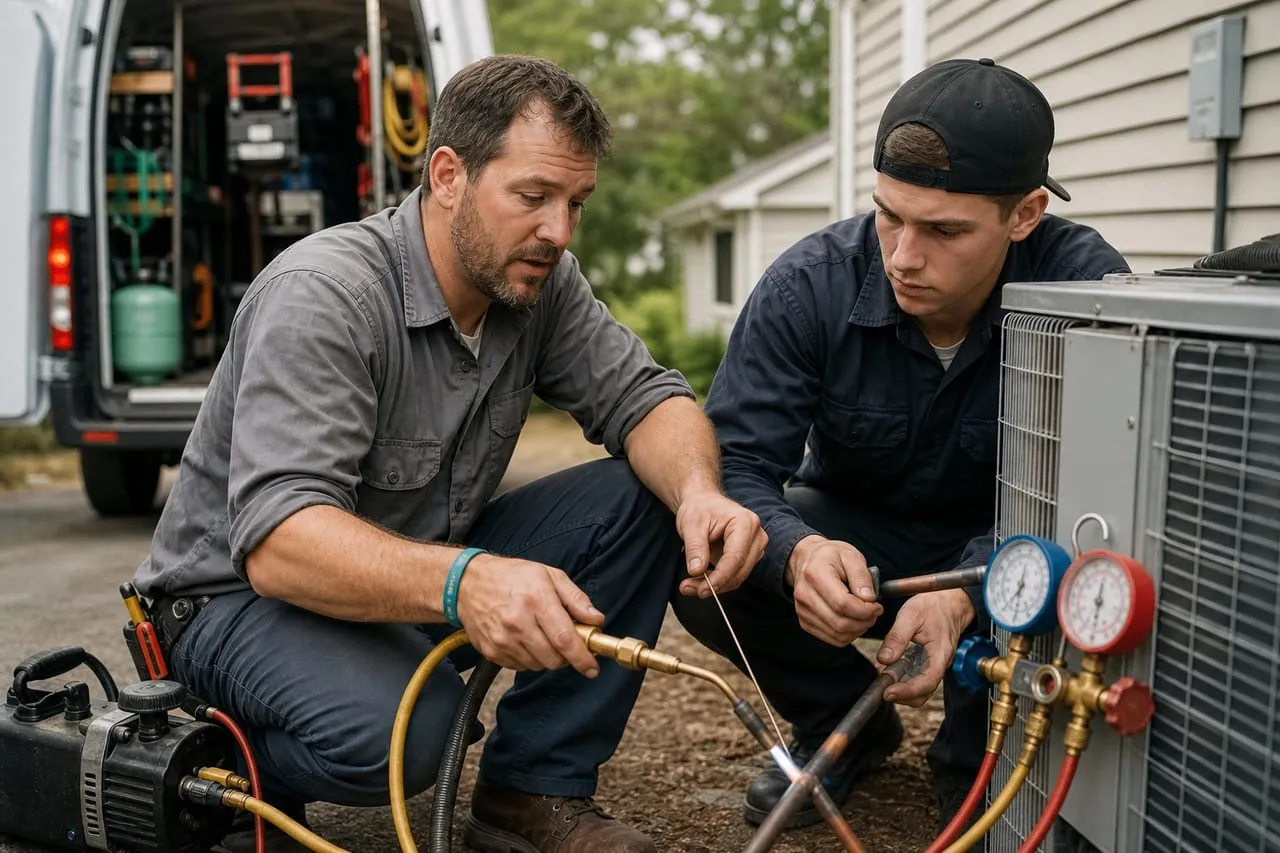
Vet via phone screen (15 min) → in-truck ride-along (4-8 hours, paid) → reference check. Skip the ride-along and you’ll hire someone who can’t braze.
The channels produce different failure modes, so run two at once. Job boards produce volume with a high noise floor: expect 30 applicants, 5 worth a phone screen, 1 worth a ride-along. The network channels (customer SMS, trade groups, the counter guys at Ferguson and Johnstone, who always know which good tech is unhappy where he is) arrive pre-filtered but slowly. Post the listing for flow and work the network for quality, because an empty second van costs you more per month than the listing fee costs once.
Pay Structure and Training Program
Base wage + performance spiff is the standard structure. Pure hourly without spiff doesn’t motivate. Pure commission scares good techs away.
- Base hourly. $25-$40/hr depending on experience and market. Pay for drive time too.
- Maintenance plan spiff. $5 per plan sold.
- IAQ add-on spiff. $30-$80 per UV light, dehumidifier, or filter upgrade closed.
- Replacement spiff. 3-5% commission on full ticket they lead-generated.
- Benefits. Health insurance ($500-$900/mo employer share), 1 week PTO year 1, 401(k) match year 2.
- Vehicle. Provided van + fuel card (Wex), or $500/mo vehicle allowance.
Training program for first 30 days:
- Days 1-3. Paperwork, software (Housecall Pro/ServiceTitan), price book familiarization, safety review, lockout/tagout, EPA 608 verification.
- Days 4-14. In-truck with you. They watch, then run small tasks under supervision.
- Days 15-30. They run calls with you nearby for backup. Daily debriefs on each call.
- Day 31. Solo on simple service calls. You handle replacements.
- Month 2-3. Gradually expand scope. Track callback rate, average ticket, plan conversion.
Callback rate is the quality metric. Under 5% is a keeper. Over 10% means more training or it’s not working out. See how to successfully run.
One pay-structure note the bullets above hide: the spiffs are alignment, not generosity. The tech is the person standing in the homeowner’s kitchen at the exact moment a maintenance plan can be sold, and a $5 spiff is the cheapest plan acquisition cost you will ever pay. The same logic caps the replacement commission at 3-5%: enough to reward the lead, not enough to turn your service tech into a pushy closer whose callbacks you inherit.
What the First Hire Does to Your Numbers
A solo operator personally earning $90k-170k a year has hit the ceiling of one set of hands. The first tech is the move toward 2-van economics: $45k-90k a month in revenue with $14k-28k of monthly profit once both trucks are productive. But the transition months look worse before they look better: your income dips while you fund the ramp, and your own billable hours drop because you are now also a trainer, dispatcher, and quality controller. Plan to cut your own call load about 20% during the ramp on purpose. The owner who keeps running eight calls a day while “managing” a new hire trains nobody and ends up redoing both jobs. The full math is in how much profit an HVAC business can make.
The other number to manage is the one in the FAQ below: 30-40% of first-year techs wash out, and most of that churn is self-inflicted by the shop. Techs rarely quit over a dollar an hour; they quit broken trucks, parts chaos, surprise Saturdays, and silence about their future. The retention tools are operational: a par-stocked van, a published on-call rotation, and a visible ladder (tech, lead tech, senior tech) with a wage number attached to each rung. Fix those and the pay conversation gets much easier.
Frequently asked questions
Should I hire a CSR or dispatcher before a second tech?
No. Service tech first, always. CSR makes sense at 2-3 vans when you literally can’t answer the phone fast enough. Until then, use a call-answering service like Smith.ai ($150-$400/mo).
What if my new tech leaves after 6 months?
Turnover is real in HVAC. Plan for it: 30-40% of first-year techs don’t stick. Mitigate with culture (real Christmas bonus, paid training, working van), competitive pay, and clear growth path. Document everything so the next hire ramps faster.
Should I make techs sign a non-compete?
Non-competes are largely unenforceable in 2026 (FTC rule). What matters more is a non-solicit clause (can’t take your customers) and a confidentiality clause. Talk to a local business attorney. See how to register.
How do I keep good techs from leaving for a bigger shop?
Pay competitively, give them clean trucks with stocked parts, fix problems they report, and offer growth (lead tech, senior tech, foreman). The trades industry retention problem is mostly broken management, not money. See how to get clients for revenue context.