Buying Equipment and Supplies for HVAC Business
The first $12k-$18k of tools makes or breaks your margin for the first two years. Buy junk and you’ll be doing a $400 repair with a $2,000 callback. Buy right and a single capacitor swap pays for your tool of the week. This is what actually goes in the van.
The Van and What Goes On It
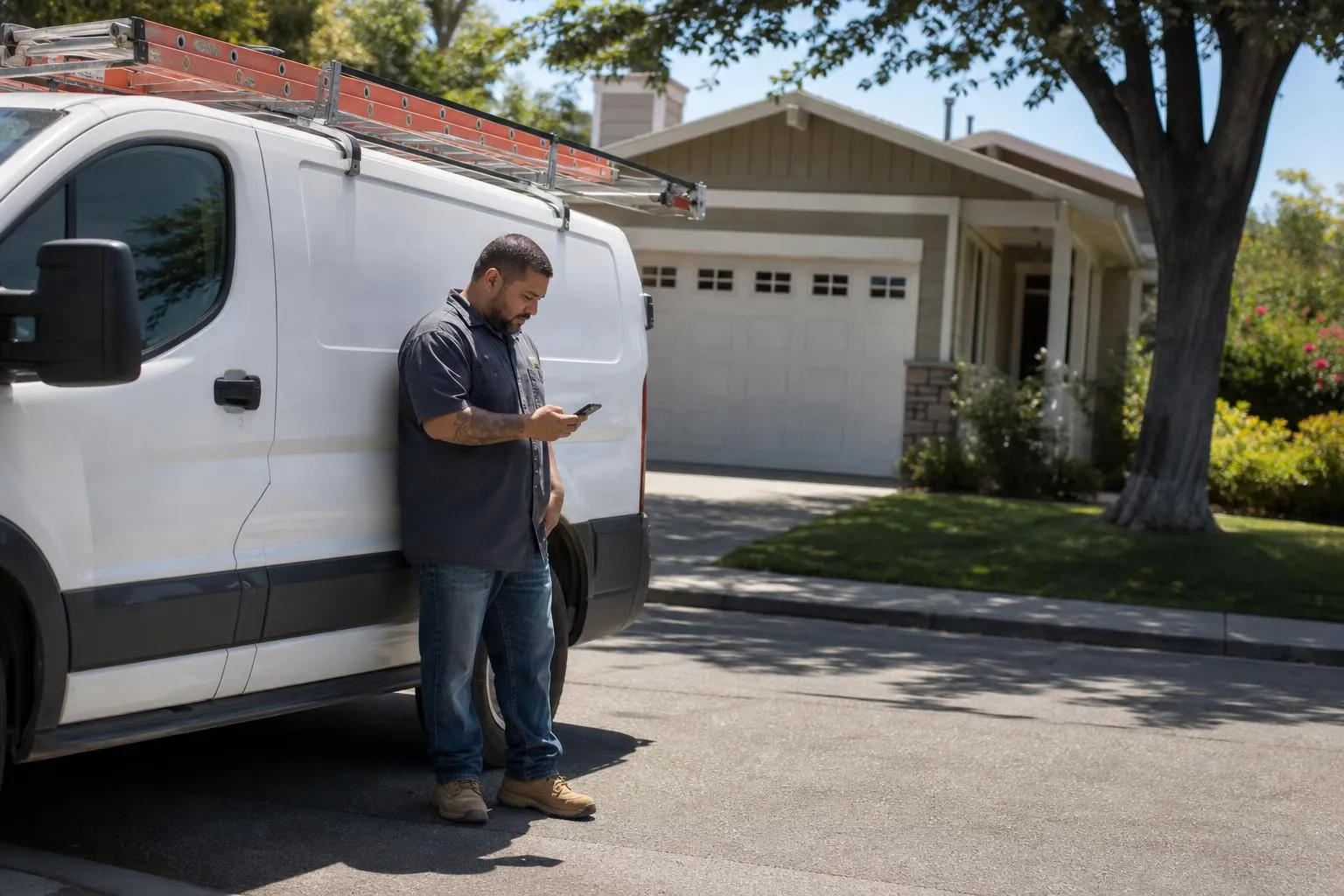
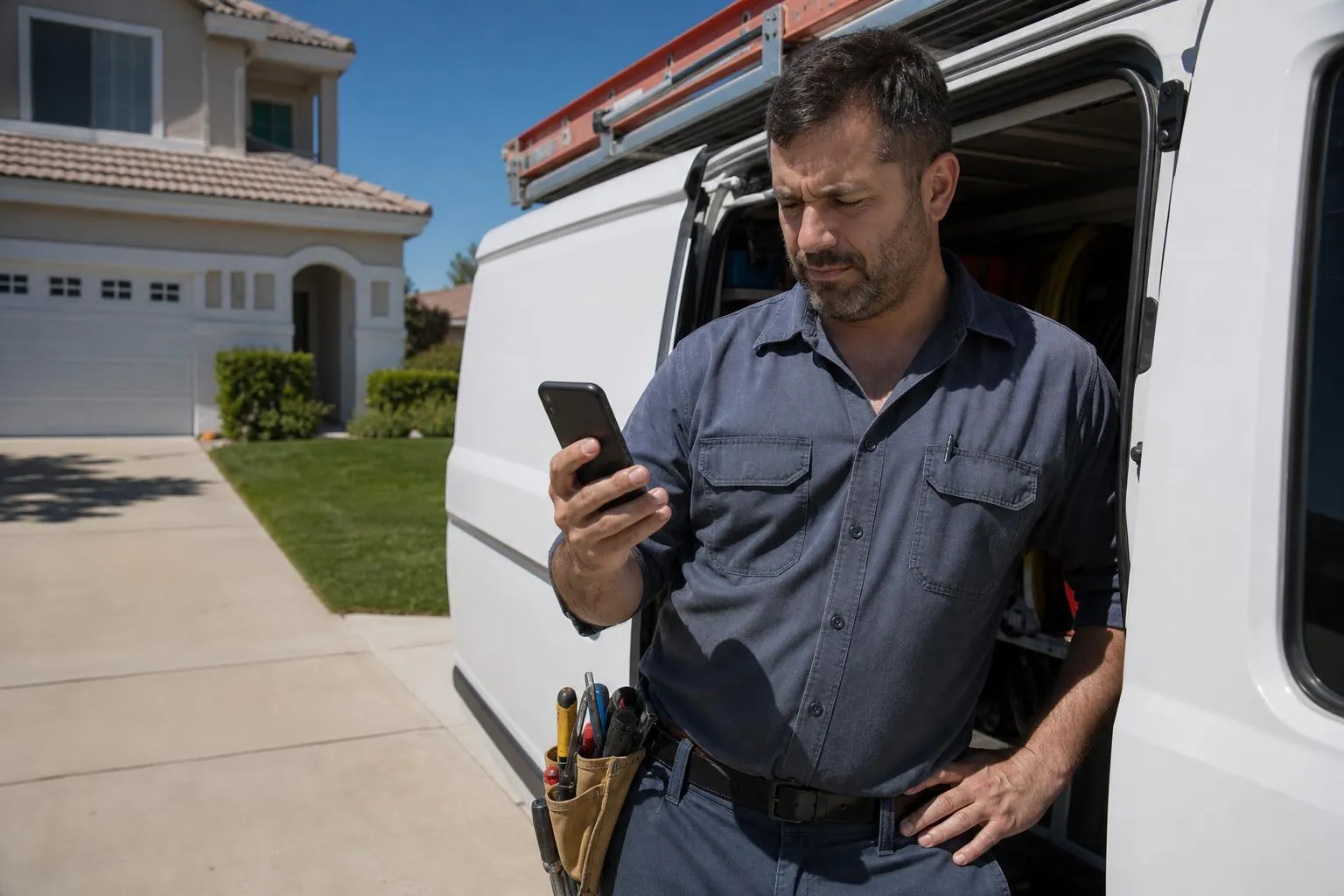
Your van is your shop, your billboard, and 30% of your customers’ first impression. Pick something you can stand up in if you’re over 5’10”. Sprinter and Transit are the two real options. Promaster works but resale is rough.
- Ford Transit 250 Medium Roof, 148” wheelbase. $8k-$15k used with 100k miles. Best parts availability, cheapest service.
- Mercedes Sprinter 2500. $15k-$25k used. Longer life but expensive when something breaks.
- Shelving. Adrian Steel or Ranger Design package, $1,800-$3,500 installed. Bins labeled by part category, not by job.
- Wrap or vinyl lettering. $2,500-$4,500 for a full wrap, $400-$800 for door + back-window lettering. Either way, phone number must be readable from 50 feet.
Lock-box your refrigerant. R-410A theft from work vans is a real problem in 2026 prices.
Treat the van choice as a downtime calculation, not a style choice. When a Transit breaks, the parts are at any Ford dealer and most independent shops will touch it, so you lose a day. When a Sprinter breaks, you can wait a week for parts and a diesel specialist, and a week of a booked HVAC van is $3,000-$5,000 of cancelled work. That argument matters more than the purchase price, which is also why the new-versus-used question deserves an honest look.
Buying the van new: pros
- Warranty covers the drivetrain through your busiest years
- No surprise $4,000 transmission failure in month one
- Easier to finance at sane rates than a 120k-mile auction unit
Buying the van new: cons
- $35k-$50k tied up in an asset that books zero extra calls
- First-year depreciation alone is $6k-$8k you never get back
- Saving up for it delays your opening by months of lost revenue
The middle path most owners land on: a 80k-120k mile Transit from a fleet sale, a $200 pre-purchase inspection, and $1,000-$1,500 of immediate maintenance (brakes, fluids, tires) so the van starts its service life with a known baseline. Budget context for where the van sits in the whole launch is in how much you need to start.
Gauges, Recovery, Pump, and Brazing
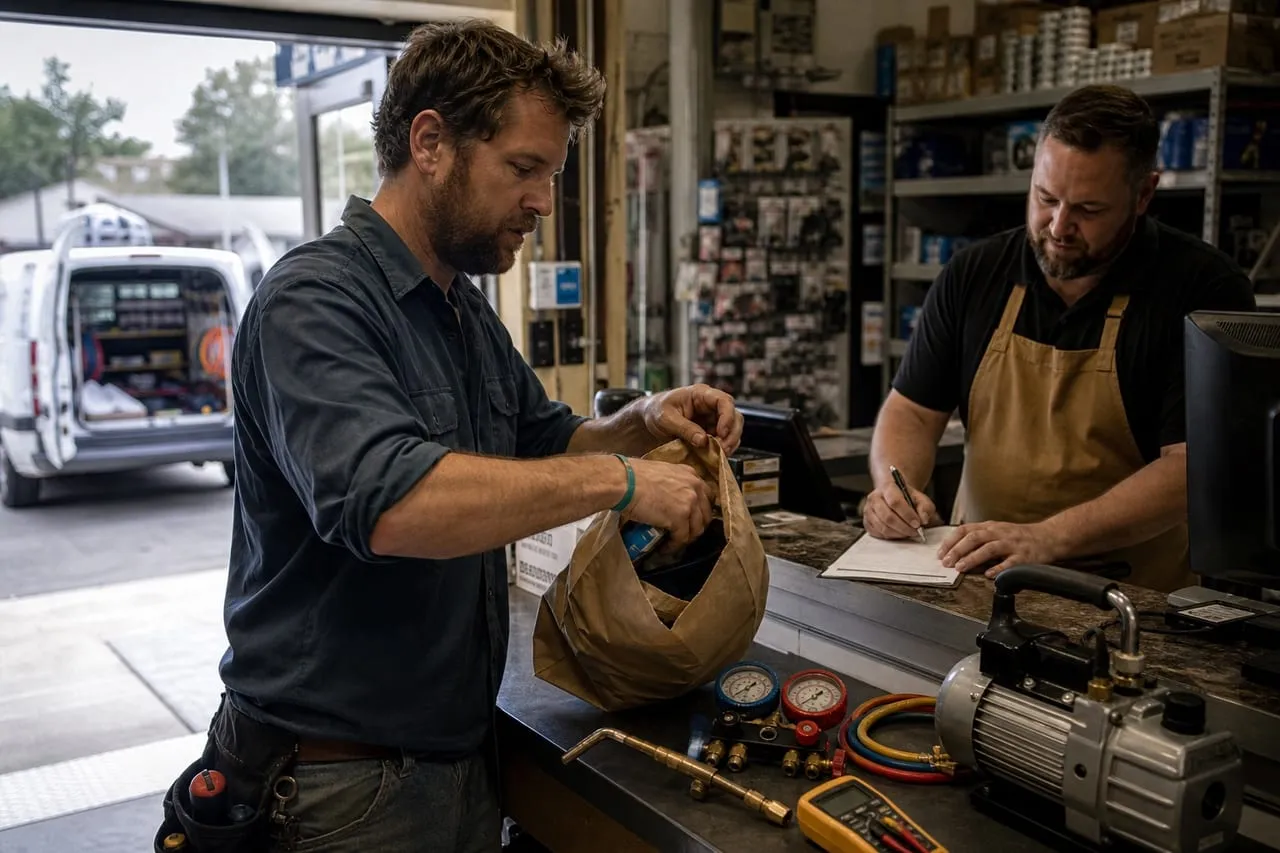
These four buys do 90% of the technical work. Cheap out anywhere here and you pay for it in callbacks.
| Tool | Standard pick | Alternative |
|---|---|---|
| Digital manifold | Fieldpiece SMAN460, $600 | Yellow Jacket Mantooth wireless, $450 |
| Recovery machine | Appion G5Twin, $1,100 | RobinAir 25201, $950 (budget pick) |
| Vacuum pump | JB DV-200N 2-stage 7 CFM, $350 | Yellow Jacket BV200, $420 |
| Micron gauge | Fieldpiece MG44, $200 | none, this one is mandatory |
| Brazing kit | Turbotorch X-4B with B-tank, $350 | plus nitrogen regulator + 80 cu ft tank, $300 |
| Leak detector | Fieldpiece DR58, $350 | Inficon D-TEK Stratus, $800 (A2L-ready) |
Two practices this gear exists to enforce: pull every system to 500 microns or below and prove it on the micron gauge, and never braze without a nitrogen purge, because the scale it prevents is exactly what destroys compressors and produces the $2,000 callback this article opened with. Either one recovers a 3-ton system or pulls a deep vacuum in about 20 minutes when the equipment is good. When it is worn out, the same job takes an hour you cannot bill for.
A callback is never just a free repair. It is fuel, two unbillable hours, a customer who now doubts you, and a public review risk, all triggered to save $150 on a pump. That math is why the rule is asymmetric: the tools that touch refrigerant circuits get bought new and name-brand, while everything that just turns screws can come from the used market. For pricing strategy on the labor you run over these tools, see setting prices and billing.
What to Buy New and What to Buy Used
The used market is full of nearly-new Fieldpiece and Yellow Jacket gear from techs who left the trade, and a low-hour digital manifold at 60% of retail is a genuinely good buy. The discipline is knowing which categories are safe. Hand tools, ladders, sheet metal tools, and cordless platforms are safe used. Gauges are fine used if they zero out and hold calibration. Recovery machines and vacuum pumps are not: a recovery unit with cross-contaminated oil or a pump that will not pull below 1,000 microns fails you on the job, where it is most expensive to find out.
Truck Stock That Closes Calls Same-Day
Parts on the truck means you collect today. Parts ordered means you come back next week and pray they’re still home.
- Capacitors. 35/5, 40/5, 45/5, 50/5, 55/5, 60/5, 70/5 dual-run. Two of each.
- Contactors. 1-pole and 2-pole 30A and 40A.
- Common motors. Universal condenser fan 1/4 HP, 1/3 HP. Blower motor X13 replacements (Genteq Evergreen).
- Thermostats. Honeywell T6 Pro ($120) for standard swaps, Ecobee Lite ($180) for upsell.
- Refrigerant. One 30 lb cylinder R-410A, one R-454B (newer Lennox/Carrier), one R-32 (Daikin mini-splits).
- Sundries. Schrader cores + remover, micron tee, filter driers (liquid line), condensate pump, drain pan tablets, mastic, foil tape, common filter sizes 16x25x1, 20x25x1, 20x25x4.
The counter-trap is over-stocking. Every dollar of parts that does not turn is cash you cannot spend on refrigerant or fuel, and dead stock quietly accumulates into thousands. Let the call log drive the shelf: the seven capacitor sizes and two contactor frames above cover the bulk of the residential fleet, and anything you have not touched in a quarter goes back. Both big supply houses take returns on unopened stock if you ask.
Set up supplier accounts at Ferguson and Johnstone Supply before day one. Counter pricing is 15-25% better than walk-in, and after a few months of orders both will extend net-30 terms, which is the cheapest financing you will ever get: the capacitor for Tuesday’s job gets paid for with Tuesday’s customer check, not your cash. When you mark parts up on a flat-rate ticket, that counter discount is not a discount, it is margin. See how to register your business for the paperwork they’ll ask for.
Frequently asked questions
Should I buy new or used equipment?
Buy the van used, buy the recovery + vacuum pump new. Gauges either way if you can find a low-hour Fieldpiece. Refrigerant tanks always new with current DOT certs.
What’s the cheapest viable starter kit?
About $4,500 in tools + $9,000 used van + $1,500 first refrigerant + parts buy = around $15k. Below that and you’re either skipping safety gear or buying tools you’ll replace in six months.
Do I need a recovery machine on day one?
Yes. EPA Section 608 requires it for any refrigerant removal. Doing a compressor change without recovery is a federal violation with $44,000+ per-day fines.
What refrigerants should I stock in 2026?
R-410A for anything 2014-2024, R-454B for new Carrier/Lennox/Trane (A2L), R-32 for Daikin/Mitsubishi mini-splits. A2L refrigerants require updated leak detector compatibility, check yours. See the step-by-step launch for the rest of the setup sequence.
Your move
Reading this does not book a job.
The owners who pull ahead are the ones who change one thing this week. If you want that one thing to be a website that sells and ads that put it in front of the right people, we build and run both for you.
Straight answer on whether we can help, usually the same day.