Setting Best Prices and Billing for HVAC Business

Pricing is the single highest-leverage skill in HVAC. A solo tech with the same workload and 22% better pricing earns $30k+ more per year. Most HVAC operators underprice because they’re afraid of losing the call. The good ones price with confidence because they know what the truck costs to roll. Here’s the pricing structure that actually works.
Flat-Rate Pricing Per Task
Time-and-materials pricing is dead. Customers want a price before you start. Flat-rate per task means you publish a price book and stick to it.
| Task | Flat rate |
|---|---|
| Diagnostic fee (credited toward approved repair) | $89-179 |
| Capacitor replacement (capacitor + labor) | $189-329 |
| Contactor replacement | $229-389 |
| Condensate pump install | $329-489 |
| Refrigerant leak repair (single joint, no recharge) | $389-649 |
| Refrigerant recharge (3-ton R-410A) | $389-849 |
| Furnace ignitor or pressure switch | $229-429 |
| Compressor replacement (3-ton, parts + labor) | $1,800-3,400 |
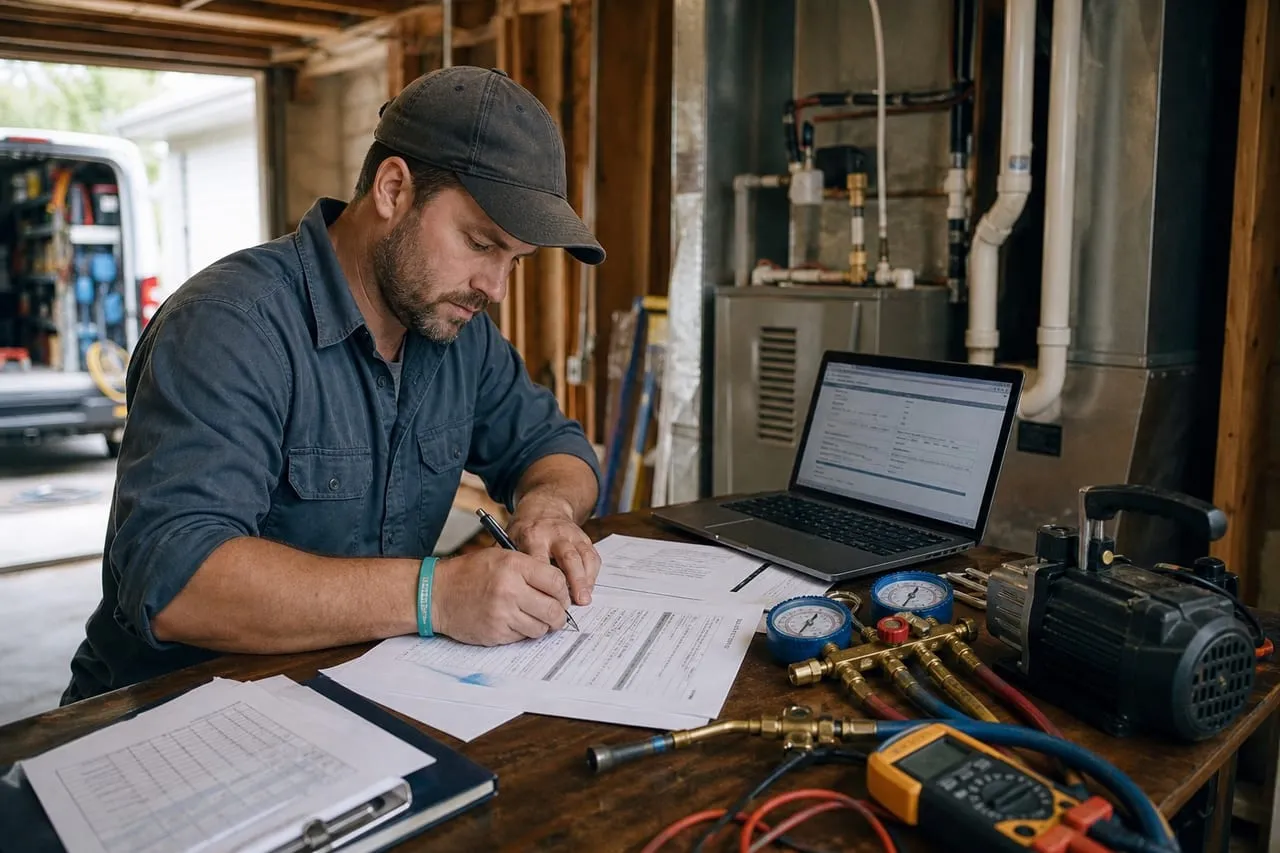
Use a flat-rate price book platform like Profit Rhino, Coolfront, or build your own in Housecall Pro. The price book sits on the tech’s iPad and gets shown to the customer.
The math: cost of the part + 3-4x markup on labor time + 25% margin buffer. A capacitor that costs you $14 wholesale, installed in 25 minutes of bench time, prices at $189-$249.
The deeper reason flat-rate wins has nothing to do with the price level. Time-and-materials makes the customer your adversary: every minute on the clock costs them money, so they hover, question, and quietly resent your fastest tech for being expensive per hour. Flat-rate inverts the incentive. Speed becomes your margin instead of your discount, the customer approved the exact number before any work started, and a tech with zero sales talent can simply turn the iPad around. Getting that 22% pricing edge is most of the spread between the bottom and top of typical solo earnings; see how much profit an HVAC business can make.
The diagnostic fee is a filter, not a revenue line. Because it credits toward the repair, a serious buyer effectively pays nothing extra for it, while the three-quote shopper who never intended to hire anyone today self-selects out before you roll a truck. Waive it “just this once” and you have converted your afternoon into free consulting for a customer who was always going to pick the cheapest bid.
Maintenance Plan Tiers
Three tiers is the standard. Customers anchor on the middle one. Here’s what each tier should include and price at.
- Basic ($15-$22/mo). 1 spring AC tune-up + 1 fall furnace check per year, priority scheduling, 15% off repairs. Targets one-system customers.
- Plus ($25-$35/mo). Everything in Basic + priority scheduling within 24 hours, 20% off repairs, no overtime charges on emergency calls, IAQ filter replacement.
- Premium ($39-$59/mo). Everything in Plus + 25% off repairs, free service calls (no diagnostic), free thermostat after 2 years, priority replacement quote discount.
Pitch every plan at every service call. “Most of my customers do the Plus plan, it’s $29/mo, covers your spring and fall tune-ups, gives you priority scheduling, and 20% off any repair. Want me to set that up?”
Target 25-40% conversion of one-time service calls to plan members. Year 2 target: 250+ plans. Year 3: 600+ plans. See how to grow.
The plan book is worth more than the sum of its monthly charges. It smooths the seasonal sine wave: cooling demand peaks June through August, heating peaks December through February, and the spring and fall tune-up visits fill exactly the shoulder weeks when the phone goes quiet. Sell plans hardest in March-May and September-November, when the tune-up is the natural conversation anyway. Each visit is also a sales call in disguise: the aging compressor you log this spring is the replacement quote you write next summer. And when you eventually exit, an acquirer prices the company off the plan base, because auto-charged members are the only revenue a buyer can bank on.
Good/Better/Best Replacement Quoting
Replacements are where margins are made or lost. Customers always buy the middle option. Structure your quotes so middle is your sweet spot.
- Good. 14 SEER2 single-stage, builder-grade brand (Goodman, Ducane). Standard 10-year parts warranty. $5,800-$8,400 typical install.
- Better. 16 SEER2 two-stage, mid-tier brand (Bryant, Rheem, Lennox base). Extended 10-year parts + 2-year labor warranty included. $8,800-$13,200.
- Best. 18+ SEER2 variable-speed inverter, premium brand (Carrier, Trane, Lennox Signature). 12-year parts + 5-year labor warranty + free first 2 years of maintenance plan. $13,500-$22,500.
Always present all three. Customers feel respected when given options. ~60% pick Better, ~25% pick Good, ~15% pick Best. Average ticket of $11,500-$14,200 across the mix.
Quote on a single 1-page sheet with all three options side-by-side. Don’t email a 12-page PDF. Show, sign, schedule. Financing options (Wells Fargo, Synchrony, GreenSky) on every quote, 0% APR for 24-60 months drives 35-50% close rate on premium.
The three tiers are not really three products; they are a frame that makes the middle feel reasonable. Build them in this order: set Better as the system you would put in your own house, then make Good visibly less (single-stage, builder brand, shorter labor warranty) and Best genuinely aspirational. The mix is your health check. If 80% of customers pick Good, your Better is overpriced for your market; if everyone picks Best, every quote left margin on the table. The 60/25/15 split is what a calibrated book looks like.
Payment Terms and Collections
Cash at the door. Always. HVAC is not a net-30 industry for residential.
- Service calls. Collected at completion via card-present (Square, Stripe Reader) or check. No invoice mailing.
- Replacements. 50% deposit at signed quote, balance at install completion. Financing if customer prefers.
- Commercial / property managers. Net-15 or net-30 with signed agreement. Late fee 1.5%/mo after due date.
- Maintenance plans. Auto-charge monthly via Stripe or QuickBooks Payments. Decline = pause plan + immediate text.
- Deposits on parts orders. For any non-stock part > $400, collect 50% before ordering. Protects you against custom orders the customer changes mind on.
See how to register your business for payment processing setup.
Flat-Rate or Time-and-Materials?
If you came up in a T&M shop, publishing fixed prices feels like volunteering for risk. The trade-offs are real on both sides, but they are not symmetrical:
Flat-rate: pros
- Customer approves a firm number before work starts, so invoices stop being arguments
- Speed becomes profit instead of a discount on your best tech
- Any tech can present prices from the book without sales talent
Flat-rate: cons
- Building and maintaining the price book is real work, quarterly at minimum
- A misjudged task time bleeds margin until you recalibrate it
- Odd one-off jobs (ductwork surgery, oddball boilers) still need judgment pricing
The workable hybrid: flat-rate everything in the book, and write the exception rule down. Anything off-book gets quoted as a custom fixed price after diagnosis, never as an open-ended hourly, because the moment a customer hears “we’ll see how long it takes,” you have reintroduced every problem flat-rate solved. And recalibrate quarterly when supplier price sheets land: the capacitor that cost $14 last year costs more after every supplier increase, and a stale book eats margin one invoice at a time without ever feeling like a decision.
Frequently asked questions
What’s the right diagnostic fee?
$89-$179 depending on your market and competition. Higher in major metros, lower in rural. Always credited toward repair if the customer approves work. This separates browsers from real buyers.
Should I match competitor prices?
No. Match value, not price. Underpricing means smaller margins and lower-quality customers who will haggle on the next job. Win on reviews, communication, and reliability.
How do I justify higher prices?
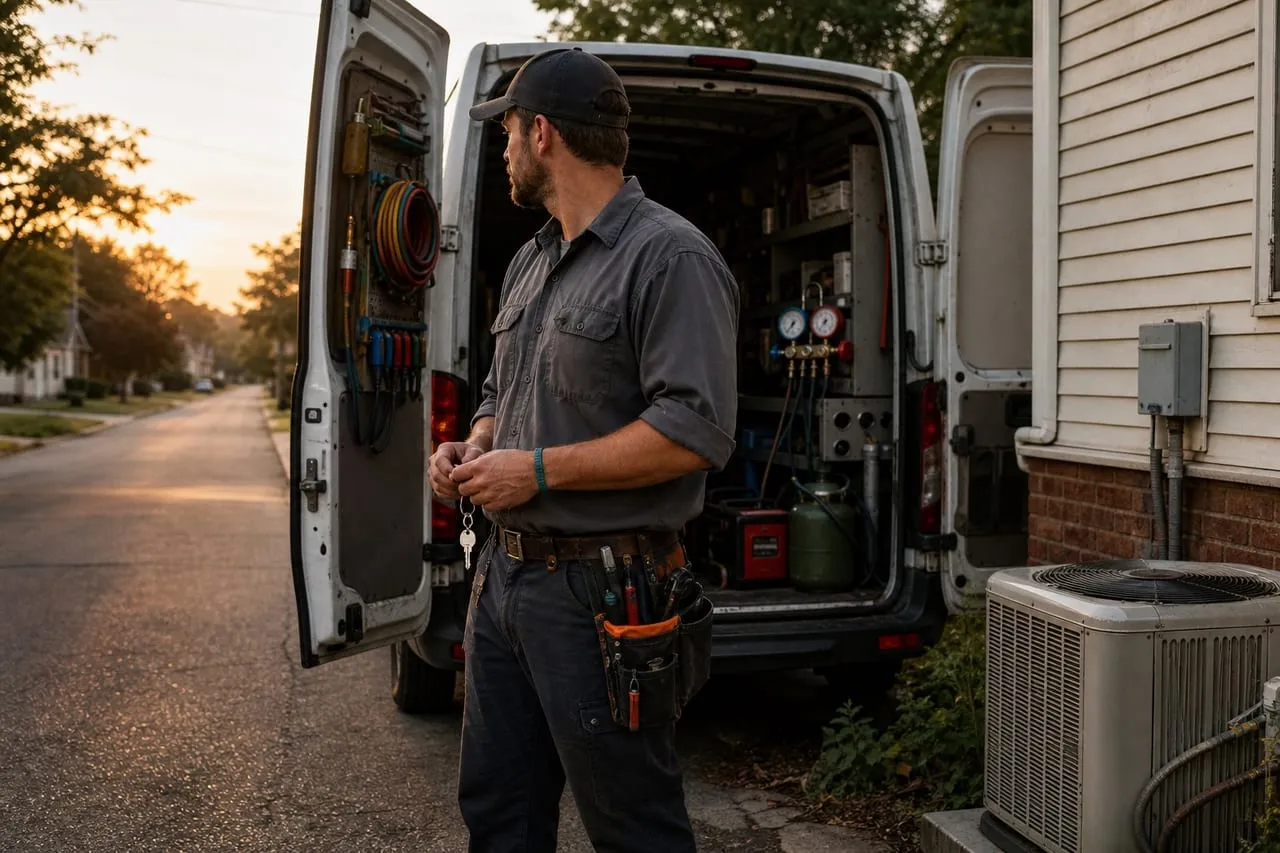
Show up on time, in a wrapped van, in uniform, with the iPad, and present clean flat-rate prices. The presentation justifies the price. Cheap operators show up in beaters and pull numbers out of the air. See how to successfully run and the channel mix.
Should I do free estimates?
For replacements yes, for repairs no. A repair without a diagnostic fee means the customer has zero commitment and you’re giving away $80 of time on browsers. Replacements are different because the ticket is large enough to justify the free quote time.