Best Way to Start and Get Into HVAC Business
The best way into HVAC is to nail the boring stuff before you ever buy a gauge. License, EPA 608, LLC, and insurance get you legal. A stocked van and a website that converts get you booked. Most guys flip the order and then sit on $15k of tools while their phone stays quiet.
Get Legal in This Exact Order
Run the sequence so each step unlocks the next. Skipping ahead burns money.
- State HVAC license. Apply through your state contractor board. Most states require 2-4 years documented field experience plus a trade and business exam. Without it, you cannot pull permits or legally sell installs.
- EPA Section 608 certification. Universal cert is $25-$150 through ESCO Institute or Mainstream Engineering. You need this to buy or handle refrigerant. Type II covers high-pressure (the bulk of residential work).
- LLC + EIN. File with your secretary of state ($50-$500 depending on state), grab an EIN from IRS.gov in five minutes.
- General liability + commercial auto insurance. $1M/$2M GL runs $80-$200/mo. Commercial auto is non-negotiable if you drive a van for work.
- Workers comp. Required the moment you hire your first tech in most states.
The license is the long pole in this list. The LLC takes an afternoon, the EIN takes five minutes, and EPA 608 can be passed online the same week, but most state boards take 60-90 days to process a contractor application, and a few run six-month backlogs. So the practical move is to submit the license application first and run everything else in parallel while the board sits on your file. Operators who treat the list as strictly serial lose a full quarter of revenue to waiting. The complete paperwork detail is in how to set up and register an HVAC business.
One timing nuance on insurance: get quotes early, because the board usually wants proof of coverage before issuing the license, but set the policy effective date as close to your realistic opening as the board allows. Binding a policy four months before you can legally invoice means paying premium on zero revenue, and carriers do not refund boredom.
Tool Up Without Going Broke
You do not need a $30k truck on day one. You need the right $12k-$18k of equipment. Start with the tools that pay back on the first three jobs, then upgrade as cash flow allows. Read buying equipment and supplies for the exact brand list.
- Used cargo van (Transit or Sprinter), $8k-$15k
- Digital manifold set (Yellow Jacket Mantooth or Fieldpiece SMAN460), $400-$700
- Recovery machine (Appion G5Twin), $1,100
- 2-stage 6 CFM vacuum pump, $300
- Brazing kit, leak detector, refrigerant scale, hand tools, $1,500
- 30 lb cylinders of R-410A and R-454B (newer systems), $400-$800
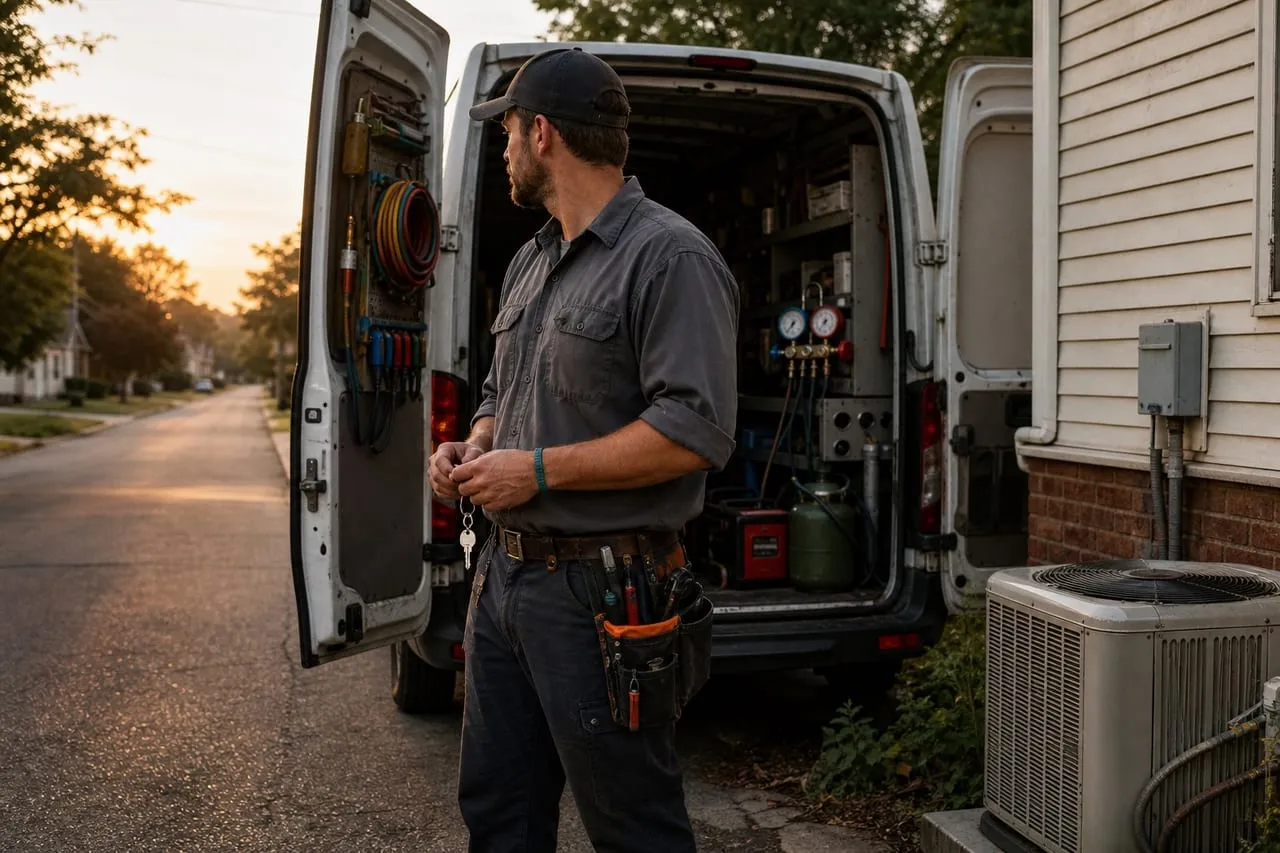
Stock the van like you are doing eight calls a day. Capacitors, contactors, common Honeywell thermostats, condensate pump, drain pan tablets, filter sizes 16x25 and 20x25. A stocked van closes more repairs same-day.
The buying order matters more than the brand debate. The recovery machine is not deferrable: EPA 608 requires recovery on any refrigerant removal, so it is effectively part of your license. The manifold, pump, and micron gauge are the revenue tools, because diagnosis is what you actually charge for. Everything else can be bought job by job as the work demands it. What you should not do is finance a full install rig before you have install demand, which brings up the first real fork in the road: launching service-only.
Service-first launch: pros
- $10k-$15k gets you open instead of $30k+
- 40-65 calls a month builds your review base faster than anything else
- Repair money collects same day, with no materials float on big equipment
Service-first launch: cons
- You hand $7,500-$12,500 replacement tickets to whoever quotes them
- Telling your own customer “I can’t do your install” costs trust you just earned
- Revenue stays capped until you can quote changeouts
The decision rule: if funding the install rig would drain your reserve below 60 days of personal plus business expenses, launch service-only and let the first cooling season buy the rig. A strong June through August of service work typically throws off enough cash to add install capability by fall, right when replacement season picks up. What hurts people is splitting the difference, buying half an install setup, and being unable to do either kind of job well.
Get the Phone Ringing
You can be the best tech in town and starve if nobody can find you. Set up these three lead sources before you take your first paying call. See how to advertise HVAC business for the full channel mix.
- Google Business Profile. Verified, photos of van and techs, service area set 15-25 miles around your shop, hours posted. Ask every customer for a review before you leave.
- A real website. Services, service area, maintenance plans, reviews, click-to-call header. Skip Wix. Use a contractor-focused builder or a done-for-you option like /get-website/.
- Google Local Services Ads. Google-screened badge, pay-per-lead not per-click. Cheapest qualified leads in HVAC.
Aim for 25 Google reviews in your first 90 days. That single metric outperforms most paid ads.
Here is why the review target is the strategy and not a nice-to-have: Local Services Ads rank on review count, review recency, and how reliably you answer the phone, not on how much you bid. The ad platform is effectively a reviews contest with a phone-answering tiebreaker. A new operator who answers every call live and asks for the review at the kitchen table will outrank a five-van shop that lets calls hit voicemail. That is the one arena where being small is an advantage, because you personally control both inputs.
Sell the Maintenance Plan From Visit One
Most new operators treat maintenance plans as something to add once things settle down. That is backwards. HVAC demand spikes June through August on cooling and December through February on heating, and the months between are quiet enough to scare you. A base of $20/mo plan members is what turns that sawtooth into a business: the recurring revenue covers insurance and the truck payment in the dead months, and the spring and fall tune-up visits fill your calendar exactly when the phone goes quiet.
The deeper reason is the replacement pipeline. A plan member’s aging system gets inspected by you twice a year, which means you are standing in front of the failing heat exchanger 18 months before it dies, with trust already built. Plan members buy their $9,000-$12,000 replacement from the company that maintains the system, almost without exception. Sell the plan at the kitchen table after every repair, priced so it feels obvious next to the repair bill they just paid. The pricing mechanics are in setting prices and billing.
Your First 90 Days by the Numbers
If the sequence above is done right, the ramp is predictable: a slow first month while reviews accumulate, real traction by week six, and a step change when the first heat wave hits.
The pattern worth noticing: nothing in that example came from paid search budgets or a $4,000 wrap. It came from being legal on time, answering the phone live, and asking for reviews. Get those three right and every marketing dollar you add later is an accelerant, not a rescue.
Frequently asked questions
How long until I make money?
6-12 weeks from license-in-hand if your van is stocked, GBP is verified, and you answer every call live. First month is usually 8-15 service calls at $200-$450 ticket.
Do I need experience before going solo?
Yes. Most states require 2-4 years as an apprentice or journeyman before you can sit for the contractor exam. Going solo without that is illegal in most jurisdictions and uninsurable in practice.
Should I start residential or commercial?
Residential. Lower entry cost, faster cash collection, simpler permitting. Light commercial (restaurants, small retail) is a logical add-on at year 2-3 once you have steady cash flow.
Is it worth buying a franchise?
Almost never for HVAC. The fees (8-12% of revenue) eat the margin you would otherwise put into a maintenance-plan base. Build your own brand. See how to start step by step.
Your move
Reading this does not book a job.
The owners who pull ahead are the ones who change one thing this week. If you want that one thing to be a website that sells and ads that put it in front of the right people, we build and run both for you.
Straight answer on whether we can help, usually the same day.