How to Successfully Run an HVAC Business
Running an HVAC business well is not about being the best tech. It’s about running predictable systems: every call dispatched fast, every truck stocked, every plan member followed up, and every dollar accounted for. The shops that scale past $500k have these systems written down. The ones that don’t, hit a ceiling.
Daily Operations Discipline
Every day in HVAC has the same shape. Build a rhythm and stick to it for a year.
- Morning huddle, 7:00-7:15am. Review day’s schedule, parts needs, special customer notes. Even solo, do this with yourself out loud.
- Dispatch flow. Every inbound call answered live, logged in software, dispatched with ETA SMS including tech name + photo.
- First call by 8:00am. No later. Late starts kill billable hours.
- Lunch logged, not skipped. Burned-out techs do callback-quality work.
- End-of-day debrief, 5:00-5:30pm. Invoices closed, parts list for next day, plan members called to confirm tomorrow’s tune-ups.
- Weekly review on Friday. Financials, marketing metrics, customer complaints, equipment status.
The software that runs an HVAC shop in 2026:
| Software | Monthly cost | Right fit |
|---|---|---|
| ServiceTitan | $300-700 | Fully featured: CRM, dispatch, invoicing, marketing automation |
| Housecall Pro | $75-300 | The standard for 1-3 truck shops, simpler to run |
| Jobber | $69-249 | Budget option that works fine through 2 vans |
The reason “answered live” is the first dispatch rule: an HVAC call is the most perishable lead in home services. A no-cool call in July books with whoever picks up first, and a voicemail converts at a fraction of a live answer because the homeowner is already dialing the next result while your greeting plays. If you genuinely cannot answer between calls, a call-answering service at $150-400/mo costs less than the two jobs a week that voicemail quietly loses you.
The same daily rhythm also has to flex with the season. June through August and December through February, the book fills itself with emergency demand and the huddle’s job is triage: protect plan members’ slots, push non-urgent work outward, keep techs fed and hydrated. March through May and September through November, the phone slows and the huddle’s job inverts: fill the day from the tune-up backlog and the renewal list. Shops that coast through the shoulder season walk into the next peak with an empty plan book and a cold pipeline.
Inventory, Parts, and Truck Stock
The shop that runs out of capacitors at 3pm on a Friday is the shop losing $1,800 of revenue. Inventory discipline matters more than people realize.
- Par levels per truck. Every truck has a written par sheet: 2x each capacitor size, 2x each contactor, 3x thermostats, 1x condensate pump, refrigerant cylinders, brazing rod, common motors. Tech restocks at end of day.
- Shop inventory. 2-4 weeks of par stock at the shop. Reorder when below 1-week supply.
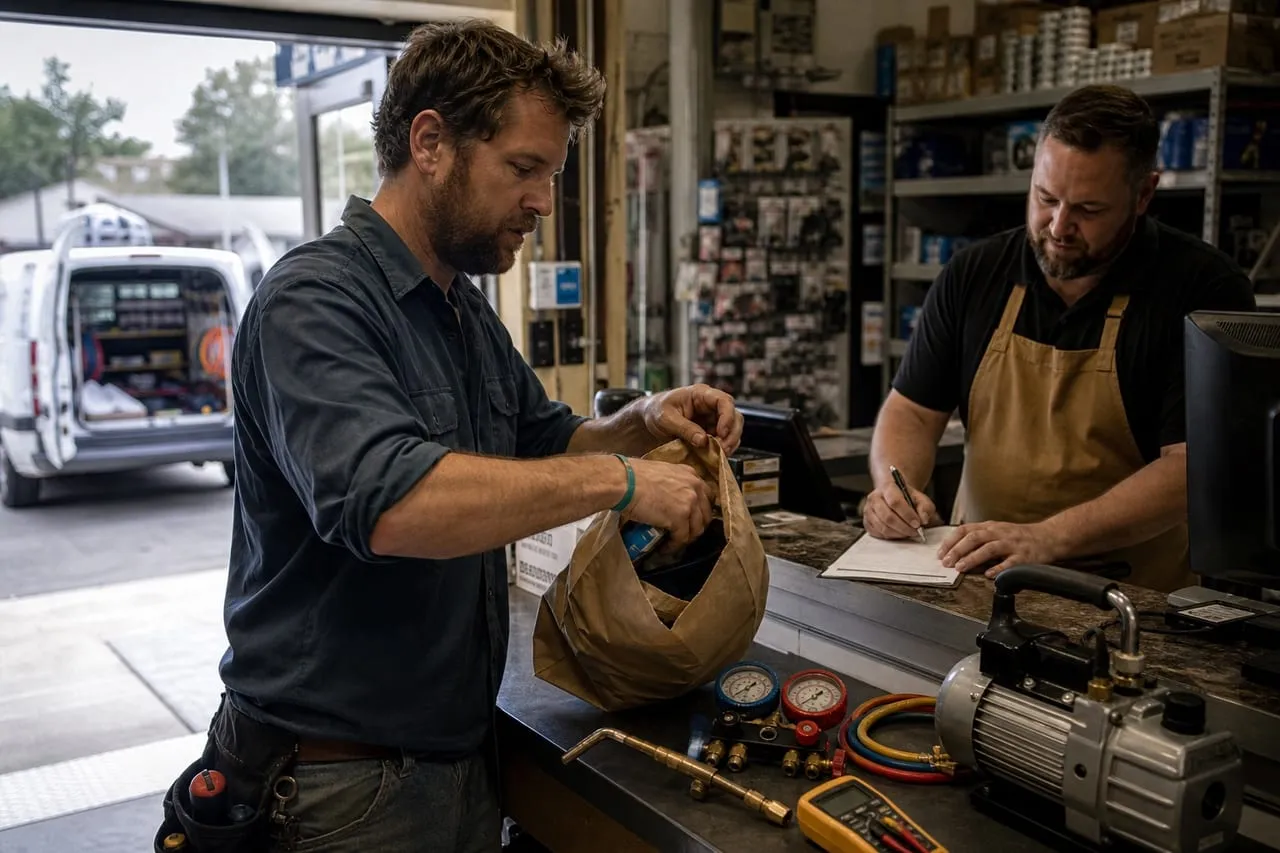
- Supplier accounts. Ferguson HVAC, Johnstone Supply, both with net-30 terms. Counter pricing 15-25% better than walk-in. See how to register.
- Refrigerant tracking. Log every cylinder used. EPA Section 608 requires recovery and refrigerant transaction logs.
- Dead inventory audit. Quarterly. R-22 stock, old brand parts, obsolete control boards. Liquidate or write off.
A solo truck with proper par stock closes 85%+ of service calls same-day. A truck running on memory closes 50% and books a callback.
Treat the supplier account as an operations tool, not just a price list. The counter staff at Ferguson and Johnstone know which compressor is on regional backorder and which substitute actually fits, and that knowledge saves jobs in July. Net-30 terms are 30 days of float on parts you have often already invoiced, which is free working capital. Pay the account on time anyway: when a heat wave empties the regional warehouse, allocation quietly goes to the accounts in good standing.
Maintenance Plans, Follow-Up, and Financial Discipline
This is the moat. Every successful HVAC company looks the same on a balance sheet: high recurring revenue from plans, predictable replacement pipeline, sub-30% COGS.
- Plan member workflow. Auto-charge monthly, scheduled spring + fall tune-ups, annual renewal SMS + email 30 days out. 78-90% renewal rate achievable. See pricing.
- Post-call follow-up. Text or call 48 hours after every service call. “Hey Mike, just checking your AC is still running good after our visit Tuesday.” Drives reviews and referrals.
- Replacement pipeline. Quote good/better/best at every replacement. 4-6 month follow-up on quoted-not-bought.
- Cash discipline. Every job invoiced day-of, payment collected at service. Net-30 only for property managers and commercial contracts.
- Bookkeeping. QuickBooks Online ($55-$235/mo) reconciled weekly. Don’t let it slip past a month or you’ll spend a weekend catching up.
- Tax planning. Quarterly estimated taxes (overestimate), retirement contributions to SEP-IRA or Solo 401(k), Section 179 deduction on van and tool purchases.
Plans look like a discount program and act like a balance sheet. The monthly auto-charge smooths the revenue sine wave: cooling peaks June through August, heating peaks December through February, and the shoulder months starve shops that only sell repairs. The scheduled spring and fall tune-ups fill exactly the weeks the phone goes quiet, and every tune-up visit doubles as a replacement-pipeline inspection, because the tech who logs a weakening compressor in April is the company that quotes the changeout in July.
The plan base is also what makes the business sellable. A buyer cannot bank on your phone ringing, but they can bank on 600 auto-charged members renewing at 78-90%. A shop with a deep plan book sells for a real multiple of earnings; a shop that is a phone number and a van sells for the price of the van. Even if you never plan to sell, build the company a buyer would want, because that company is also the one that survives a slow February.
By year 3 most owners should be out of the truck full-time. See how to grow and when to hire.
The Numbers That Tell You It’s Working
Benchmarks keep you honest, because a ringing phone hides a lot of sins. A dialed-in solo operator should be earning $90k-170k a year personally. A 2-van team should run $45k-90k a month in revenue and keep $14k-28k of it as profit, with COGS under 30%. If you are materially below those bands at comparable scale, the leak is almost always one of two things, in this order: pricing that never got rebuilt after your costs rose, or unsold capacity in the shoulder seasons that a plan book should be filling. Work the diagnosis in that order before blaming marketing; see how much profit an HVAC business can make for the full margin math.
Frequently asked questions
What software should I run my HVAC shop on?
ServiceTitan if you can afford $300-$700/mo and want full features (CRM, dispatch, invoicing, marketing automation). Housecall Pro at $75-$300/mo is the standard for 1-3 truck shops. Jobber at $69-$249 is the budget tier.
How much should I pay myself?
In year 1, take what the business can support, often $4k-$8k/mo. By year 2, target an actual owner-operator salary of $7k-$12k/mo. Don’t reinvest 100% past year 1, that’s how burnout happens.
What’s the biggest financial mistake new HVAC operators make?
Not tracking cash flow weekly. The phone keeps ringing so it feels like business is good, but parts costs, fuel, and insurance creep up while you’re not looking. Reconcile QuickBooks every Friday.
How do I prevent burnout?
Three rules: never work Sundays, take a full week off twice a year, hire the second tech earlier than you think you need to. See how to grow and how to get clients.