How Much Do You Need to Start an HVAC Business
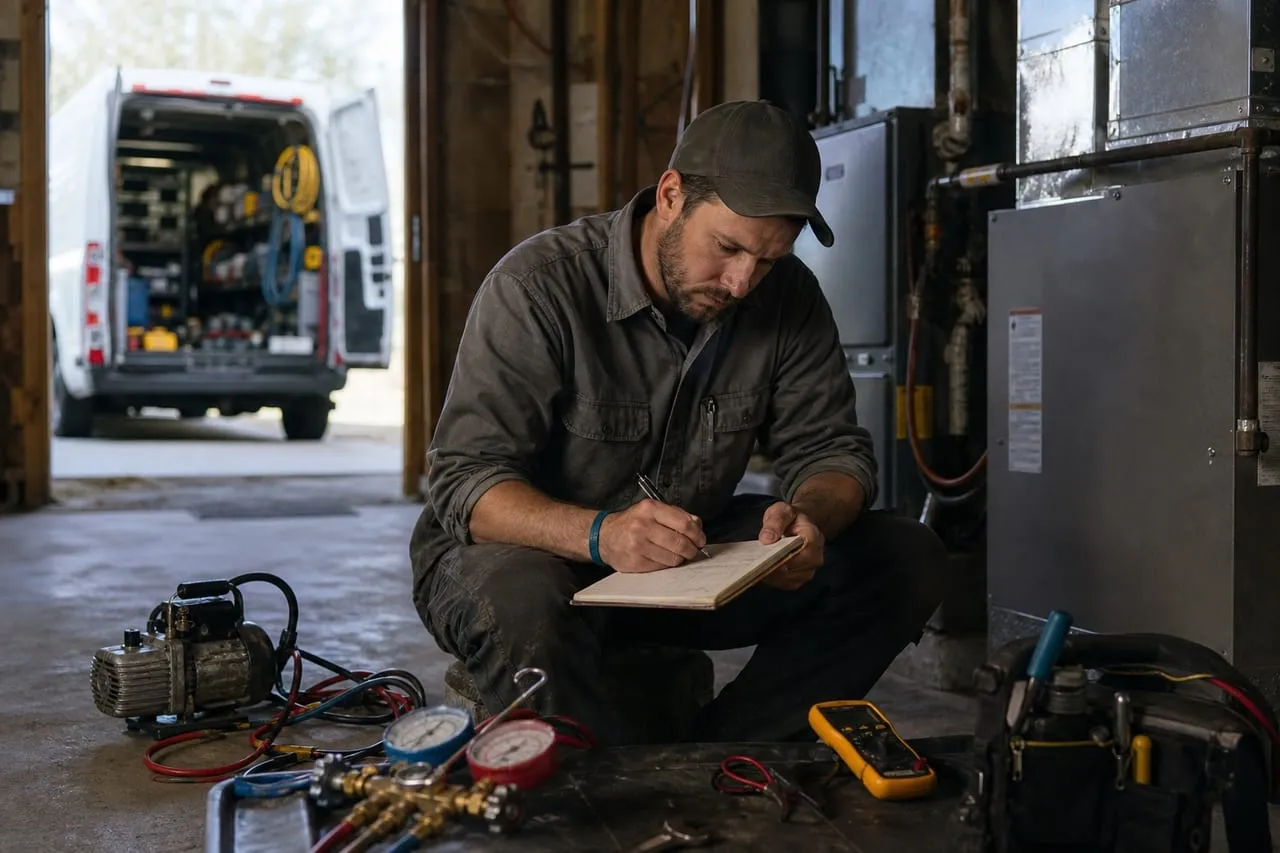
You can start an HVAC company for $10k if you already own a usable truck and only do service. You’ll need $25k-$40k to do installs and quote replacements properly. The biggest variables are the van (used cargo vs new Sprinter) and how deep you go on refrigerant stock. Here is what every dollar actually buys.
The Three Builds, Side by Side
Every line below is a cost you will actually hit. The three columns are the same business at three spending levels, so mix them: your old pickup with the full tool package, or a bought van with the lean stock list.
| Line item | Lean bootstrap | Standard solo | Install-ready |
|---|---|---|---|
| Van | $0 (truck you own) | $8,000-$14,000 used | $10,000-$16,000 cleaner used |
| Shelving + branding | $0-$400 magnets | $2,500 shelving + lettering | $4,000-$6,000 shelving + wrap |
| License, EPA 608, LLC, bond | $1,200 | $1,200 | $1,200 |
| Insurance (first year) | $1,800 | $1,800 | $1,800 |
| Tools | $3,200 core + brazing | $5,500 complete package | $6,500-$7,500 with install rig |
| Truck stock + refrigerant | $2,600 | $3,500 | $5,000 (adds R-454B, R-32, N2) |
| Changeout materials | $0 | $0 | $2,500-$3,500 |
| Website + marketing | $500-$1,200 | $2,500 (site + 60 days ads) | $3,500-$5,000 (90-day launch) |
| Software | $0-$200 | $400 | $400 |
| Working capital | $1,500 | $1,500-$2,500 | $5,000 |
| Total | $10,800-$12,100 | $26,900-$33,900 | $39,900-$51,400 |
Look at where the columns diverge. The license, EPA 608, insurance, and software lines are nearly identical across all three builds, because the legal floor of an HVAC business costs about $3,000-$3,400 whether you are scrappy or polished. Almost the entire spread comes from the van, the install rig, branding, and ads, and those are exactly the lines where spending more is a choice rather than a requirement. That is the most useful fact in the table: the mandatory core is small, and everything above it should be judged on payback, not on how legitimate it makes you feel. The paperwork behind that $1,200 legal line is itemized in how to set up and register.
Lean Bootstrap: $10k-$15k
This budget works if you already have a small cargo van or a pickup with a cap, and you focus on residential service and repair for your first 6 months. You are trading missed install tickets for low burn: expect 25-40 service calls a month and a polite “I’ll refer you to someone” on replacements until you upgrade. The website can stay simple, a DIY build on a contractor platform or a done-for-you option like /get-website/.
The failure mode of this build is not the gear, it is pricing like an amateur because the truck looks amateur. Charge full market rates from the first call. The customer with a dead AC in July cares that you answered and showed up, not what you drove. The second trap is staying lean too long: every month past your first busy season without install capability is $7,500-$12,500 replacement tickets walking to a competitor.
Standard Solo Setup: $25k-$30k
This is what 80% of new HVAC operators actually spend. You can quote service, repair, replacement, and basic installs: a real used van with shelving and lettering, the complete tool package, three refrigerants, and a proper website plus 60 days of Local Services Ads. For the exact tool brand picks see buying equipment and supplies.
The van is where this build goes wrong. An $8,000-$11,000 Transit with 110k miles and a clean inspection is a better business decision than a $16,000 van that delays opening by four months of saving, because the van does not book calls, the Google Business Profile does. Buy the cheapest van that will reliably survive two years, and put the difference into truck stock and the ad launch, the two lines with measurable payback.
Full Install-Ready Setup: $30k-$40k
This setup lets you sell and install changeouts (condenser + air handler + line set + thermostat) on day one. Bigger ticket means faster cash but more upfront: the install rig with nitrogen setup, a deeper refrigerant inventory including R-454B and R-32, materials for one full changeout on the shelf, and a 90-day advertising launch. At this level you can close a $9,500 changeout the same week you finish setup.
Notice what this build does not include: a new van. A new or low-mile van at $18k-$28k turns this into a $50k+ launch, and nothing about a new van closes more changeouts. The install-ready premium should go entirely into capability (rig, materials, refrigerant) and demand (ads), because those two pay back in weeks. If there is money left over after that, it belongs in the reserve, not the driveway.
Should You Finance the Tool Package?
Tool trucks will happily finance you, and the FAQ below names the rates. The real decision is the 0% intro APR business card route for the $5k-$10k tool buy.
0% card for tools: pros
- Preserves cash reserves through the slow first months
- 12-15 months of interest-free float while revenue ramps
- On-time payments build the business credit file for the van loan later
0% card for tools: cons
- The limit and the personal guarantee both ride on your personal credit
- The rate jumps to 20%+ the day the intro window closes
- A card that bought tools quietly starts buying everything else
The decision rule: finance the tools only if your realistic month-3 cash flow pays the balance off inside the 0% window. A solo operator doing 20+ calls a month from week 6 clears $5k of tool debt in two to three months without strain. If your market or season makes that uncertain, buy the lean kit in cash and upgrade tool by tool.
Open Before the Heat, Not After
The same dollars buy different outcomes depending on the calendar. HVAC demand peaks June through August on cooling and December through February on heating, and a new company that opens four weeks before a peak rides it with a full pipeline, while one that opens in September spends the shoulder months burning reserve. Since the contractor license takes 60-90 days, the planning math is simple: file in winter to open in April or May, or file in summer to catch heating season. The shoulder months you do hit are for selling maintenance plans, which smooth the next trough.
This is also why working capital is a line item and not an afterthought. A new HVAC business is usually profitable on paper by month two and cash-poor until month four or five, because you front parts and fuel while the install deposits and net-30 supplier bills cycle through. Under-capitalization kills more first-year contractors than lack of work. Treat the 60-day reserve as part of the startup cost, and size your build so it survives opening into the wrong season anyway. The revenue side of this timing is laid out in how much profit an HVAC business can make.
Frequently asked questions
Can I really start with $10k?
Yes, if you already own a van or truck and limit yourself to service/repair. You’ll be passing on $4k-$12k replacement tickets until you upgrade tools and refrigerant inventory.
What’s the single biggest expense?
The van. Either $10k used or $28k new. Everything else combined usually totals under what the van costs.
Should I finance the tools?
Snap-on and MAC offer tool financing but the rates are brutal (15-22% APR). A 0% APR business credit card from Chase Ink or Capital One Spark is the better play for $5k-$10k of tool buys.
How long does $25k last?
If you’re getting 20+ service calls a month from week 6 on, you’re cash flow positive by month 3. Read how much profit you can make and how to advertise locally for the revenue side.
Your move
Reading this does not book a job.
The owners who pull ahead are the ones who change one thing this week. If you want that one thing to be a website that sells and ads that put it in front of the right people, we build and run both for you.
Straight answer on whether we can help, usually the same day.