Apr 2019
A category where nobody buys twice
In April 2019 a Polish manufacturer of precast concrete tanks came to us with nothing in the Czech Republic: no Czech website, no rankings, no analytics. We built the websites from scratch and took on their whole market strategy there and in Slovakia. By the start of 2021 the main site had climbed to position 5 on Google for “concrete cesspits” (searched in Czech), the term the whole category fights over.
On 12 November 2021 it was at position 1. No trick. We measured where it stood from day one, then worked through the list for two and a half years. We still run their Czech and Slovak markets today.
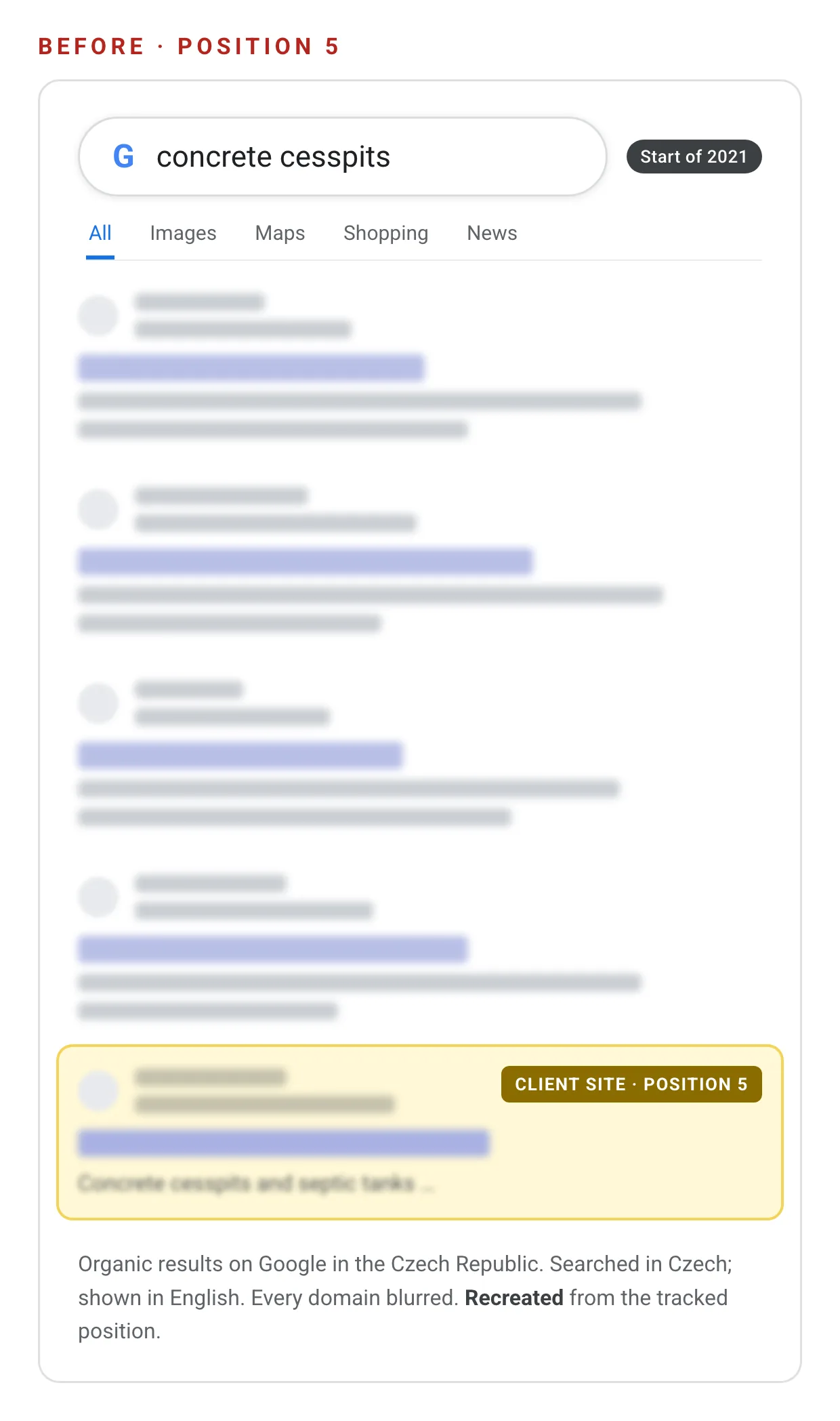
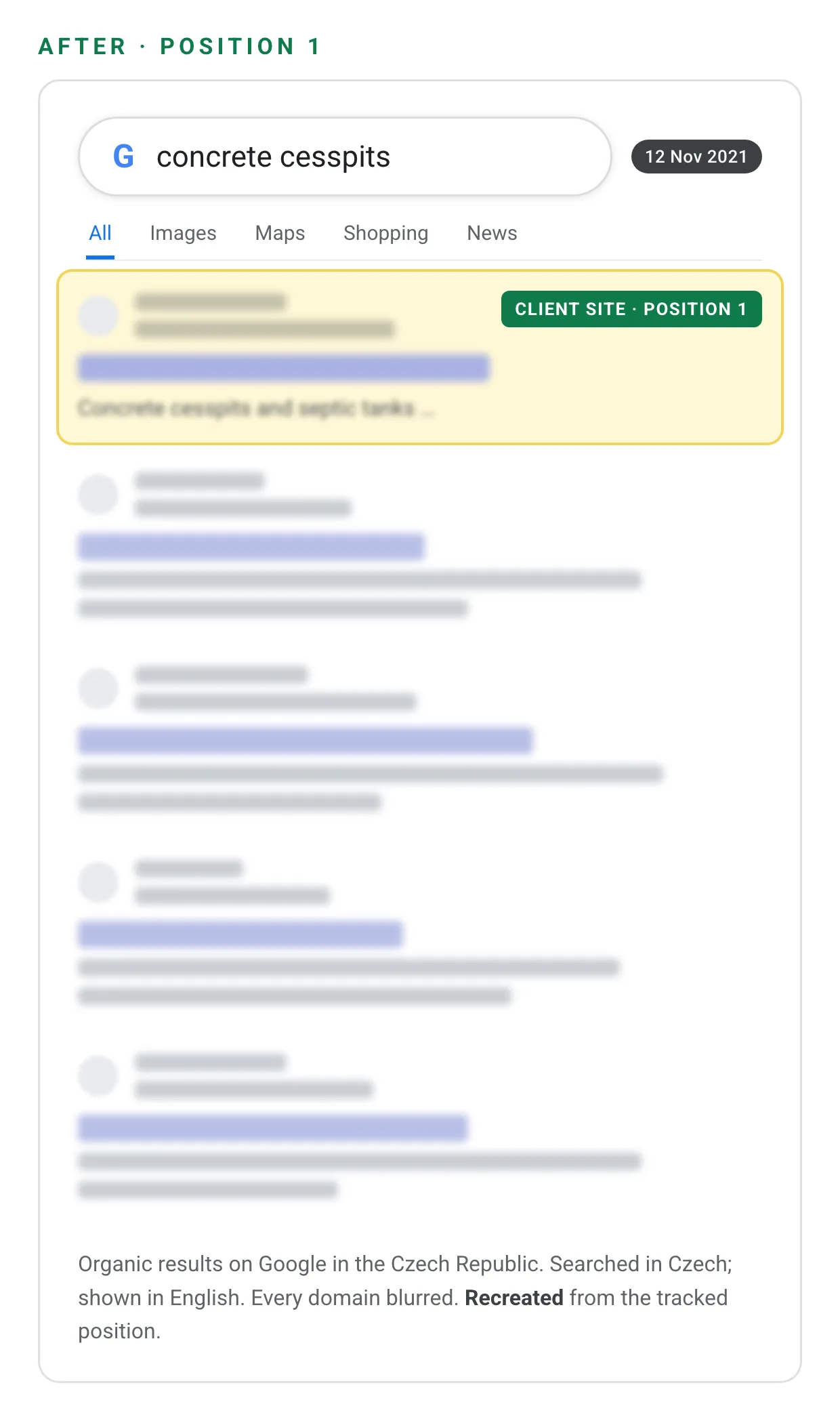
Searched in Czech; shown in English. The client’s domain and every other result are blurred.
A concrete cesspit is a purchase almost nobody makes twice. A house gets one. The owner researches for weeks (volume, wall thickness, delivery, crane access), then buys, and never thinks about it again.
That breaks the marketing most suppliers rely on. Paid advertising pays off best when the same customer comes back. Here there is no second order. You pay full price to win every sale, forever.
So the category gets sold the same tired way. A thin brochure site. A phone number. A price list nobody ever rewrote. Nobody measures anything, so the site ranks wherever it happens to rank, and everyone shrugs and calls it the market.
In a category where nobody buys twice, the only asset that lasts is being the page that is already there when someone finally searches.
The effort was there. The direction was not.
Most SEO in this market is sold by the month, as a quantity of something. Articles. Links. “Optimization.” The quantity is usually real. What is missing is direction: nobody has decided which position they are trying to move.
We started from a blank page: no Czech website, no keyword strategy, no rank tracking, no backlinks and no analytics. So measurement came first, before a single page went live, and every page was built for a position we had named in advance.
| How it usually goes | What we did, from month one |
|---|---|
| Buy links and hope | Reviewed 60+ directories, registered in 13 |
| No rank tracking at all | Rank tracking installed in month one |
| Copy translated from the parent company’s site | Homepage and price list written for Czech buyers |
| Articles counted as the deliverable | Positions counted as the deliverable |
| Results claimed after the fact | Trend tracked all year, in writing |
25 Apr –
25 May 2019
Three parts, in the order they have to happen
Month one ran from 25 April to 25 May 2019 and bought no positions. It bought measurement and plumbing, and it is still the month that decided how the account went.
Measure first, then change things
Keyword analysis built from scratch. A written SEO strategy. Rank tracking installed. Analytics, Tag Manager and Ads access set up. None of that moves a position by itself. All of it decides whether you will ever know what did.
Build it right before chasing links
Titles, H1s, H2s and meta descriptions set for every page. Internal linking planned around the pages that matter. Images properly named. Homepage and price-list copy written for Czech buyers, not translated from older Polish sites.
Earn the links by hand, then verify them
60+ directories and catalogs reviewed. 13 backlinks registered and verified. Not 13 promised. 13 live and checked. The fee that month was about $720, and that list is what it bought.
If you cannot name the position you are trying to move, you are not doing SEO. You are redecorating.
Head terms are shelf space. Local terms are a separate fight.
Part one: the head term
A head term is shelf space.
“Concrete cesspits” is what a Czech homeowner types once they know they need a tank but not yet who to buy it from. No brand. No town. No qualifier. Whoever holds the top of that results page gets first look from every buyer in the country.
There are roughly three phrases like it here: “concrete cesspits”, “concrete septic tank” and “concrete waste tanks”. So the work is concentrated: a price-list page for each chamber type and volume, and internal links that push authority toward those three pages.
Part two: the local grid
Local queries cost more.
Town-level searches (the same product with a place name attached) are won differently. Each one needs its own page and its own local signals. A small retainer cannot pay for either.
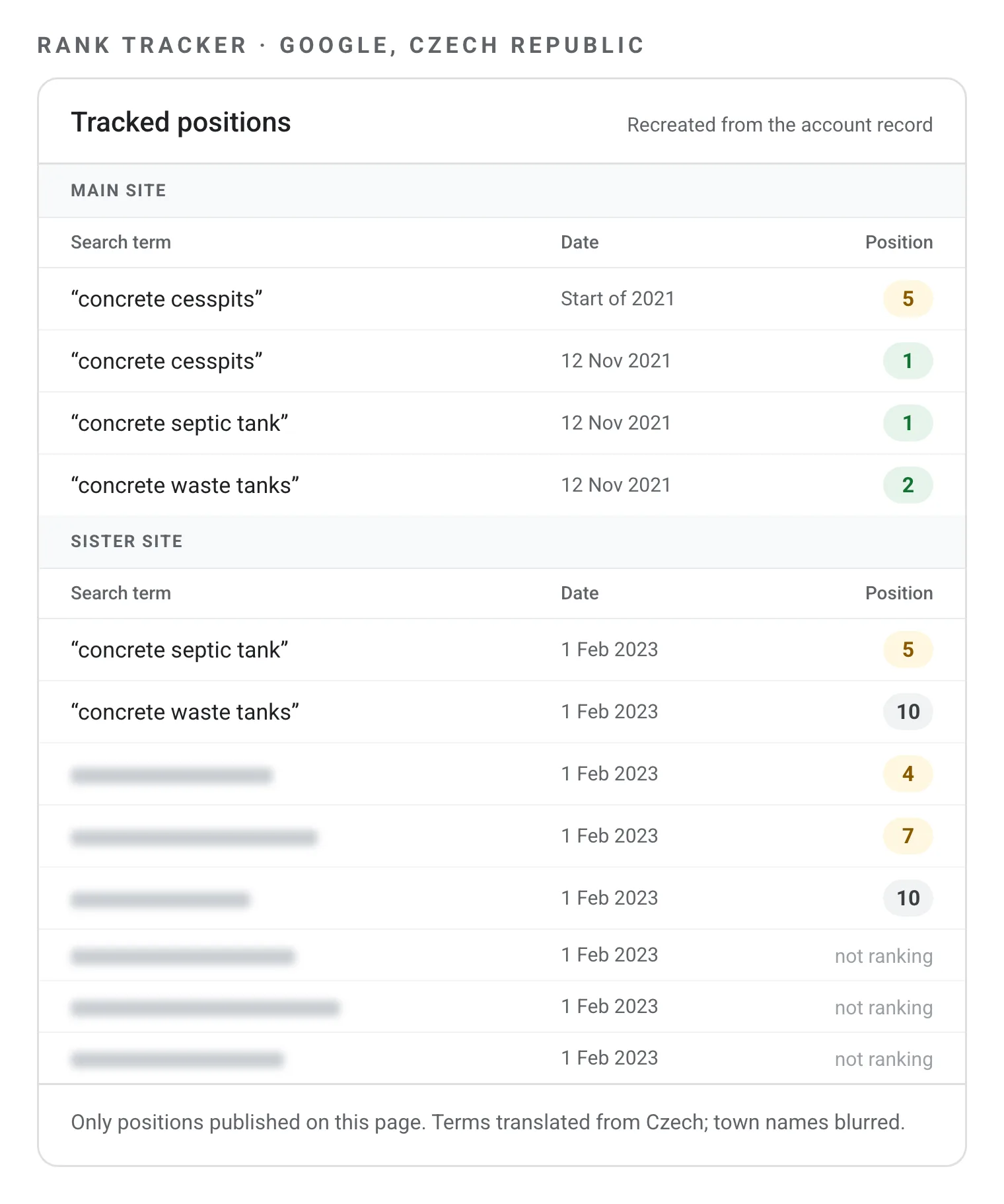
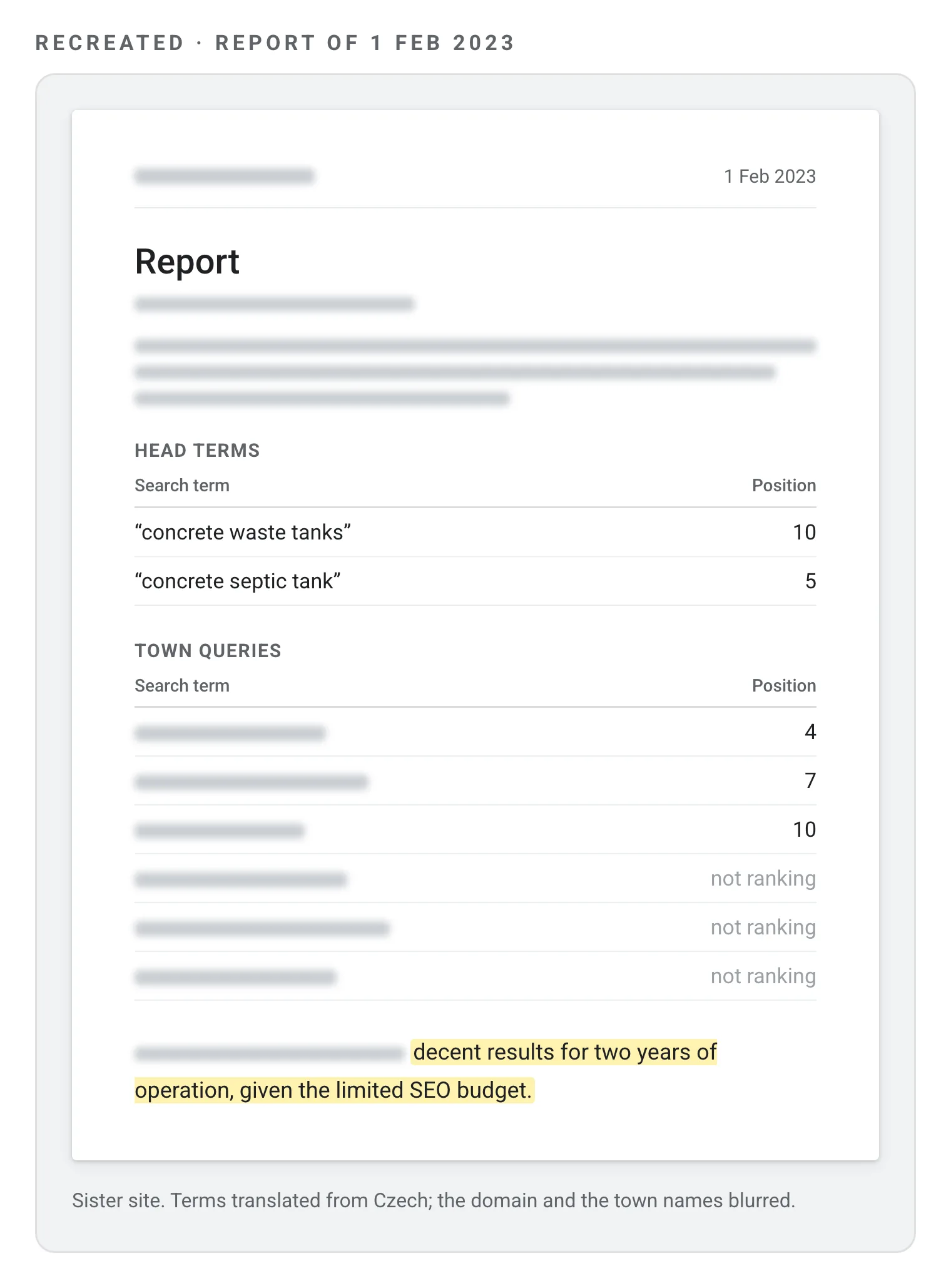
We know what that trade-off costs: we ran the same playbook on a sister site with a smaller budget. The head terms moved, slowly. The local terms mostly did not. In the report of 1 February 2023, three of six sampled town queries did not rank at all.
Secure the national terms first. Then spend what they earn on the local grid.
Head terms: shelf space
Internal links from the rest of the site push authority toward these three pages
The local grid: one page per town
- Town page
- Town page
- Town page
- Town page
- Town page
- Town page
- Town page
- Town page
Separate fight, separate budget.
Rank tracking is not a report you hand over at the end. It is the instrument you steer with. We watched the climb from 5 to 1 across 2021 as it happened, which is also how we knew which terms were not moving.
 Michal Mujgos, on the rule this account ran on, written for this page
12 Nov 2021
The sales side noticed first
12 November 2021: an unprompted message from the client’s Czech sales rep, and Michal’s reply the same day.
The client’s Czech sales rep:The site is in first place in SEO for the keyword ‘concrete cesspits’ SUPER :) it is currently one of the strongest sites in CZ for tanks.
Michal Mujgos:We know about it, we measure it regularly: the trend from the start of the year, from position 5 to position 1. We’re climbing on Seznam the same way. We’re also in position 1 on ‘concrete septic tank’…
It came from sales, not from us. The person closest to the phone spotted it before any report went out. And it came with a date.
| Term | Position |
|---|---|
| “concrete cesspits” · 12 Nov 2021 | 1 |
| “concrete septic tank” · 12 Nov 2021 | 1 |
| “concrete waste tanks” · 12 Nov 2021 | 2 |
| Shafts, cellars and pit pages · May 2021 | 2 |
A test you can run in ten seconds
The test needs no tools. Open a clean browser, type what your buyer would type, and see where you land.
On 12 November 2021, the tracked position for “concrete cesspits” was 1: the site was the top result. In April 2019 there was no Czech site to find. We make no claim about today’s rankings.
- No Czech website
- No rankings
- No backlinks
- No keyword strategy
- No analytics
- Position 1: “concrete cesspits”
- Position 1: “concrete septic tank”
- Position 2: “concrete waste tanks”
- Climbing on Seznam
- Every position tracked
2022
No traffic figures we cannot stand behind
No session counts, no conversions, no revenue. The record here is rank positions and a work log. A number we cannot source is not proof.
We flag a drop before it happens. From mid-2022 we warned the client that the cookie-consent banner would cut measured traffic by 30–50%. The business does not shrink. The measurement does.
The half that did not work goes in the report too. On the sister site, 1 February 2023: “I agree the local terms have weaker results.”
1 Feb 2023
The second site is the honest test
The real test of a method is running it a second time, on a smaller budget. A sister domain, launched in early 2021, got the same playbook.
We reported on it two years in, on 1 February 2023: position 10 on “concrete waste tanks”, position 5 on “concrete septic tank”. The local queries were the weak spot. Of six sampled town searches, three ranked 4th, 7th and 10th, and three did not rank at all.
Our verdict, sent to the client rather than filed away: “decent results for two years of operation, given the limited SEO budget.” Slower. Partial. Reported anyway.
Two and a half years, as it happened
None of this happened in a single quarter. The climb from 5 to 1 took all of 2021, and 2021 was year three.
| When | What happened |
|---|---|
| Apr 2019 | Start from scratch: no Czech website, no strategy, no tracking, no links, no analytics. |
| 25 Apr – 25 May 2019 | Month one: strategy, Czech copy, on-page setup, 60+ directories reviewed, 13 backlinks live, tracking installed. About $720. |
| Start of 2021 | Position 5 on “concrete cesspits”. |
| May 2021 | New shafts, cellars and pit pages reach position 2. |
| 12 Nov 2021 | Position 1 on “concrete cesspits” and “concrete septic tank”; position 2 on “concrete waste tanks”. |
| 2022 | Portfolio: about $2,150 a month across 7 sites. |
| 1 Feb 2023 | Sister site reported at positions 10 and 5; three of six local queries not ranking. |
| Today | Still running their Czech and Slovak markets. |
People ask how long SEO takes and want a single number. The honest answer looks like this. Month one bought measurement and plumbing, not positions. Year one bought a site that could move at all. Year three bought the climb: position 5 to position 1 over 2021.
It happened because somebody had already done the unglamorous work nobody compliments: fixed the titles, named the images, verified the backlinks. That is the whole trick. There is no other one.
Michal Mujgos, written for this page in 2026, not a recorded quote What compounds is not any single month. It is that every position on the list was watched, so the ones that moved and the ones that did not were both visible at the time.
It is also the wrong tool for plenty of businesses. If you need leads next month, buy ads. If people buy your product often and on impulse, the economics point elsewhere. Work this deep suits purchases that are large, researched for weeks and made once.
Client anonymized. Positions are Czech-market results recorded on the stated dates between 2019 and 2023, not a claim about current rankings. There are no traffic or revenue figures because none could be traced to a source. Amounts are converted to US dollars at the 2026 average exchange rate.
Questions
How long did it take?
Month one bought measurement, not positions. By the start of 2021 the new site was at position 5 on “concrete cesspits”. On 12 Nov 2021 it was at position 1, in the third year.
What did it cost?
About $720 for month one, 25 April to 25 May 2019. In 2022 the work ran at about $2,150 a month across a portfolio of 7 sites.
Is this for my business?
If people buy what you sell once, after weeks of research, yes. If you need leads next month, buy ads instead.