Start a landscaping business with no money and for free

You do not need money to start a landscaping business. You need a mower, a truck, and one paying lawn, and then you let that lawn buy the next thing. Landscaping is one of the few real businesses you can start this weekend for the price of a used mower and a tank of gas, because the customer pays you within days, not months. The trick is not finding capital. It is spending almost nothing until the route itself funds every upgrade. Here is the cheapest legal path from broke to booked.
Sell the labor before you buy the gear
The reason landscaping bootstraps so well is the cash cycle. You mow a lawn Tuesday, hand over an invoice, and get paid that day or that week. Compare that to a shop that sinks $80,000 into a buildout before the first dollar. Your job in month one is not to look established; it is to get one lawn paying, then three, then ten, and buy nothing you cannot pay for out of what those lawns bring in.
Start with the equipment you already have or can borrow, and take only the work that gear can do. A push mower, a string trimmer, a blower, and a truck bed will service small and mid-size residential lawns all day. You physically cannot service a five-acre commercial property with that, so do not chase it yet. Match the jobs to the tools you have, bank the cash, and upgrade on the route’s schedule, not your ego’s. The full lean-startup sequence is in the best way to start and get into a landscaping business.
Buy used, and let the route buy the upgrades
New commercial equipment is a trap for a broke startup. A brand-new zero-turn mower runs $8,000 to $12,000 and does not cut grass any better than a five-year-old commercial unit off Facebook Marketplace for $2,500, or a solid used residential push mower for $150 to $300. Grass does not know what you paid. Buy the cheapest reliable tool that does the job, run it until the route can afford better, then upgrade to save time, never to look good.
Renting fills the gaps for jobs you cannot yet justify owning gear for. Need an aerator for two lawns this fall? Rent it from Home Depot Tool Rental or Sunbelt for $60 to $90 a day, bill the customer for it, and never own a machine that sits 360 days a year. The buy-versus-rent-versus-used decision for every major tool is laid out in buying equipment and supplies for a landscaping business.
| Item | New | The broke-startup move | Cost |
|---|---|---|---|
| Mower | $8,000-$12,000 (new ZTR) | Used commercial or good push mower | $150-$2,500 |
| String trimmer + blower | $600+ new pair | Used name-brand (Echo, Stihl) | $80-$200 |
| Trailer | $2,000-$5,000 | Use truck bed / ramps first | $0 |
| Aerator, dethatcher, tiller | $2,000+ each | Rent per job, bill the customer | $60-$90/day |
| Truck | New purchase | Whatever you already drive | $0 |
Marketing that costs nothing but your legs
You do not buy customers when you are starting; you earn them with time and a phone number. The free stack, in order of return: a fully filled-out Google Business Profile with your service area and photos of every lawn you finish, so you show up when a neighbor searches “lawn care near me.” Then door hangers, which you can print for a few cents each and hang on 200 doors in the exact tight neighborhood you want to service. Then referrals, the highest-converting lead there is, which cost you nothing but asking every happy customer.
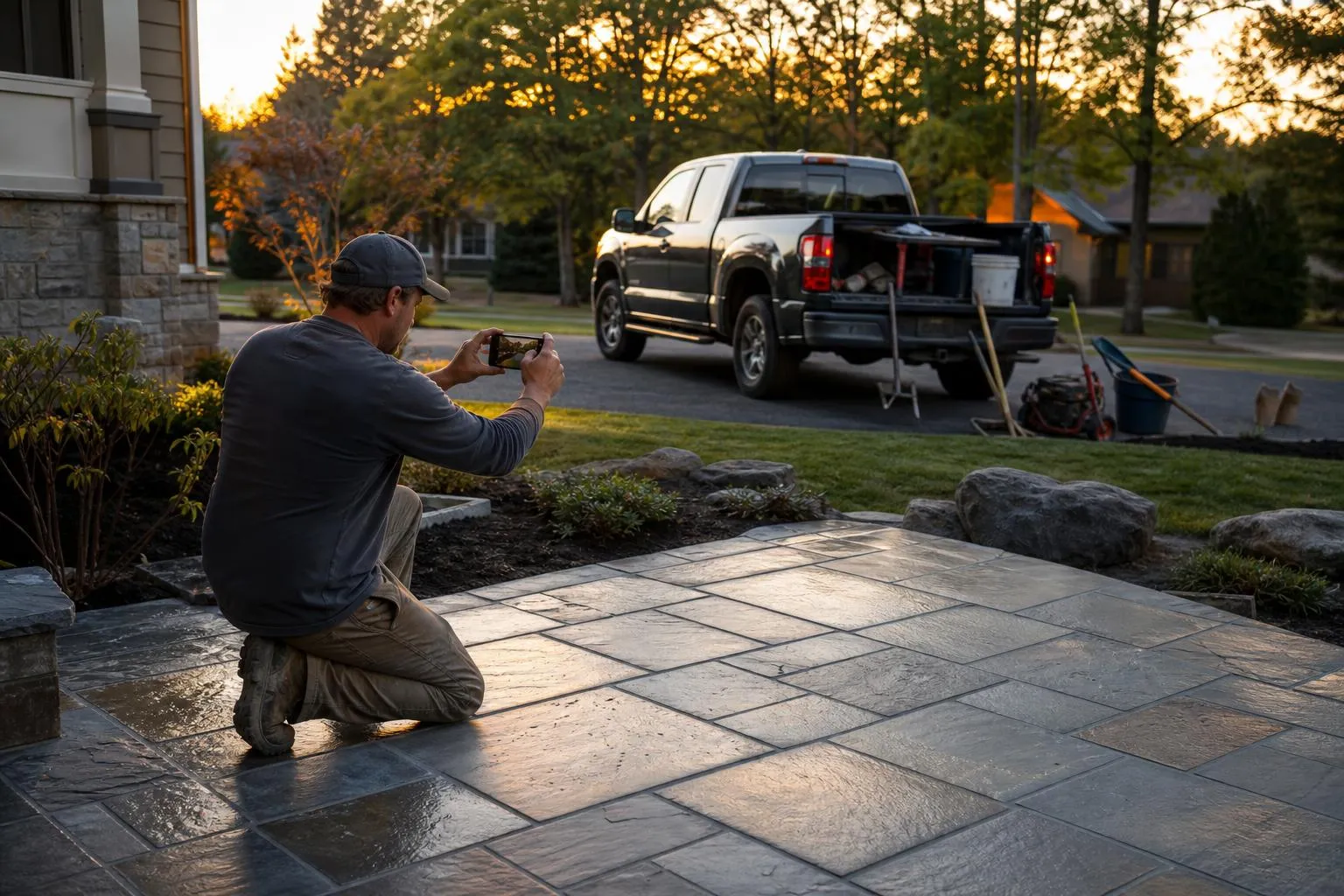
Social proof does the rest. Post before-and-after photos of your work to a Facebook business page and a neighborhood group, and ask your first customers to leave a Google review the day you finish. The channel-by-channel free playbook is in how to promote your landscaping business locally, and the Google side specifically is in how to advertise your landscaping business on Google.
Stay legal, because “free” fines are expensive
Starting cheap does not mean starting illegal, and the cheapest mistake is skipping the paperwork that costs almost nothing. Register the business: a sole proprietorship or a simple LLC and a local business license usually run $50 to $300 total, and the LLC keeps a customer’s lawsuit off your personal bank account. Get an EIN from the IRS for free in ten minutes. This is the foundation, and it is cheap on purpose. The full registration walk-through is in how to set up and register a landscaping business.
The one line you cannot cross for free is chemicals. The moment you apply herbicide or fertilizer for money, most states require a commercial pesticide applicator license from the Department of Agriculture, which means an exam and often separate insurance. Mowing, trimming, mulching, and cleanups need no such license, so start there and add spraying once you are licensed and can charge a premium for it.
Reinvest first, pay yourself second
The discipline that separates a hobby from a business is where the first dollars go. For the first season, the money the route generates goes back into the route: a better mower to cut time, a cheap trailer so you stop dropping ramps, insurance so you sleep, and eventually a helper so you can double the stops. Pay yourself a small, fixed draw and pour the rest back in. A landscaping business that reinvests compounds fast because every upgrade either saves hours or adds capacity.
Partnerships stretch your reach for free, too. A local nursery or garden center sends you install work in exchange for you buying materials there; a real estate agent hands you pre-sale cleanup jobs because a sharp lawn sells the house. Neither costs a dollar, and both plug you into customers you would spend months finding alone. How to turn that first reinvested season into a real growth curve is in how to grow a landscaping business.
Buy a used commercial mower up front
- Cuts your time per lawn dramatically, so you fit more billable stops into the same day.
- A commercial deck handles thick and tall grass a push mower stalls in, opening up bigger jobs.
- Holds resale value, so you can sell and upgrade later with little loss.
Buy a used commercial mower up front
- Even used, it is $1,500 to $3,000 you may not have before the route is proven.
- A big mower cannot access small gated backyards, so you still need a push mower anyway.
- Buying capacity before you have customers is money sitting idle instead of compounding.
Getting found is the part that decides everything
Free marketing gets you the first route, but at some point growth needs to be built, not just hustled, and that is where doing it badly costs more than not doing it. The free moves stay worth it forever: keep the Google profile current with fresh photos, keep asking for reviews, and keep the referral loop turning. Lead-generation tactics beyond door hangers are in how to get clients and customers for a landscaping business.
The higher-stakes part is a real website and paid ads once the route can fund them. A site that ranks for “lawn care near me” and turns searchers into booked estimates is what takes you from your neighborhood to the whole town, and a bad one just quietly hands leads to a competitor. That is the work we do: to have it handled instead of guessed at, get a free website walkthrough. For local SEO and paid ads, see our services. If you have the idea but not the business plan, start at expntl.com.
Frequently asked questions
Can I really start a landscaping business with no money?
Close to it. If you already own a truck, you can put a legal one-person mowing operation on the street for under $1,500 using a used mower, a used trimmer, and a borrowed blower, with maybe $200 more for an LLC and business license. Because customers pay within days, your first few lawns fund every upgrade after that, so you are really starting with a mower and letting the route buy the rest.
What free marketing works best for a new landscaping business?
A fully built-out Google Business Profile is the top free channel because it puts you in front of neighbors searching “lawn care near me.” Right behind it are door hangers you print for pennies and hang on the tightest cluster of houses you want, plus referrals, which convert better than anything and cost only the asking. Post before-and-after photos and collect Google reviews from your first customers to make all of it work harder.
How do I get equipment with almost no cash?
Buy used and rent the rest. A reliable used push mower runs $150 to $300 and a used commercial zero-turn $1,500 to $2,500 on Facebook Marketplace or Craigslist, and grass cuts the same regardless of what you paid. For occasional gear like an aerator or tiller, rent it per job from Home Depot or Sunbelt for $60 to $90 a day and bill the cost to the customer instead of owning a machine that sits all year.
Do I need a license to start mowing lawns for money?
For plain mowing, trimming, mulching, and cleanups, you generally need only a local business license, which is cheap. The moment you apply herbicide, pesticide, or fertilizer for pay, most states require a commercial pesticide applicator license from the Department of Agriculture, with an exam and often separate insurance. Start with the non-chemical services while you study for that license, and never spray for money without it because fines start around $500 per incident.
Should I pay myself or reinvest the money I make first?
Reinvest almost all of it for the first season and pay yourself a small fixed draw. Every early dollar put back into a time-saving mower, a trailer, insurance, or a helper compounds, because it either shrinks your minutes per lawn or lets you add stops. A landscaping business that reinvests early grows far faster than one where the owner cashes out month one, so feed the route before you feed yourself.
Your move
Reading this does not book a job.
The owners who pull ahead are the ones who change one thing this week. If you want that one thing to be a website that sells and ads that put it in front of the right people, we build and run both for you.
Straight answer on whether we can help, usually the same day.