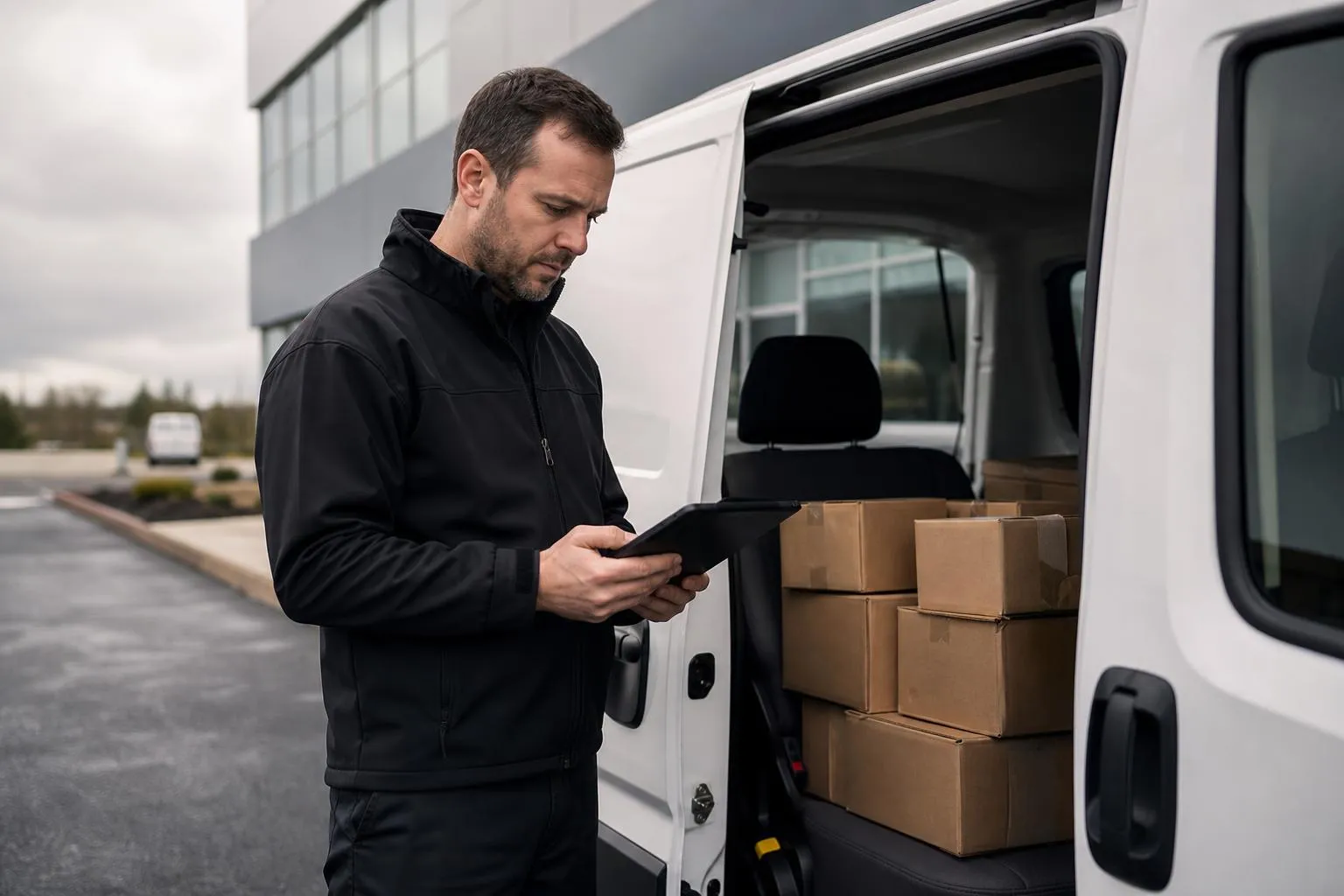
How to start a courier business: Ultimate guide

The courier business that makes money is not the one with the most vans; it is the one with the densest routes. Almost everything that decides whether you profit or spin your wheels comes down to a single idea most new owners miss: you are not paid for the package, you are paid for solving a time problem, and your costs are your own hours and your fuel. That means twelve stops on one tight loop can out-earn thirty scattered across a county. This guide goes deep on the whole model, from which contracts actually pay to the driver structure and the unit economics, so you build a business, not a job that owns you. If you want the launch in strict order instead, that lives in the step-by-step starting guide; this one is the map of the whole territory.
Understand what you actually sell
You are not in the package business; you are in the time-and-reliability business. A law firm does not pay $18 for you to carry paper eight blocks; it pays because missing the 4pm court cutoff costs them a case. A pharmacy pays because a patient without their medication is a liability and a lost customer. Once you internalize that you are selling the removal of a risk, two things follow: you can charge for urgency, and you should chase clients whose problems are expensive, not clients who are simply nearby.
This reframes your whole target list. The best courier customers are businesses with recurring, time-critical, low-tolerance-for-failure needs, because they will pay a premium and stay for years. The worst are one-off consumers comparing you to a $7 rideshare delivery. The complete picture of the business, including the operational discipline, is in how to successfully run a courier business.
Pick the niche, because the niche sets the margin
Not all courier work pays the same, and the difference is enormous. Consumer same-day and food-style delivery is a race to the bottom against apps. Recurring B2B and medical work commands multiples of the rate because fewer couriers can meet the requirements. Choose deliberately.
| Niche | Typical rate | What it demands | Margin quality |
|---|---|---|---|
| Medical / lab (STAT + routine) | $15 to $40/stop + mileage | HIPAA agreement, coolers, reliability | Highest; sticky, recurring |
| Legal filings & process | $12 to $30/stop | Court-cutoff timing, proof of service | High; premium for urgency |
| Pharmacy delivery | $8 to $18/stop | Temperature control, signature, HIPAA | Strong; daily recurring routes |
| Auto parts / B2B supply | $8 to $20/stop | Speed, many stops per loop | Good; dense routes |
| E-commerce local fulfillment | $5 to $12/stop | Volume, tracking, tight windows | Moderate; scales with density |
| Consumer one-off / on-demand | $10 to $25/job | Nothing special | Weak; competes with apps |
The lesson in the table: the requirements that scare off competitors (HIPAA, coolers, court timing) are exactly what protect your rate. Medical and legal are harder to enter and far harder to get undercut in. Most durable courier businesses anchor on one recurring B2B niche and fill the edges with everything else. Where those clients cluster geographically is its own decision, covered in identifying the ideal locations for a courier business.
Do the unit economics before you scale
A courier business succeeds or fails on the math per hour, not per package. Your costs per delivery hour are fuel, vehicle wear (budget $0.15 to $0.30 a mile for maintenance and depreciation on top of fuel), your insurance amortized, and your or your driver’s time. Revenue per hour is stops times average stop value. The entire game is fitting more paying stops into each hour without adding cost, which is why density beats distance every time.
Set prices on the levers that reflect that cost: a base stop fee, per-mile, and premiums for STAT, after-hours, and temperature-controlled loads. Then quote recurring routes as a flat monthly rate once you know the mileage, which clients prefer and which stabilizes your revenue. Getting this right is the difference between a profitable route sheet and busywork; the full method is in setting the best prices and billing for a courier business, and the honest ceiling on earnings is in how much profit a courier business can make.
Choose the driver model deliberately
The fixed cost of a courier business is drivers, and how you structure them decides your risk and your scalability. The common model is 1099 owner-operators: independent contractors who use their own vehicles and get paid per stop or per route. It keeps your fixed costs near zero and lets you scale by signing more contractors. The alternative is W-2 employees in your vehicles, which gives you far more control over quality, scheduling, and branding, at real cost.
1099 owner-operators vs W-2 employee drivers
- 1099 drivers use their own vehicles, so you avoid buying and insuring a fleet.
- You pay only for routes that run, keeping fixed cost near zero on slow weeks.
- You can scale capacity up fast by onboarding more contractors when you win a big account.
1099 owner-operators vs W-2 employee drivers
- You cannot control a contractor’s schedule, appearance, or exclusivity the way you can an employee’s, which risks your service quality.
- Misclassifying a driver who functions like an employee triggers back payroll taxes, workers-comp premiums, and penalties, easily five figures per driver.
- Contractors can quit mid-week or work for a competitor, so an anchor account riding on one 1099 driver is fragile.
The practical rule: start 1099 to stay lean, but understand the classification line, because the IRS and many states look at how much control you exert, not what the contract says. If you dictate hours, require your uniform, and forbid other clients, you have an employee no matter what the paperwork calls them. The hiring and training decision, including when to bring drivers on at all, is in when and how to hire and train staff for a courier business.
Build for density, then grow deliberately
Growth in courier is not “more territory, ” it is “more stops per existing loop.” Adding a driver to cover a whole new sprawling zone often loses money; adding stops to a route you already drive is pure margin. So the growth playbook is: win a second and third client whose stops sit near your existing anchor route, raise the density until the day is full, and only then add a driver and repeat the pattern in a new zone. Route software (Circuit for Teams, OnFleet, or Routific) is what makes higher density manageable and gives clients the tracking they expect.
Scale the operations before the fleet. Systematize dispatch, proof of delivery, and invoicing so a second driver plugs into a machine, not into your memory. The strategic view of expanding without breaking is in how to grow a courier business, and getting and keeping the accounts that make growth possible is in how to get clients and customers for a courier business.
Getting found is the part that decides everything
You can master the economics and the routing and still stall if the phone never rings. The accounts that make the model work are B2B decision-makers who need to trust you before they hand over their medical or legal deliveries, and they check you out before they call.
Free and worth doing this week: claim and fully complete your Google Business Profile with your service area, hours, and real photos of your van and process, and ask every clean-running client for a written recommendation. Those two moves pull in the local searches and referrals that feed your route sheet for free. The wider free playbook is in advertising a courier business.
Now the part that decides it. A pharmacy administrator who hears your name lands on your website before they trust you with patient deliveries, and a slow or vague site loses them in seconds. The gap between a site that turns a cautious B2B buyer into a signed recurring account and one that merely lists services is invisible until you count who actually contacts you. That is the work we do: to have it built to convert, get a free video walkthrough. For the ads and SEO that keep new accounts coming, see our services. If you have the courier vision but not the plan and numbers behind it yet, start at expntl.com.
Frequently asked questions
What kind of courier business is the most profitable?
Recurring B2B work in medical, lab, legal, and pharmacy, because those clients pay a premium for reliability and chain of custody and rarely switch vendors. Consumer on-demand delivery is the least profitable, since it competes directly with rideshare-style apps on price. The requirements that make medical and legal harder to enter, like HIPAA agreements and coolers, are exactly what protect your rate from being undercut.
How much can a courier business actually make?
A single well-run van at healthy route density grosses roughly $6,000 to $12,000 a month, with net profit depending heavily on how dense your routes are and whether you drive or pay a driver. The real earnings jump comes from adding drivers only once your routes are dense enough to keep them fully booked, so profit scales with density, not with headcount. The detailed ceiling is in how much profit a courier business can make.
Should I hire drivers as 1099 contractors or W-2 employees?
Start with 1099 owner-operators to keep fixed costs near zero and scale flexibly, but stay well inside the classification line. If you control a driver’s hours, require your uniform, and forbid them from serving other clients, tax authorities will treat them as an employee regardless of the contract, and misclassification penalties run into five figures per driver. Move to W-2 when you need real control over quality and scheduling for premium accounts.
Do I need my own fleet of vehicles to start?
No, and buying a fleet early is a common way to go broke. Most operators start with one vehicle they already own and, as they grow, add capacity through 1099 owner-operators who bring their own vans, so you scale routes without buying trucks. Invest in a fleet only once dense, proven routes justify the fixed cost and the control it buys.
What’s the difference between this guide and the step-by-step one?
This guide is the deep map of the whole business model: the economics, the niches, the driver structure, and how to scale profitably. The step-by-step starting guide is the strict launch sequence, the exact order of operations from forming your LLC to your first paid stop. Read this one to understand the game, and that one to execute the opening moves in order.
Your move
Reading this does not book a job.
The owners who pull ahead are the ones who change one thing this week. If you want that one thing to be a website that sells and ads that put it in front of the right people, we build and run both for you.
Straight answer on whether we can help, usually the same day.