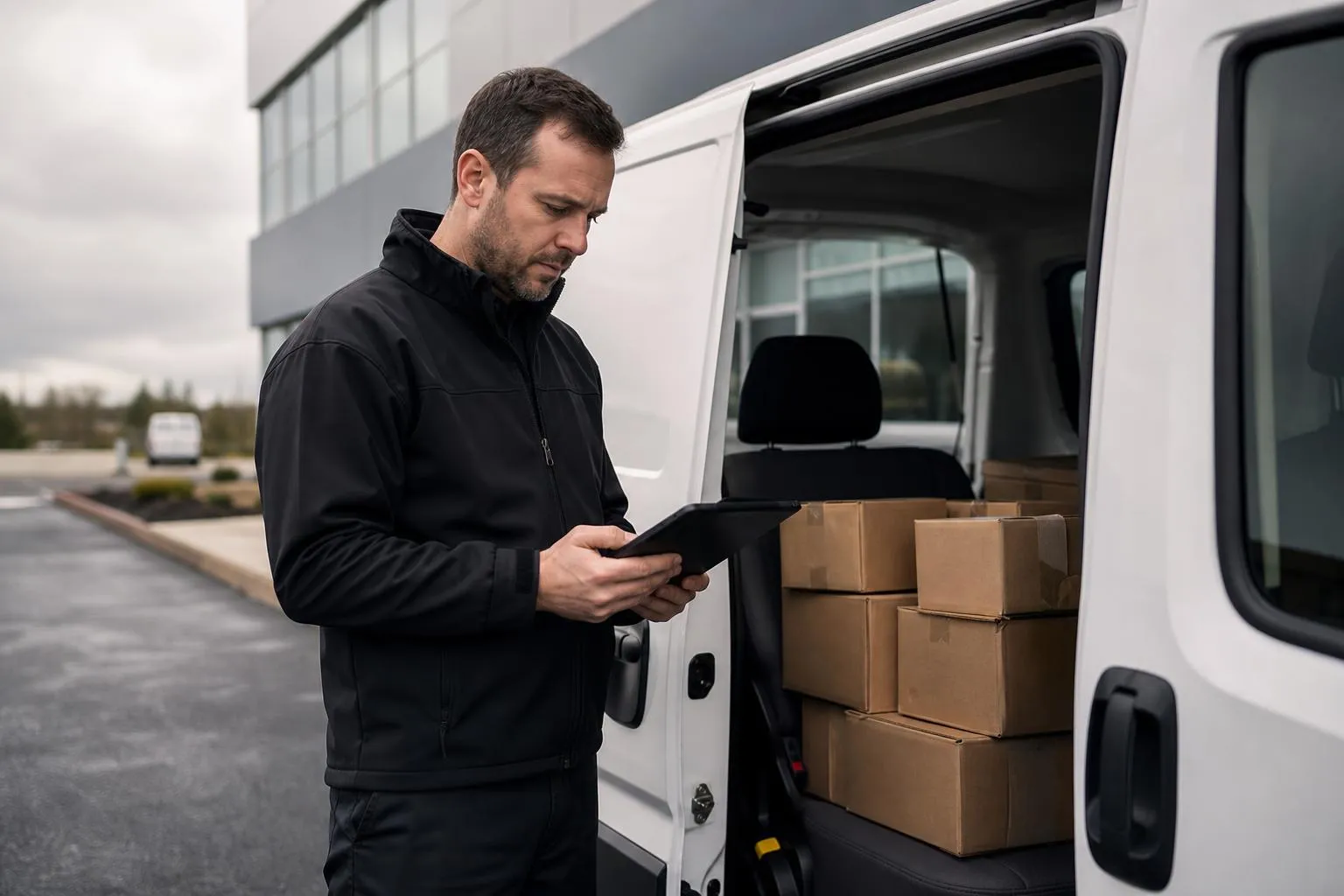
How to grow a courier business

The instinct when a courier business starts working is to buy another van. That is usually the wrong move, and it is how profitable one-van operations turn into stressed two-van operations that make less money. Growth in this business is not about more vehicles on the road, it is about more stops per hour on the roads you already run. You grow by making each route denser and each account stickier before you add the overhead of a second driver. Add vans to fill demand you have already proven, never to chase demand you are hoping for.
Grow density before you grow the fleet
The unit that determines whether a courier makes money is stops per hour, not total deliveries. A driver doing 12 tightly clustered stops an hour is profitable; the same driver doing 4 scattered stops across town is losing money on fuel and time. So the first lever of growth is not more vans, it is packing more paying stops into the routes and hours you already run.
That means when you win a new account, the best kind is one whose pickups and drop-offs sit near a route you already drive. A second pharmacy on the same side of town is worth far more than a bigger account on the opposite edge of your service area, because it adds revenue without adding empty miles. Grow toward density, and the second van becomes obvious only when a single route genuinely cannot hold more.
Grow the base with recurring contracts, not one-off jobs
You cannot grow predictably on delivery jobs that appear and vanish. Predictable growth comes from recurring B2B contracts, the pharmacies, labs, law firms, and e-commerce operations that need a driver on a schedule. Each signed recurring account is a block of guaranteed hours you can build a route around, which is what makes hiring and buying vehicles a calculated move instead of a gamble.
Adding services can widen the base too, but only ones that fit your routes: same-day windows, scheduled recurring runs, refrigerated medical transport, or overnight for legal filings. Every new service should either deepen an existing route or open a sticky vertical, not just add complexity. The sales motion that lands these accounts is in how to get clients and customers for a courier business, and the pricing that keeps them profitable is in setting the best prices and billing for a courier business.
Rank the growth levers by what they actually return
Not every growth move pays the same. Here is how the real levers stack up for a local courier trying to scale profitably.
| Growth lever | Revenue upside | Risk / cost | When to pull it |
|---|---|---|---|
| Fill an existing route denser | High margin | Very low | Always, first |
| Land recurring contracts in your zone | High, predictable | Low, time to sell | Continuously |
| Add dispatch/routing software | Cuts cost 20-30% | Low, $30-$200/mo | Before second van |
| Hire a driver / add a van | Doubles capacity | High: fixed overhead | Only when a route overflows |
| Expand to a new service area | New market | High: starts density at zero | After home zone is dense |
| Chase one-off consumer jobs | Low, unstable | Low but distracting | Rarely, fills gaps only |
The order is the point. Density and recurring contracts come first because they are cheap and high-return. Software comes next because it multiplies everything. Adding a van and expanding to new areas are last, because they add fixed cost and reset your density to zero. Do them in that order and growth funds itself.
Use software and a driver bench to break your ceilings
Two things quietly cap a growing courier: bad routing and no drivers. Fix routing with dispatch software, because manually sequenced routes leave 20% to 30% of the efficiency on the table. Circuit, Onfleet, and Routific optimize stop order, cut miles per delivery, and give clients live tracking, the same tracking that helps you win and keep B2B accounts. At scale, a 25% cut in miles per stop is a direct margin increase across every route. The tooling side is in buying equipment and supplies for a courier business.
The harder ceiling is drivers. In this business, demand is rarely the bottleneck, driver supply is. You cannot say yes to a new pharmacy contract if you have nobody to drive it, and hiring reactively means turning away accounts or scrambling. Build a bench: keep a pipeline of screened 1099 drivers warm so you can staff a new route the week you sign it. The full hiring and training system is in when and how to hire and train staff for a courier business.
Add a full-time driver versus stay solo and dense
- A second driver doubles capacity, letting you say yes to accounts you would otherwise turn away.
- You free your own time to sell and manage instead of driving every stop yourself.
- With two drivers you can cover overlapping routes, so one sick day does not fail a client.
Add a full-time driver versus stay solo and dense
- You take on $4,000 to $7,000 a month in fixed van, insurance, and pay before the routes fill.
- A half-loaded second route bleeds margin, so a bad-timing hire can shrink profit while growing revenue.
- Drivers, training, and quality control become a management job on top of running the business.
The rule that keeps growth profitable: add the driver only once a single route consistently overflows, not to chase an account you are still hoping to close.
Getting found is the part that decides everything
Dense routes and recurring contracts are the engine, but you still have to win the accounts that fill them, and buyers vet you before they sign. Two pieces are free and worth doing this week; the rest is high-stakes work where doing it badly costs more than not doing it.
Free, now: map your densest route corridor and aim all outreach inside it, and complete a Google Business Profile with real van photos and your service area so prospects who look you up see a real, growing operator.
Now the high-stakes part. Every new account you chase runs a ten-second trust test on your website before signing a recurring, time-critical contract. Good means it loads in under three seconds on a phone, states your same-day windows, service area, and tracking, and shows reviews and a click-to-call button above the fold. The gap between a site that converts a wavering ops manager and a pretty one that loses them is invisible until you compare who actually books. This is the work we do. To have it handled, get a free video walkthrough. For Google Ads, SEO, and local promotion run properly, see our services. If you have the growth plan half-formed, sharpen it at expntl.com.
Frequently asked questions
What is the fastest way to grow a courier business?
Make your existing routes denser before you add anything. Every stop you pack into a route you already drive is nearly pure margin, because the van and driver are already paid for. So win recurring accounts whose pickups and drop-offs sit near your current routes, and only add vehicles once a single route genuinely overflows.
Should I buy a second van to grow?
Only when an existing route is consistently full and turning work away, never to chase an account you are still hoping to close. A second van and driver add $4,000 to $7,000 a month in fixed cost, and a half-loaded route bleeds money. Owners who add headcount ahead of density usually grow revenue while shrinking profit.
What software helps a courier business scale?
Route and dispatch platforms like Circuit, Onfleet, and Routific. They optimize stop order, cut miles per delivery by 20% to 30%, and give clients live tracking that also helps you win and keep B2B accounts. At scale, a 25% cut in miles per stop is a direct increase in margin across every route you run, for $30 to $200 a month.
What actually limits how fast a courier can grow?
Driver supply, not customer demand. You cannot accept a new recurring contract with nobody to drive it, and hiring reactively forces you to turn accounts away or scramble. Keep a bench of screened 1099 drivers warm so you can staff a new route the week you sign it, and recruiting stops being the thing that caps your growth.
How do I grow without losing service quality?
Grow into density and keep recurring accounts stickiest by never failing them. Add routing software for live tracking and tighter routes, communicate proactively when a delivery runs late, and only take on new volume you have the drivers to cover well. Controlled, dense growth protects the on-time record that wins referrals; overreaching to grab distant accounts is what breaks it.
Your move
Reading this does not book a job.
The owners who pull ahead are the ones who change one thing this week. If you want that one thing to be a website that sells and ads that put it in front of the right people, we build and run both for you.
Straight answer on whether we can help, usually the same day.