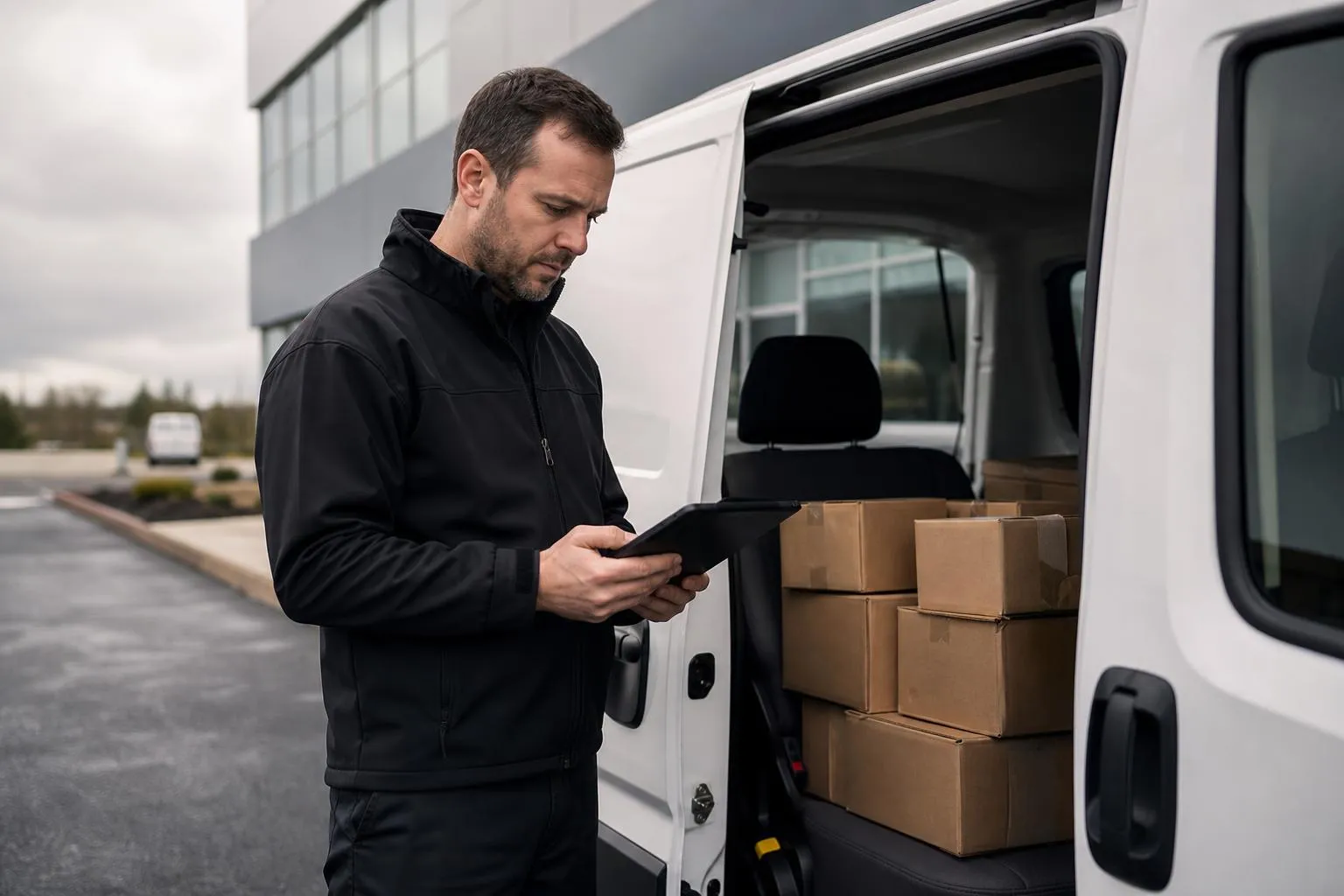
How to successfully run a courier business

Running a courier business well is not about moving more packages. It is about protecting two numbers until they become a habit: the percentage of stops that hit their window, and the dollars it costs you to make each one. Owners who watch revenue go up while those two numbers quietly rot are the ones who fold in year two. Here is how the operators who last actually run the day.
Run the recurring routes, chase the on-demand
The couriers who survive are not the ones fighting Uber and DoorDash for hot food. They run the boring recurring stuff: a pharmacy that needs the same 40 prescriptions delivered every afternoon, a law firm that files at the courthouse daily, a lab that shuttles specimens between three clinics on a fixed loop. That work is unglamorous, it pays net-30, and it books the same route every day so your truck is never empty.
On-demand same-day is your high-margin topping, not your base. A rush legal filing or an emergency parts run bills two or three times the standard rate because the customer has no alternative at 3pm. The mistake is building the whole business on it. On-demand is lumpy, it strands you with idle drivers on slow days, and it never gives you the predictable recurring revenue a lender or a landlord wants to see. Land the recurring B2B clients first, then let on-demand fill the gaps.
Protect the on-time rate like it is the product
In courier work, on-time delivery rate is the product. A pharmacy does not care that you are cheap if the insulin misses its window. Track it per account, not just company-wide, because one failing route can hide inside a good average while it quietly loses you a contract. Above 97% is the floor for medical and legal work; below 95% and you will start getting the “we’re exploring other options” email.
The failure is almost never the driver being lazy. It is the route being built wrong: too many stops crammed into rush hour, a new hire guessing at addresses, or a dispatcher who took a 20th stop the truck could not physically reach. Use routing software (Circuit for Teams, Onfleet, or OptimoRoute) so the route is planned by drive time and time windows, not by the order calls came in. The software pays for itself the first month it saves one dropped medical stop.
Make route density do the work
Two couriers can bill the same $600 in a day and one keeps $400 while the other keeps $150. The difference is density. Fifteen stops packed into a 3-mile downtown loop burn a gallon of gas and two hours; fifteen stops scattered across a 40-mile county burn a tank and a full day. Same revenue, wildly different cost per stop, and cost per stop is the number that determines whether you actually made money.
Build your book geographically, not just by who says yes. Turning down a profitable-looking account 30 miles outside your zone is often the right call, because it drags a driver off the dense loop that pays the bills. If you must serve the outlier, cluster it: pick up and drop several stops in that pocket on the same run, or charge a zone surcharge that pays for the dead miles. Read more on drawing that zone in identifying the ideal locations.
| Route shape | Stops | Miles driven | Approx. cost per stop | What it tells you |
|---|---|---|---|---|
| Tight urban loop | 15 | 8 | $3 to $4 | The route you want to fill first |
| Suburban cluster | 15 | 25 | $6 to $8 | Fine if the per-stop price covers it |
| Scattered county | 15 | 55 | $11 to $15 | Only viable with a zone surcharge |
| Single rush run | 1 | 18 | $18 to $30 | Price it as premium or decline it |
Watch the meters that actually move: fuel, maintenance, insurance
A courier business is a rolling cost machine, and three meters eat your margin: fuel, vehicle maintenance, and insurance. Fuel is obvious but under-managed. A fleet card (WEX, Fuelman) gets you 3 to 8 cents off per gallon and a per-vehicle spend report that surfaces the driver who is idling or running personal errands on your dime. On 3,000 miles a month per van, that is real money and real accountability.
Maintenance is where owners get lazy and pay for it. A van down for a transmission is not just the $4,000 repair, it is the routes you cannot cover and the contract you might lose covering them badly. Run oil, tires, and brakes on a calendar, not on a breakdown. And insurance is the line people try to shrink and should not: commercial auto plus cargo/inland marine coverage runs roughly $2,500 to $6,000 per vehicle per year, and hired-and-non-owned coverage is mandatory the day a 1099 driver uses their own car for you. Skimping here is not saving money, it is deferring a much bigger bill.
Only hire when the math forces it
The instinct is to hire when you feel busy. The discipline is to hire when the numbers say you are turning away profitable, dense work you cannot cover. A second driver is real fixed cost, so add one when your existing routes are consistently full and you are declining stops inside your core ZIPs, not when you are simply tired. The full trigger and the 1099-versus-W-2 call are laid out in when and how to hire.
Independent contractor drivers vs employee drivers
- No payroll tax, workers’ comp, or paid downtime; you pay only for stops or routes actually run.
- Scale up for a holiday surge and back down in January without layoffs or unemployment claims.
- Drivers supply and maintain their own vehicles, keeping your fixed fleet cost near zero.
Independent contractor drivers vs employee drivers
- Limited control over schedule, uniform, and process, which is exactly what medical and legal accounts scrutinize.
- Misclassify a 1099 driver you actually control like an employee and back taxes plus penalties can run into five figures per driver.
- Turnover is higher, so your on-time rate wobbles every time a route changes hands to someone who does not know it.
Getting found is the part that decides everything
You can run flawless routes and still stall if operations managers never find you. Two pieces are free and worth doing this week. First, claim and complete your Google Business Profile with your service area, your niches (medical, legal, same-day), and real photos of a labeled van; local searches for “same day courier near me” and “medical courier [city]” are how B2B buyers shortlist. Second, build a one-page list of every pharmacy, clinic, law firm, and lab in your dense ZIPs and call ten a week; recurring B2B is won on the phone, not on ads. The local playbook is in how to promote your courier business locally.
The higher-stakes piece is a site that turns a searching ops manager into a booked account. That means it loads in under three seconds on a phone, names your niches and service area, shows proof you hit windows, and puts a quote request and a phone number above the fold. The gap between a site that books contracts and a pretty one that does nothing is invisible until you compare the leads. That is the work we do. To have it handled instead of guessed at, get a free video walkthrough. For Google Ads, local SEO, and paid social, see our services. If you have the idea but not the plan yet, start at expntl.com.
Frequently asked questions
What is a good on-time delivery rate for a courier business?
Aim for 97% or higher on medical and legal accounts, where a single miss can trigger a termination clause. General e-commerce and retail work is more forgiving, but below 95% overall you will start losing contracts to competitors. Track the rate per account, not just company-wide, so one failing route cannot hide inside a healthy average.
How do I lower my cost per stop?
Density and routing. Cluster your stops into tight ZIP-code loops so a driver makes more deliveries per mile, and use routing software like Circuit or Onfleet to sequence by drive time instead of call order. On a well-built urban loop, cost per stop can sit around $3 to $4; on scattered county work it climbs past $12, which is why you either cluster those outliers or charge a zone surcharge.
Should I focus on B2B contracts or on-demand gig work?
Build the base on recurring B2B contracts (pharmacy, legal, lab, parts) because they refill the same route daily and pay predictably on net-30. Use on-demand same-day work as your high-margin topping, since it bills two to three times the standard rate but arrives unpredictably. A healthy book is roughly 60% to 80% recurring, with on-demand filling the gaps.
What software do I actually need to run routes?
At minimum, routing and dispatch software so routes are planned by drive time and time windows rather than by the order calls came in. Circuit for Teams, Onfleet, and OptimoRoute are the common choices, and most run $20 to $40 per driver per month. The tool pays for itself the first time it prevents a dropped medical stop that would have cost you the account.
How many packages a day does a courier need to be profitable?
It depends far more on density than raw count. A single driver running 40 to 60 stops inside a tight urban loop can be very profitable, while 25 stops scattered across a county may lose money on fuel and hours. Watch cost per stop and stops-per-route rather than total volume, because a smaller, denser route often out-earns a larger, spread-out one.
Your move
Reading this does not book a job.
The owners who pull ahead are the ones who change one thing this week. If you want that one thing to be a website that sells and ads that put it in front of the right people, we build and run both for you.
Straight answer on whether we can help, usually the same day.