Identifying the Ideal Locations for a Roofing Business
Where you swing your service area decides 50% of the business. A roofer in the hail belt of Dallas, Denver, or Oklahoma City has insurance pipeline volume that a roofer in Portland Maine will never see. A roofer working 1980s-built subdivisions has reroof demand that a roofer in a 5-year-old neighborhood does not. Here is how to pick the geography.
Home age is the first filter
Asphalt shingle roofs last 18-25 years. The reroof market in any neighborhood is essentially a curve that hits its peak at year 22. Pull up your county property records (most are free online) and filter for homes built between 1995-2010. Those are the homes coming due now.
| Build era | Where it sits in 2026 | The play |
|---|---|---|
| 1995-2005 | At or past the 18-25 year mark | Canvass and sign these streets now; highest close rates |
| 2005-2015 | Coming due 2026-2035 | Plant reviews and brand presence now, harvest in 2-5 years |
| Pre-1970 | On a second or third roof | Higher tickets, more decking work, lower volume |
| Under 10 years old | A decade out | Repairs and storm damage only; do not canvass for reroofs |
The reason the curve is so sharp is worth understanding, because it is the whole targeting model. Insurance does not pay for worn-out roofs, so retail demand waits until shingles visibly fail: cupping, granule loss, the first leak. In a subdivision where every house went up within 18 months of each other, those failures arrive together, street by street. The first two or three reroofs on a block are the hard sells; after that, every homeowner has watched the neighbors’ tear-offs and priced their own roof mentally. You want to be the company whose sign was in those first yards.
What this looks like on the ground:
- 1990s subdivisions of 200-1,000 houses are the gold zone. Drive them, canvass them, put yard signs there, and run Facebook ads to those zip codes, the same zips you should feed into how to advertise your roofing business.
- 2005-2015 builds will start hitting in 2026-2030. Build relationships now.
- Older custom homes (1960s and before) have higher tickets but lower volume and often need more decking work.
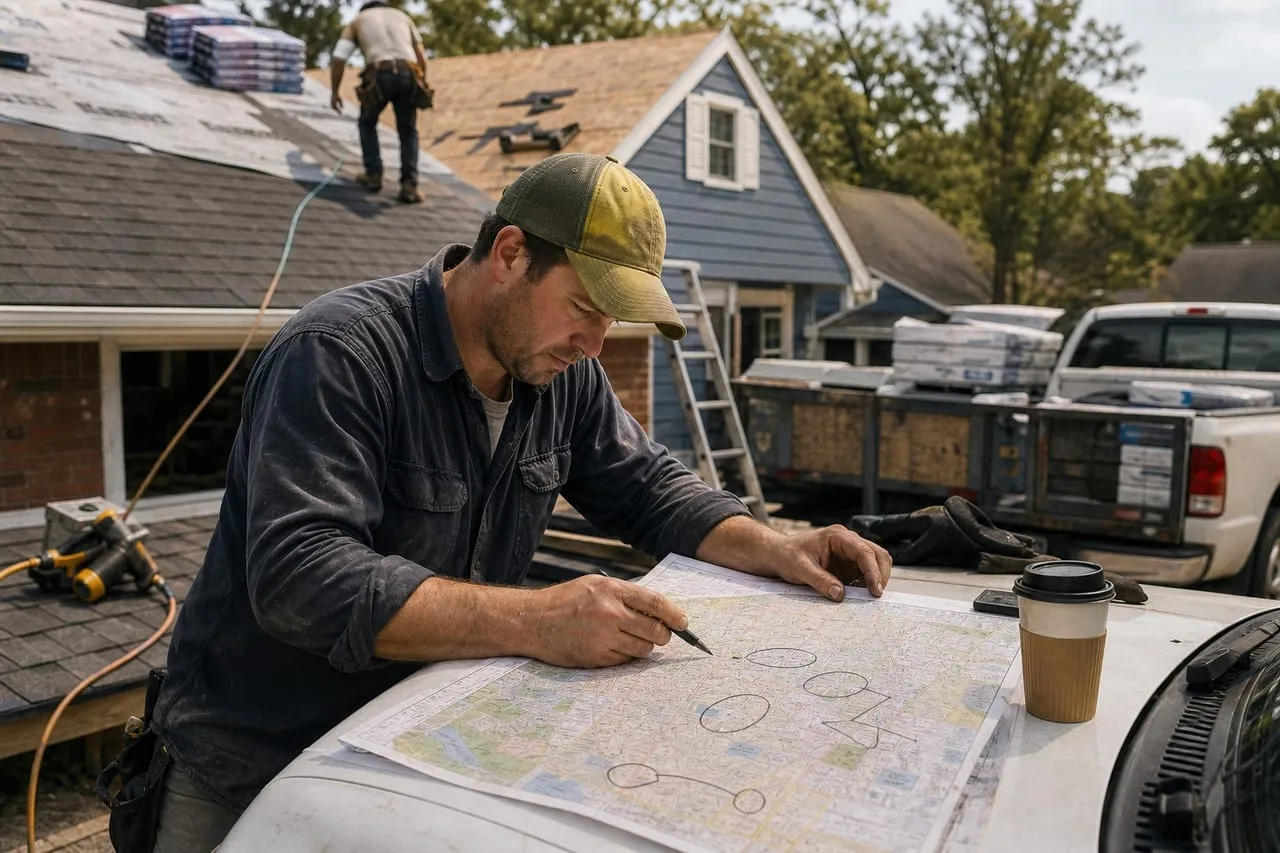
A simple targeting rule: pick three to five neighborhoods of 500+ homes within 20 minutes of your truck base. That’s your starter map.
Storm exposure changes the model
If you live within the “hail alley” (a corridor from Texas through Nebraska into Colorado and Wyoming), or in a hurricane region, the business model shifts. Insurance restoration becomes the dominant work type, not retail reroofs.
Storm-active markets look like:
- Texas Triangle (Dallas-Houston-San Antonio) - hail and wind.
- Colorado Front Range (Denver, Colorado Springs, Fort Collins) - hail.
- Oklahoma and Kansas - hail and tornadoes.
- Florida and Gulf Coast - hurricanes.
- Carolinas inland - hail and wind.
In these markets, post-storm door-to-door is the dominant lead engine. A single supercell can drop 5,000 hail claims in a county overnight, and the roofer who is on the streets within 48 hours captures them. See how to get clients for a roofing business for canvassing scripts.
Whether to build the company around that pipeline is a real strategic fork, not a free upgrade:
Building around storm work: pros
- One event books a season; volume arrives in waves no ad budget can buy
- Price resistance drops because the carrier pays, not the homeowner
- Supplements and code-upgrade scope add 10-15 margin points over retail
Building around storm work: cons
- Revenue is event-driven; a hail-free year empties the calendar you staffed for
- Carrier accreditation and adjuster relationships take 18-36 months to build
- Checks land in 60-90 days, so you float payroll and materials the whole time
The blend most hail-belt shops settle into: a retail reroof base sized to keep crews busy in quiet months, with storm capacity layered on top through piece-rate sub crews who scale up after an event and roll off when the wave passes. Outside the storm belt, do not force restoration; steady retail demand from old roofs is the better business, just a slower one.
Commute radius and crew logistics
Drive time is overhead. A crew that spends 90 minutes getting to a job loses 1.5 hours of billable time per day, two days a week. Math:
- 30-minute service radius: most roofers’ comfort zone.
- 45-minute radius: viable if average ticket is above $15k.
- 60+ minutes: only for commercial flat roofs or full-week tear-offs.
Stack your service area as concentric rings from your truck base. Bid jobs in the outer ring at slightly higher prices to cover drive time. Decline jobs in the third ring unless they are insurance restoration with full scope and supplements.
The “neighbor magnet” effect
A single completed roof in a neighborhood produces 1-3 additional jobs on the same block within 12 months. Reasons:
- Yard sign visibility during the install.
- Neighbors talking over fences.
- Aging neighborhood means several roofs are within 1-2 years of each other.
- Trust transfers locally.
This is why concentrating your first 20 jobs in three target neighborhoods beats spreading them across a 40-mile radius. The compounding lead flow alone justifies tighter geography. See how to promote roofing locally for the full neighbor-magnet playbook.
Concentration also builds a moat that spread-out work never does. Ten roofs in one subdivision makes you “the roofer who did the Hendersons’ and the corner house,” a position no out-of-area competitor can canvass away, because every door they knock already has your hanger and a neighbor’s recommendation behind it. The operational side compounds too: the supplier branch knows the delivery routes, the permit office knows your paperwork, and crews stop burning mornings on unfamiliar drives. Five jobs scattered across five towns generate five first impressions; five jobs on two streets generate a reputation.
The discipline this demands is saying no, and it is the part owners struggle with in year one. A $14,000 job 70 minutes away feels unrefusable when the calendar has gaps. But it consumes the crew-days, the fuel, and the management attention that would have planted two more signs in your core zone, and it produces zero neighbor effect because you will never canvass that street again. Take it only at outer-ring pricing, and treat every in-zone job as worth more than its invoice says.
Frequently asked questions
What if I live outside a storm zone?
Stick to retail reroofs and lean harder on Google Business Profile + Local Service Ads. The volume is lower but the margins are steadier and the legal complexity is minimal.
How do I find home-age data?
County assessor websites are usually free. Some markets have it in MLS. Tools like PropertyRadar, Reonomy, or Batch Leads aggregate it nationally for $50-$200/month.
Should I chase storms in other states?
Out-of-state storm chasing has a bad reputation, often deserved. Several states have anti-storm-chaser laws and licensing requirements. Stick to your licensed states unless you build a permanent satellite operation.
How many neighborhoods can one crew cover?
Three to five primary zones within a 30-minute radius is the sweet spot for a single crew. Past that you spread thin and lose the neighbor-magnet effect.
Is rural worth it?
Lower job volume but less competition. A rural roofer with a Google Business Profile and one solid review base often dominates a 50-mile radius with one crew. Ticket sizes are smaller but margins can be similar.
Your move
Reading this does not book a job.
The owners who pull ahead are the ones who change one thing this week. If you want that one thing to be a website that sells and ads that put it in front of the right people, we build and run both for you.
Straight answer on whether we can help, usually the same day.