How to start a pressure washing business, step by step
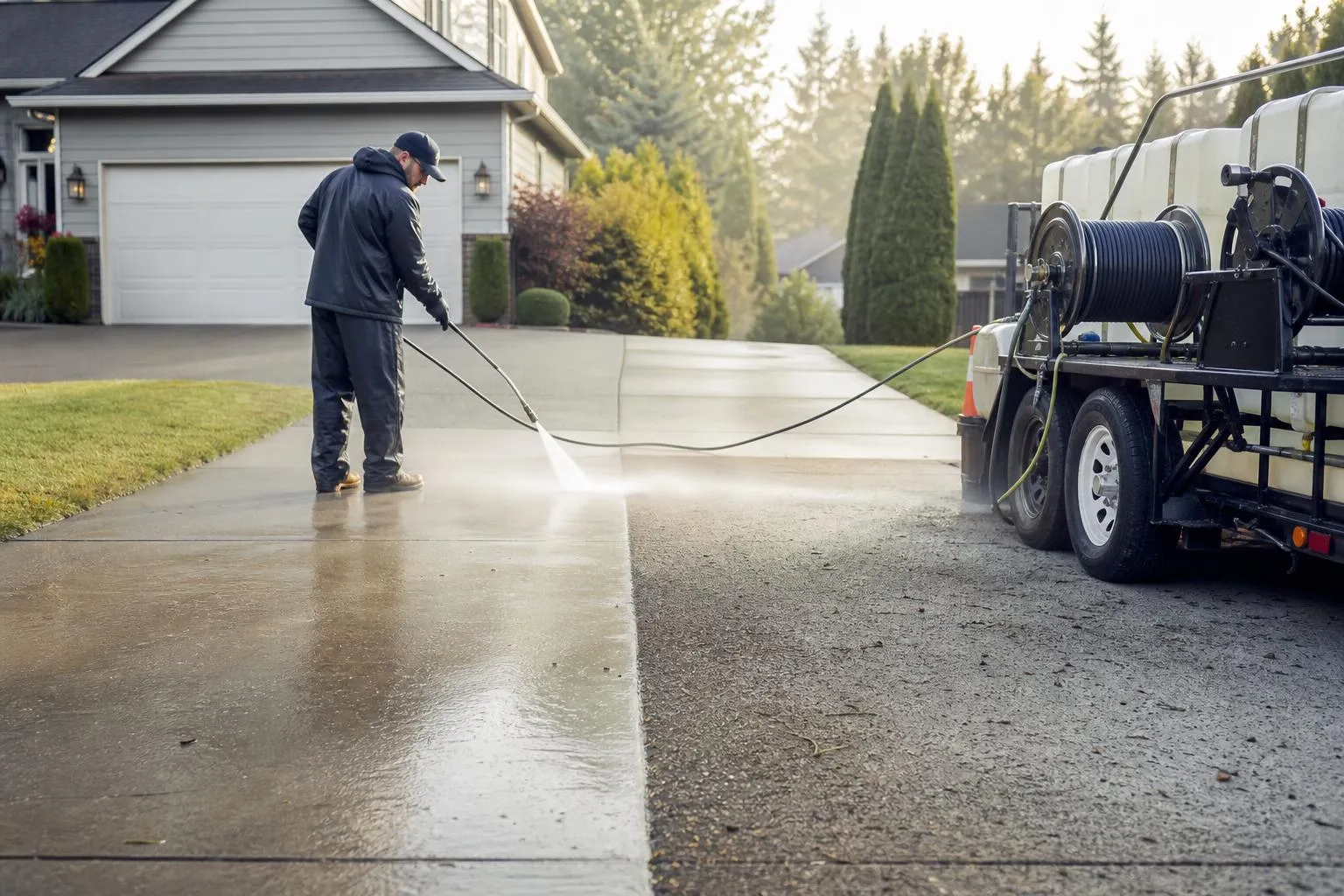
Most people start a pressure washing business in the wrong order. They buy a $7,000 machine first, then realize no commercial client will let them on the lot without an insurance certificate, and the machine sits in the garage for a month. The right order is the reverse: make yourself legal and insurable in week one, buy the smallest rig that does real work in week two, and spend weeks three and four getting your first five customers before you have spent a dime on ads. Here is that sequence, laid out as a 30-day plan you can actually follow.
Step 1: Register and insure before anything else
Form an LLC with your secretary of state ($50 to $500 depending on the state), then get a free EIN on irs.gov the same day. Add a local business license or permit if your city requires one. This is the boring part that unlocks everything else: a business bank account, supplier accounts, and, critically, insurance. The detailed walkthrough lives in setting up and registering.
Then bind general liability insurance, $1M per occurrence is the standard ask, which runs roughly $500 to $1,500 a year for a solo operator and is often payable monthly. You need the certificate of insurance (COI) in hand before you can work for any HOA, property manager, or commercial account, and before some equipment suppliers will open a net account. Do this in week one and everything downstream stops being blocked.
Step 2: Buy the smallest rig that does real work
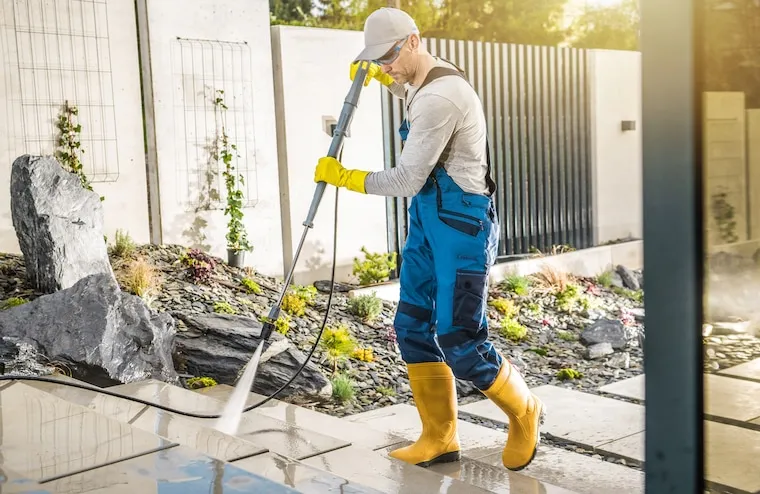
You do not need a wrapped truck or an 8 GPM hot-water skid on day one. A residential-capable cold-water setup handles the vast majority of first jobs: a 4 GPM, 4000 PSI belt-drive machine (a name like Simpson, BE, or a Honda/GX-powered unit), a 20-inch surface cleaner so you are not wand-striping every driveway, 150+ feet of hose, and a soft-wash setup (a 12V pump and downstream injector) for house siding and roofs, which must never be hit with high pressure.
| Item | Budget range | Why it matters |
|---|---|---|
| 4 GPM cold-water pressure washer | $1,200 to $2,800 | GPM (flow) rinses; PSI (pressure) cuts. Flow is what saves you time. |
| 20-inch surface cleaner | $250 to $600 | Turns a 2-hour striped driveway into a 30-minute even clean |
| Soft-wash setup (12V pump + injector) | $200 to $700 | The only safe way to do siding and roofs; high pressure destroys them |
| Hoses, reels, wands, tips, ladder | $400 to $900 | The daily kit that connects it all |
| Sodium hypochlorite + surfactant chemicals | $150 to $400 | Cleaning is chemistry; pressure alone leaves mold roots behind |
That is a $2,500 to $6,000 working rig, and you can pull it in an open trailer behind the vehicle you already own. The full breakdown is in buying equipment and supplies, and if cash is genuinely tight, starting with no money covers renting a machine for the first jobs.
Step 3: Set one price sheet before you quote anyone
Decide your pricing before the first customer asks, or you will lowball on the spot and regret it. Two common models: per square foot (roughly $0.15 to $0.35 for flat concrete, $0.20 to $0.60 for house soft wash) or flat rates by job type (a typical driveway $100 to $250, a single-story house wash $250 to $500). Set a minimum service charge, $125 to $175 is common, so a tiny job is still worth the drive and setup.
Write down three or four standard packages so quoting takes two minutes. The full method, including how to bid commercial and how to bill, is in setting prices and billing.
Step 4: Get your first five customers off your own street
Your first five jobs should cost you nothing in ads. Do your own driveway and house, shoot clean before/after photos, and post them into 5 to 8 local Facebook groups with a first-customer offer. Knock on the doors of the houses on either side of a job while your machine is out; the “I’m already on your street” pitch closes at a remarkable rate. Tell every friend and neighbor. This is how you validate that your price and offer actually land before you spend money scaling.
The point of the first five is not profit, it is proof: real photos, real reviews, and a real sense of how long each job takes so your future quotes are accurate. Deeper tactics are in getting your first clients and promoting locally.
Buy leads on day one vs earn the first five free
- Free first-five (your street, groups, referrals) costs nothing and proves your offer works before you risk ad money.
- The photos and reviews you collect become the exact assets your future ads and website need.
- You learn true job times, so your later quotes are accurate instead of guesses.
Buy leads on day one vs earn the first five free
- Free leads come in slower, so week three feels quiet compared to paying for volume.
- You are limited to your own network’s reach until the referral flywheel catches.
- It takes discipline to ask every customer for the photo and the review, and it is easy to skip.
For a first launch, earn the free five, then turn on paid channels once you have proof and a price sheet that holds.
Getting found is the part that decides everything
Two free steps the moment you are legal: create and verify a Google Business Profile with real before/after photos so “pressure washing near me” can find you, and post your first job into local groups. Both cost nothing and both start the flow of inbound calls.
Then the high-stakes part. A website is not a brochure; a good one loads in under three seconds on a phone, ranks locally, and turns a searching homeowner into a booked job with a click-to-call button above the fold. The gap between a site that converts and one that just looks fine is invisible until you compare the lead numbers, and doing it badly quietly costs more than not having one. That is the work we do. To have the site built to convert instead of guessed at, get a free video walkthrough. For ads and SEO once you are ready to scale past your street, see our services. If you have the idea but not the full business plan, start at expntl.com. When you outgrow this launch checklist, the ultimate guide goes deeper on every pillar.
Frequently asked questions
How much money do I need to start a pressure washing business?
A lean, legal start runs about $3,000 to $7,000: LLC filing and first insurance installments, a 4 GPM cold-water rig with a surface cleaner and soft-wash setup, hoses, and chemicals, pulled in a trailer behind a vehicle you already own. You do not need a wrapped truck or a hot-water skid to book your first jobs.
Do I need a license to start?
You need an LLC (or another registered entity) and, in many cities, a local business license or permit, but there is no national pressure washing certification required to operate. What you truly cannot skip is general liability insurance, because HOAs, property managers, and commercial clients will not let you on site without a certificate.
How long does it take to get up and running?
About 30 days if you work the steps in parallel: registration and insurance in week one, equipment in week two, and your first customers in weeks three and four. The bottleneck is usually insurance paperwork, so start that on day one.
What should I buy first, and does PSI or GPM matter more?
GPM matters more. Buy a 4 GPM commercial machine with a 20-inch surface cleaner and a soft-wash setup before anything fancier. Flow (GPM) is what rinses dirt away and saves you time; high PSI at low flow damages surfaces and makes you crawl.
Where do I find my very first customers?
Your own street and local Facebook groups. Clean your own driveway, post the before/after with a first-customer offer, and knock on the neighbors’ doors while your machine is out. Earn five jobs and five reviews that way before spending a dollar on ads, so you validate the offer first.
Your move
Reading this does not book a job.
The owners who pull ahead are the ones who change one thing this week. If you want that one thing to be a website that sells and ads that put it in front of the right people, we build and run both for you.
Straight answer on whether we can help, usually the same day.