How to get clients and customers for a pressure washing business
Most new washing operators think getting customers is an online problem. It isn’t, not at the start. The fastest paying customers come from the street you’re already standing on, the property manager who’s tired of a dirty sidewalk, and the happy homeowner who knows three neighbors with the same green siding. Ads work, but they’re the slow-burning half. This is the ground game: how to fill next week’s schedule with your boots, your truck, and the jobs you’ve already done.
Farm the street you’re already on
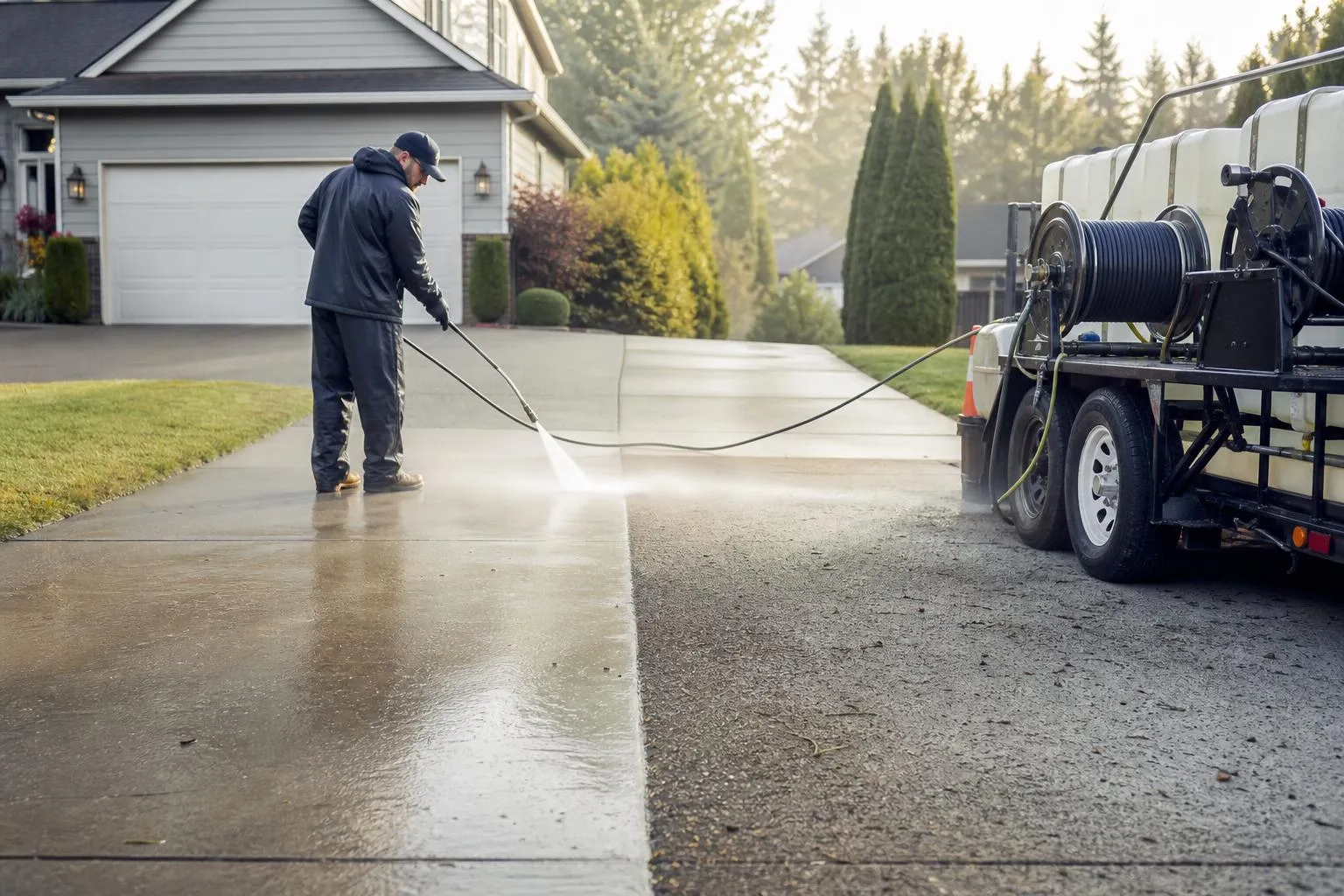
When you finish a driveway, you have a truck, equipment, and undeniable proof parked in front of a whole street of similar houses. That’s the moment to hang door-hangers on the ten homes on either side. The pitch writes itself: “We just cleaned your neighbor’s driveway at [address]. Want yours done while we’re in the area? Text for a same-week price.” Neighborhood mail-merge flyers get ignored; a flyer that says “we’re literally next door right now” gets calls.
Cold door-hangers across a fresh subdivision convert at roughly 1% to 3%, which sounds small until you realize 300 hangers on a Saturday morning is three to nine leads for the cost of paper and an hour. Target the neighborhoods that match your best jobs: the right locations are homes 15-plus years old with concrete drives, HOA-maintained streets, and mid-range values where people pay for curb appeal but do their own yard work.
Land one recurring account and stop starting over
One-off driveways are a treadmill: you’re only as booked as this week’s marketing. The way off the treadmill is recurring commercial and community work. An HOA that needs its sidewalks, entrance monuments, and pool deck done twice a year is worth more than a dozen random driveways, and it books itself once you’re in. Same with a strip of storefronts, a property management company’s rental turnovers, a gas station’s forecourt, or a restaurant’s grease-stained back patio on a monthly cadence.
Go get them directly. Walk into the storefront and talk to the manager about the dirty entrance customers walk over. Email the property manager, not a generic address, with a before/after of a similar building. Show up to the HOA board meeting with one clean and one dirty photo of their own common area. Commercial buyers care about liability (a slippery, algae-covered walk is a lawsuit) and appearance, so sell those, not “clean.” Pricing these recurring jobs is its own skill, covered in setting prices and billing.
Turn every finished job into the next two
Referrals close higher than any ad because trust transfers with the recommendation. Yet most operators never ask, or they mumble “tell your friends” and leave. Make it a system. At the end of every job, while the customer is admiring the clean concrete, ask directly: “Really glad you’re happy. Do you know a neighbor whose driveway or siding could use this? Send them my way and I’ll take $25 off your next visit.” Hand them two business cards, one to keep and one to pass.
Then follow up. A text a week later (“Thanks again, [name]! If anyone asks who did your driveway, here’s my number”) keeps you top of mind. Referrals and reviews feed each other, and both amplify whatever you’re doing on Facebook and Google.
| Channel | Cost per lead | Close rate | Speed to first job |
|---|---|---|---|
| Referral from a happy customer | ~$0 (or $25 thank-you) | 50% to 70% | Days |
| Door-hangers on a fresh street | Pennies each | 1% to 3% of doors | Same week |
| HOA / commercial direct outreach | Your time | Low volume, huge value | Weeks, then recurring |
| Local group / community post | Free | Moderate | Days |
| Paid ads (Google / Facebook) | $8 to $90 | Moderate | Same week, ongoing |
Cluster the work or the math never closes
The customer you want isn’t just any customer; it’s the one near the customers you already have. Every job scattered across town costs you windshield time you can’t bill and fuel you can’t recover. So price and market for clusters. Offer a small “neighbor discount” when two houses on the same street book the same day. Block your calendar by area, washing one part of town on Tuesdays and another on Thursdays. Route density is the single biggest lever on daily revenue once you’re booked.
Chase residential one-offs
- Fast cash: a homeowner can say yes and pay the same week.
- Every job is a fresh before/after photo and a shot at referrals.
- Low barrier: you can start booking these on day one with a truck and flyers.
Chase residential one-offs
- The treadmill never stops; next week’s income depends on this week’s hustle.
- Jobs scatter across town, eating drive time and fuel unless you farm clusters.
- Seasonal and weather-dependent, with dead winter weeks in cold climates.
The mature move is to use residential one-offs to fund the hunt for recurring commercial and HOA accounts, then let those steady contracts carry the slow months while referrals and clustered driveways fill the rest.
Getting found is the part that decides everything
Two things cost nothing and belong in your routine today. Hang door-hangers on the ten nearest homes every time you finish a job, and ask every happy customer for a neighbor referral with a $25 thank-you before you pull away. Those two habits fill more of next week’s schedule than most people’s ad spend.
The online side is where doing it badly costs more than skipping it. When a referred neighbor or a curious homeowner looks you up, a slow or missing website loses the job you already half-earned, and untracked ads bleed money on the wrong leads. That’s the work we do. To get the site that closes the people your ground game sends to search, get a free video walkthrough. For Google Ads, local SEO, and paid social done right, see our services. If you’ve got the business but not the plan, start at expntl.com.
Should you win customers yourself, or hand it off?
Door hangers, referrals, and knocking on commercial doors are the cheapest customers you will ever win, and for a washing business they should stay firmly in your own hands. The paid layer is the only real question: whether the hours and the wasted spend of learning Google and Facebook cost more than paying a team that runs them daily. We wrote an honest breakdown of when that spend is worth it for a small operator and when it is not: is a marketing agency worth it for a small business?. When your route is dense and your calendar is full, the answer is often not yet. When you want it handled, request a free proposal.
Frequently asked questions
What’s the fastest way to get my first paying customers?
Door-hangers plus your existing network. Tell everyone you know you’re washing driveways and siding, then work fresh subdivisions on foot: 300 door-hangers on a Saturday reliably produces a handful of same-week jobs. Pair that with a free, complete Google Business Profile so the people who see your truck can find and call you.
How do I get commercial and HOA contracts?
Direct, in-person outreach beats waiting. Walk into storefronts and talk to the manager about the dirty entrance, email property managers individually with a before/after of a similar building, and show up to HOA board meetings with photos of their own dirty common areas. Sell liability and appearance, not just cleanliness, and always lead with a flat number they can approve rather than “call for a quote.”
How do I ask for referrals without being pushy?
Ask at the peak moment, right when the customer is admiring the finished work, and make it easy and rewarding: “Know a neighbor whose driveway needs this? Send them over and I’ll take $25 off your next visit.” Hand them two cards and follow up with a friendly text a week later. It feels natural because you’re offering them a discount, not begging for a favor.
Why does route density matter so much?
Because drive time and fuel are pure losses you can’t bill. Two jobs 25 minutes apart burn an unpaid hour and $15 to $25 in gas, shrinking your effective rate. Ten jobs clustered on one street let you finish more work in less time with almost no driving. Chasing tight clusters, not raw customer count, is what turns a busy schedule into a profitable one.
How many customers do I need to make this full-time?
Fewer than you’d think if you mix in recurring work. A handful of HOA and commercial accounts plus a steady flow of clustered residential jobs and referrals can support a solo operator; the exact math is in how much profit a pressure washing business can make. One or two recurring contracts stabilize your income far more than doubling your one-off count.
Your move
Reading this does not book a job.
The owners who pull ahead are the ones who change one thing this week. If you want that one thing to be a website that sells and ads that put it in front of the right people, we build and run both for you.
Straight answer on whether we can help, usually the same day.