How much profit can a pressure washing business make

Pressure washing is one of the highest-margin service trades a solo operator can start, but the number that decides your profit is not the headline margin everyone quotes. It is revenue per booked hour. Two washers can both run “50% margins” and one takes home $55k while the other clears $110k, because one fills the day with $300 house washes on a tight route and the other drives across the metro for $120 driveways. Materials are cheap in this business. Time is the whole game, and the operators who win are the ones who protect it.
Margin is high because materials are cheap
The reason pressure washing throws off strong margins is that your two biggest costs, water and chemical, are nearly free. A house wash that bills $300 might consume $8 to $20 of sodium hypochlorite and surfactant and a few dollars of gas. There is no expensive inventory, no parts markup to manage, and no product cost of goods eating half your invoice like it does in most trades. Once the machine is paid off, most of what you collect is labor and profit.
That is why net margins realistically land between 35% and 55% after fuel, chemical, insurance, software, and equipment wear, and higher on the specific jobs with the best revenue per hour. The trap is assuming a high margin percentage automatically means high income. A great margin on a half-booked day is still a small paycheck. The launch fundamentals that set this up are in the best way to start and get into the business.
The number that actually matters: revenue per booked hour
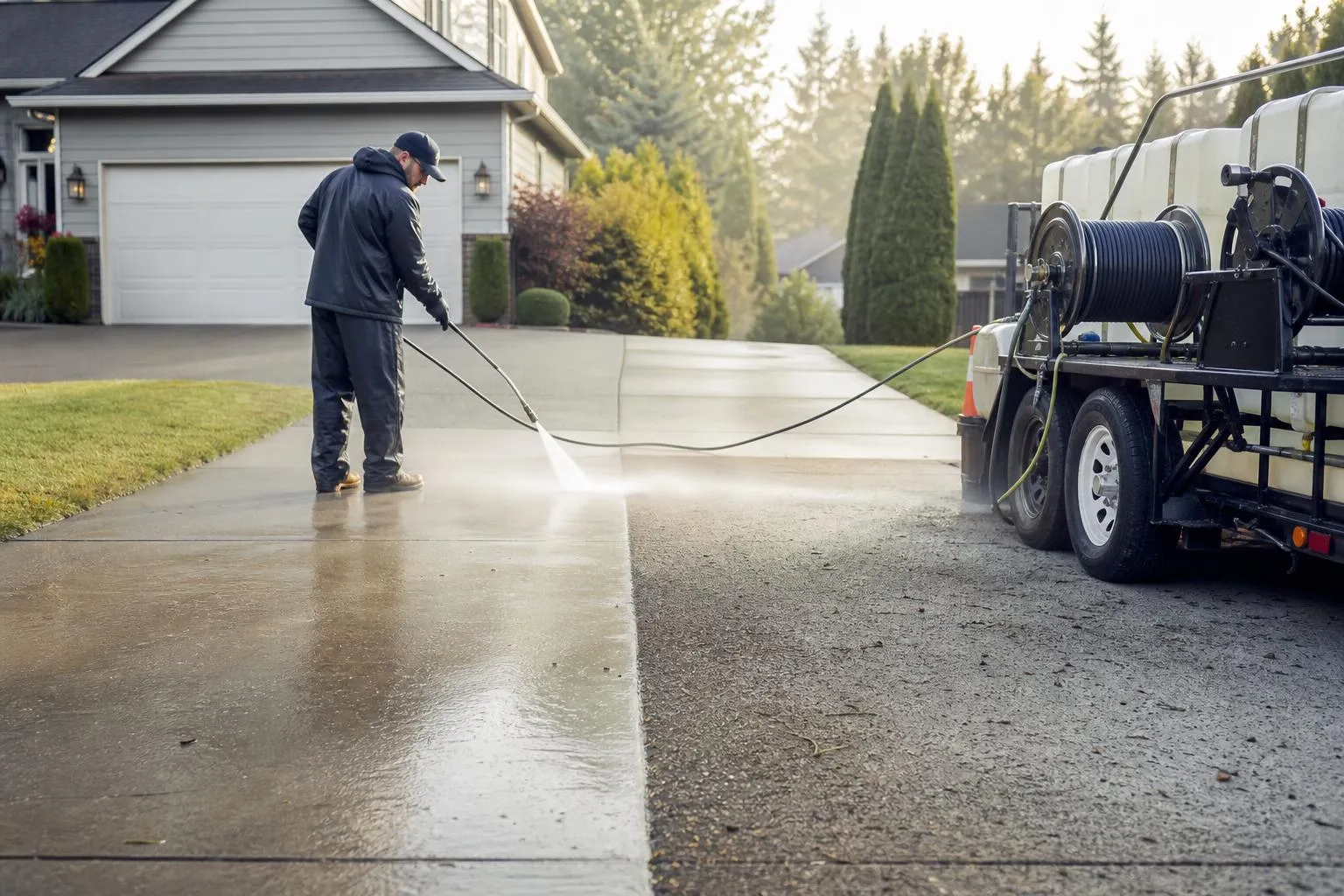
Stop thinking in margin percentages and start thinking in dollars per hour of actual cleaning. That single metric ranks your services and tells you what to sell more of. House washing wins because soft-wash chemistry does the work fast: 90 minutes of application and rinse on a $300 job is $200 an hour. Flatwork with a surface cleaner is strong but slower per dollar. Commercial pays big totals but often at a lower hourly rate and on net-30 terms.
| Service | Typical ticket | Time on site | Revenue per booked hour |
|---|---|---|---|
| House wash (soft-wash, single-story) | $250 to $450 | 1 to 1.5 hrs | $200 to $300 |
| Driveway / flatwork (surface cleaner) | $90 to $200 | 0.5 to 1 hr | $130 to $200 |
| Roof soft-wash | $400 to $900 | 2 to 4 hrs | $150 to $250 |
| Deck / fence | $200 to $500 | 2 to 4 hrs | $90 to $150 |
| Commercial (sidewalks, pads, net-30) | $400 to $2,000+ | varies | $80 to $150 |
The lesson operators learn by year two: build the calendar around house washes and driveways, take roof and commercial work selectively, and treat deck and fence restoration as premium add-ons, not your bread and butter. How to actually set these rates is in setting prices and billing.
Drive time is the silent profit killer
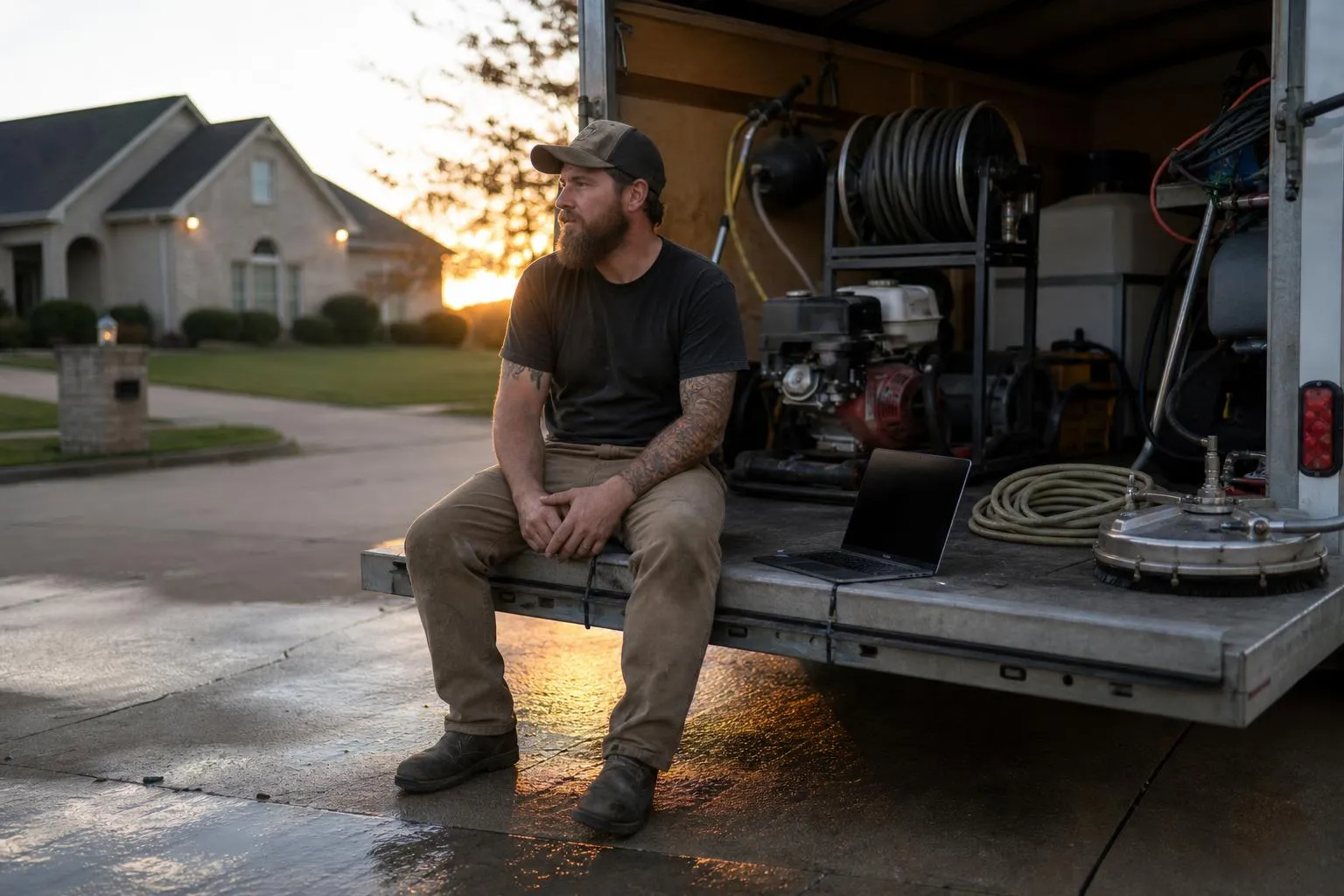
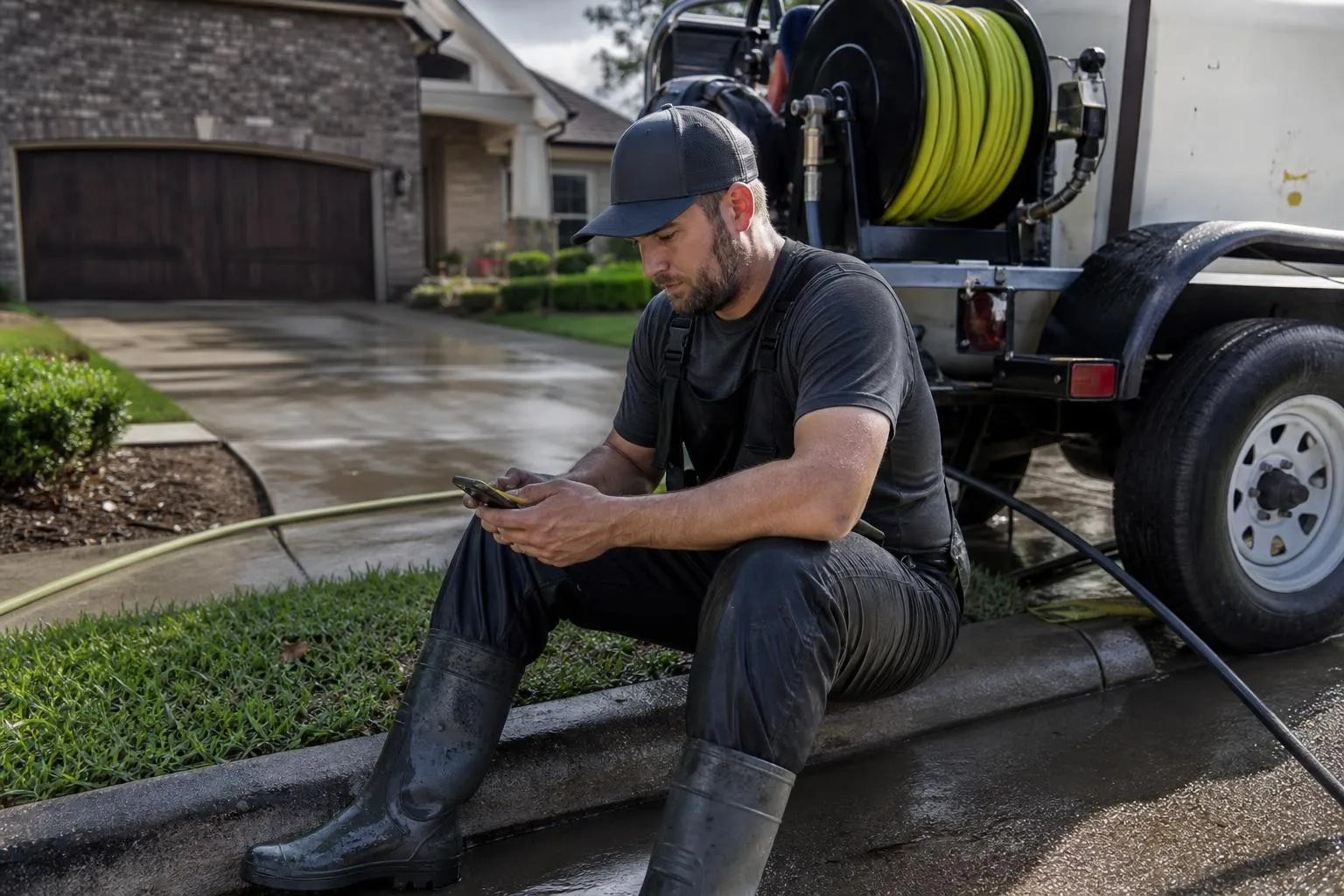
The dirty secret of this business is that your calendar looks full while your bank account says otherwise, and the gap is almost always unbilled drive time. Every mile between jobs is unpaid, and unloading and setting up burns 10 to 15 minutes a stop. A day of jobs scattered across the metro can leave you billing four of eight hours; the same day clustered in two zip codes bills six or seven. That difference is often $300 a day, which is more than most operators could gain by raising prices.
This is why route density, not price, is where the real money hides, and it is why the free neighborhood marketing pays off so hard. Cluster the work, and every job’s yard sign and door hangers feed the next job on the same street. The mechanics of tightening a route are in how to grow a pressure washing business and identifying the ideal locations.
Residential recurring versus commercial contracts
The two paths to a bigger, steadier number are recurring residential and commercial contracts, and they behave very differently. Recurring residential (annual house washes, seasonal driveway cleanings) is high-margin, paid on the spot, and built on the reviews and referrals you already generate. Commercial contracts are larger and more predictable month to month but lower per hour, slower to pay, and demand insurance certificates and sometimes wastewater compliance gear.
Recurring residential vs commercial contracts
- Residential pays same-day at $200 to $300 an hour on house washes; no waiting on invoices.
- Margins stay high because there is no procurement department negotiating you down.
- Every job feeds referrals and reviews that book the next one for free.
Recurring residential vs commercial contracts
- Residential demand is seasonal and weather-dependent, thin in a northern winter.
- Commercial smooths revenue but pays lower per hour and on net-30 or net-60 terms.
- Commercial requires COIs, sometimes runoff-capture gear, and patience on collections.
The balanced book most profitable operators run: residential recurring as the high-margin core, plus a few well-priced commercial accounts to smooth the slow months, never underpriced ones taken just for the size of the number.
Getting found is the part that decides everything
Every profit lever above assumes the phone rings. Two moves are free and worth doing this week; the rest is high-stakes work where doing it badly costs more than skipping it.
The free moves, now: claim and fully complete your Google Business Profile with real before/after photos, and text a review link to every happy customer before you leave the driveway. Your first couple dozen reviews out-pull any ad and are what let you price in the top third of the market. The local playbook is in how to promote your business locally.
Now the part that pays for a pro. A pressure washing website earns its keep only if it loads fast on a phone, ranks for “pressure washing near me,” shows real results and a click-to-call button above the fold, and turns a searching homeowner into a booked quote. The gap between a site that converts and one that just looks fine is invisible until you compare the numbers. That is the work we do. To have it handled, get a free video walkthrough. For ads and SEO, see our services, and if you have the idea but not the plan, start at expntl.com.
Frequently asked questions
How much profit can a pressure washing business realistically make?
Net margins typically run 35% to 55% after fuel, chemical, insurance, and equipment wear. In dollars, a solo operator who prices well and routes tightly commonly nets $50k to $120k a year, and a small crew running two trucks can clear $150k to $300k. The spread inside that range is set by revenue per booked hour and route density, not by the margin percentage.
Which pressure washing service is the most profitable?
House washing, on a per-hour basis. Soft-wash chemistry cleans a house fast, so a $250 to $450 job done in about 90 minutes yields $200 to $300 an hour, better than flatwork, roofs, decks, or most commercial work. Build your calendar around house washes and driveways and treat deck, roof, and commercial as selective add-ons.
What are the biggest costs cutting into profit?
Not materials, which are cheap: a house wash uses $8 to $20 of chemical. The real drains are unbilled drive time (the single largest hidden cost), fuel, insurance, and equipment wear. A scattered route can quietly cut a $700 day to $400, so tightening your routing protects more profit than raising prices does.
How long until a pressure washing business is profitable?
Because startup costs are low and materials are cheap, many solo operators are cash-flow positive within the first month or two of steady work, often recovering the entire equipment spend in three to four weeks. What takes longer is building the review base and route density that let you fill the calendar with high-per-hour jobs. The cost side is broken down in how much you need to start.
Can I make six figures pressure washing?
Yes, but usually not solo in year one. A solo operator tops out around the volume one person can clean in a season, roughly $80k to $120k in revenue on a strong tight route. Crossing well into six figures of profit generally means adding a second truck and a trained tech, which is covered in how to grow a pressure washing business.
Your move
Reading this does not book a job.
The owners who pull ahead are the ones who change one thing this week. If you want that one thing to be a website that sells and ads that put it in front of the right people, we build and run both for you.
Straight answer on whether we can help, usually the same day.