Best way to start and get into phone repair business

The best way to get into phone repair is not to lease a storefront and hope walk-ins find it. It is to start on a bench you already own, learn to fix the repairs nobody else will touch, and buy broken phones cheap so a slow week still makes money. The storefront is a decision you earn once the tickets pile up, not a bet you place on day one. Here is how to start lean, pick services that actually pay, and get found in a category Google won’t let you advertise normally.
Start on the smallest footprint that takes tickets
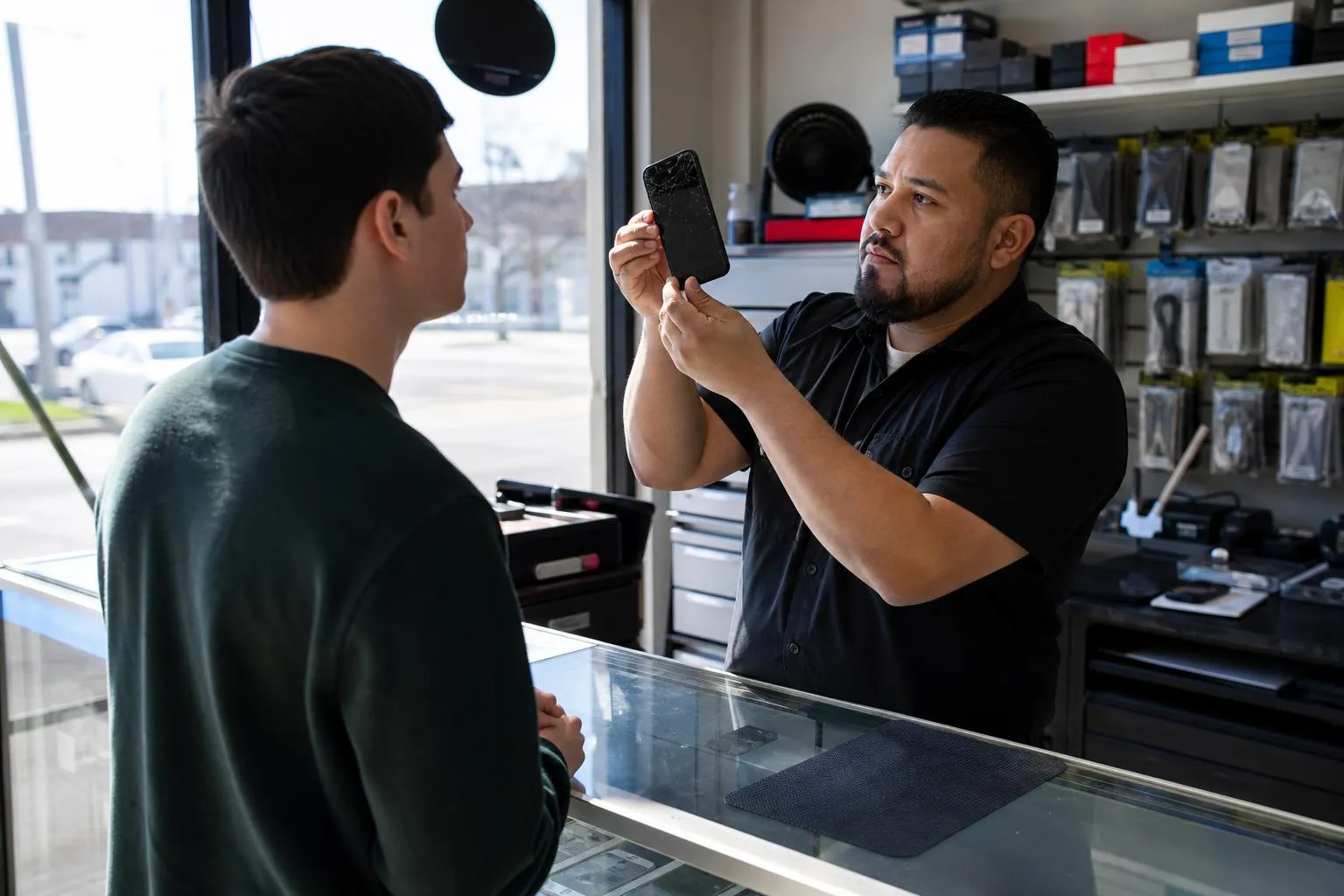
You do not need a storefront to start taking money. The three lean entry points are a home or mobile bench (you drive to the customer or they drop off), a mall kiosk or a rented counter inside a phone-accessory or pawn shop, and mail-in repair advertised online. Each keeps your fixed cost near zero while you build the review count and the parts knowledge that make a storefront survivable later.
The mistake is treating the storefront as the starting line. Rent, a buildout, signage, and a second tech turn a $4k launch into a $30k one, and now you need 150 tickets a month just to break even before you have a single review. Start where the overhead is a folding table and a light, prove you can turn ten to twenty repairs a week, then let that number tell you when a lease pays for itself. The full launch order is in the step-by-step guide, and if you are truly starting broke, read starting with no money.
Learn the repairs your competition refuses
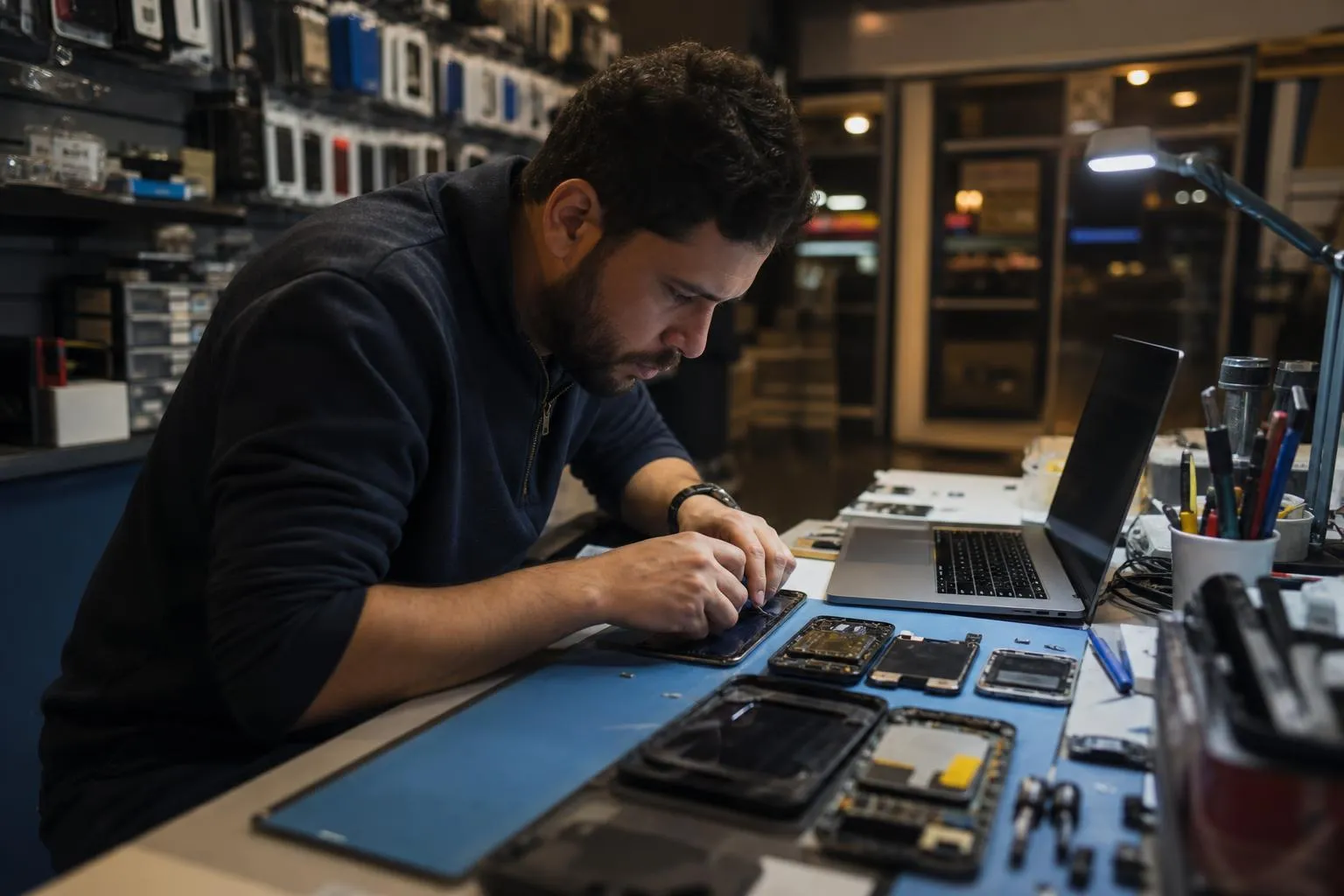
Screen and battery swaps are the volume that pays your rent, and every shop in town does them at roughly the same price. The money hides one layer down, in the jobs that need a microscope and a soldering iron: a bad charging IC, a broken backlight filter, a lifted pad, water-damage board cleaning, data recovery off a dead logic board. These are board-level repairs, and almost no strip-mall shop will attempt them.
That refusal is your margin. A screen swap on an iPhone 13 nets you maybe $60 to $90 over parts. A charging-port-IC repair on the same phone bills $120 to $180 and the part costs five dollars, because you are selling skill, not glass. You do not need microsoldering on day one, but the operator who learns it stops competing on price and starts taking the jobs that get referred out.
| Service | Typical price to customer | Part cost | Net per job | Who else in town does it |
|---|---|---|---|---|
| iPhone screen swap (aftermarket) | $90 to $150 | $25 to $60 | $60 to $95 | Every shop |
| Battery replacement | $50 to $90 | $8 to $20 | $40 to $75 | Every shop |
| Charging port / IC microsolder | $120 to $180 | $3 to $10 | $110 to $170 | Almost none |
| Water damage board cleaning | $80 to $150 | Near $0 | $70 to $140 | Almost none |
| Data recovery (dead board) | $150 to $400 | Varies | $120 to $350 | Almost none |
Buy broken phones so a slow week still pays
The service side has a ceiling: you can only bill the hours you work. The move that separates a struggling repair guy from a profitable one is repair-and-resell. You buy cracked, no-power, or “for parts” phones from customers, marketplace listings, and lots, fix what is economical, and resell them refurbished. A slow repair week still makes money because inventory you bought last month sells this month.
The math is simple and forgiving. A customer’s iPhone 12 with a smashed screen and a bad battery is worth $80 to $120 as-is. Put $70 of parts and an hour into it and it retails refurbished for $260 to $320. Do that on three phones a week and you have added a second income stream that has nothing to do with how many walk-ins showed up. The one discipline: know the resale value before you buy, because overpaying for a “for parts” phone with a bad board turns your arbitrage into a paperweight.
Price the labor, not the part
New owners price by copying the shop down the street, then wonder why they are busy and broke. Your price has to cover the part, the ten to forty minutes of skilled labor, your overhead, the occasional comeback, and profit. A screen “costing $40” is not a $60 job; it is a $110 job because the customer is paying for a guaranteed working screen installed by someone who won’t crack their frame.
Build a flat price list by model and repair type, mark parts up to a real labor-inclusive number, and never quote hourly to a walk-in. The full method, including how to handle the aftermarket-versus-OEM screen conversation, is in setting prices and billing. That same margin math is what tells you when you can afford your first employee, which is covered in when and how to hire.
Kiosk versus mail-in as your first channel
- A kiosk captures the impulse walk-in who cracked a screen at lunch and wants it fixed in 30 minutes.
- Cash flow is immediate and daily; you see money the same afternoon you do the work.
- Physical presence builds local trust faster and seeds Google reviews from people who watched you work.
Kiosk versus mail-in as your first channel
- Rent runs $1,500 to $4,000 a month whether ten people show up or none do.
- Your market is capped at the mall’s traffic; you cannot serve a customer three towns over.
- Mall hours chain you to a schedule, so a board repair that needs two days competes with the counter.
The rule most solo operators land on: start mail-in and home-bench to keep overhead at zero while you build reviews and skill, and add a kiosk or storefront only once repeat tickets prove the demand is there every single week, not just on paydays.
Getting found is the part that decides everything
You can master every repair above and still starve if nobody knows you exist. Two pieces are free and worth doing this week; the rest is high-stakes work where doing it badly costs more than skipping it.
The free pieces, now: create and fully verify a Google Business Profile with real photos of your bench and finished repairs, and text every satisfied customer a direct review link before they leave. Your first 20 to 30 reviews pull more callers than any ad, and that matters double here because Google restricts device-repair advertising and disapproves sloppy campaigns outright. The local playbook is in how to promote locally.
Now the high-stakes part. A repair-shop website is not a brochure; it loads in under three seconds on a phone, ranks for “phone repair near me,” and turns a panicked searcher with a cracked screen into a booked drop-off with a click-to-call button above the fold. The gap between a site that converts at 6% and a pretty one that converts at 2% is invisible until you compare the lead numbers, and it is two-thirds of your walk-ins. Ads are the same, and because this is a restricted Google category, an amateur campaign gets disapproved before it spends a dollar. That is the work we do. To have the site handled instead of guessed at, get a free video walkthrough. For ads, SEO, and the compliant campaign setup this category needs, see our services. If you have the idea but not the plan yet, start at expntl.com.
Frequently asked questions
Do I need a storefront to start a phone repair business?
No. Most successful operators start on a home bench, a mall kiosk, or as mail-in, keeping fixed cost near zero while they build reviews and parts knowledge. A storefront makes sense once repeat tickets consistently exceed what a bench can handle, usually 100 or more repairs a month, not before.
What is the most profitable repair to learn first?
Screen and battery swaps are your volume, but board-level microsoldering (starting with charging-IC replacement) is the profit lever because it bills $80 to $150 more per job than a swap and almost no competitor offers it. Practice on cheap donor phones before charging for it.
Can I make money reselling repaired phones?
Yes, and it is often the difference between a good month and a break-even one. Buy broken phones for $80 to $120, invest $70 in parts and an hour of labor, and resell refurbished for $260 to $320. Always run the IMEI against the blacklist before you buy, or a stolen or financed phone becomes your loss.
How much do I need to start?
A lean home-bench or mail-in launch runs $2,000 to $6,000 covering a toolkit, a microscope and soldering station, an ESD mat, and an opening parts float. The line-by-line breakdown is in how much you need to start.
Why can’t I just run Google Ads like any other business?
Phone repair is a restricted category on Google Ads because of past fraud in the space, so campaigns must be built to comply or they get disapproved. That is why your Google Business Profile and reviews matter more here than in most trades, and why paid campaigns need a careful setup, covered in how to run Google Ads for phone repair.
Your move
Reading this does not book a job.
The owners who pull ahead are the ones who change one thing this week. If you want that one thing to be a website that sells and ads that put it in front of the right people, we build and run both for you.
Straight answer on whether we can help, usually the same day.