Buying equipment and supplies for phone repair business
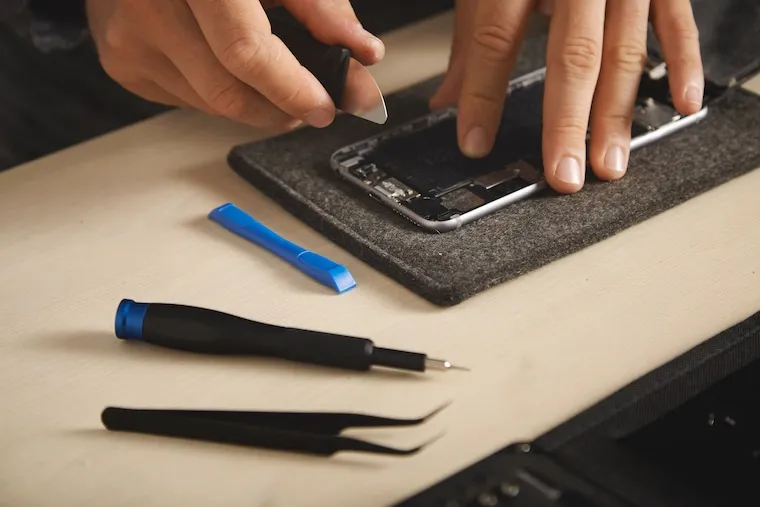
Buying repair equipment is not about owning every tool. It is about owning the right tool at the right stage, because a $1,800 microscope you can’t use yet is dead capital and a $9 pair of tweezers you skimped on will bend a connector and cost you a $200 board. The gear splits into three clear tiers, each unlocked by the jobs you are ready to take. Buy the tier the work demands, source your parts from suppliers who honor warranties, and let repair volume fund the next tier. Here is exactly what to buy, in order.
Tier one: the swap bench that opens the doors
Ninety percent of the tickets that walk in are screens, batteries, and charging ports on phones you fix by swapping a part, not by soldering. That work needs a surprisingly cheap bench. Skimp here on the wrong item and you pay for it in bent shields and stripped screws, but you do not need anything exotic to start earning.
| Tool | Cost | Why it earns |
|---|---|---|
| iFixit Pro Tech or Mako driver kit | $65 to $75 | Every screw type on every phone |
| iSclack or screen-separator + suction | $25 to $60 | Opens phones without cracking glass |
| Hot plate or LCD separator machine | $40 to $200 | Softens adhesive; frame straightening |
| ESD-safe mat + wrist strap | $20 to $40 | One static zap kills a board |
| Fine tweezers (ESD, curved + straight) | $10 to $25 | Handling connectors and flex cables |
| Precision heat gun | $25 to $60 | Adhesive, back-glass, waterproof seals |
| Isopropyl 99%, OCA/adhesive, lint-free wipes | $30 to $80 | Consumables every single job burns |
That is a $500 to $900 bench that can take the bulk of walk-in work from day one. The full picture of what this bench serves is in the step-by-step start guide.
Tier two: the microscope-and-iron jump that changes your margins
The moment you want to bill the high-margin jobs, everything in tier one refers out, you graduate to board-level tools. This is one deliberate purchase, not a slow drip, because a microscope without a proper soldering station is half a workstation.
| Tool | Cost | What it unlocks |
|---|---|---|
| Trinocular stereo microscope (AmScope) | $350 to $700 | Seeing 0201 components and pads |
| Soldering station (JBC clone or Hakko) | $150 to $500 | Charging ICs, filters, pad rework |
| Hot-air rework station (Quick 861) | $150 to $350 | Chip removal and reballing |
| Bench DC power supply (adjustable) | $70 to $150 | Diagnosing shorts by current draw |
| Preheater / PCB heat plate | $60 to $200 | Removing PMICs without lifting pads |
| Flux, solder paste, low-melt, wick | $60 to $150 | The consumables of every board job |
Call it $1,200 to $2,500 on top of tier one. That spend is what turns a shop that competes on screen prices into one that takes the $150 charging-IC and water-damage jobs everyone else turns away. The reason those jobs matter to your bottom line is spelled out in how much profit a shop can make.
Buy the tools your models need, not the catalog
The trap that drains a new owner’s budget is buying for phones nobody in their market brings in. Your first thirty tickets will be overwhelmingly recent iPhones and Samsung Galaxy flagships, because those are the phones people pay to fix rather than replace. Stock tools and parts for those first, then add Pixel, older iPhones, and the occasional iPad as the jobs actually appear.
The same discipline applies to specialty rigs. A dedicated Face ID repair jig, a laser separator for back glass, or a full BGA reballing setup are real tools, but each one should be funded by the jobs waiting on it, not bought on speculation. Match the gear to your ticket mix, which starts with knowing your local demand, covered in identifying the ideal location.
Source parts like the recurring cost they are
Tools are a one-time spend; parts are forever, and they are where your money actually goes month to month. Open accounts with at least two US-based distributors so you can compare price and stock: Injured Gadgets, MobileSentrix, Mobile Defenders, and Repairs Universe are the names operators lean on. Buy screens in the grade your customers will pay for (aftermarket incell, hard OLED, or genuine OEM pulls), and be honest with the customer about which one they are getting.
Two accounts, not one, for the same reason a roofer keeps multiple suppliers: when a new iPhone drops and screens are scarce, distributors allocate stock to established accounts first, and a shop with one supplier waits while the shop with two keeps working. The choices you make on part grade and markup feed directly into setting prices and billing.
Aftermarket screens versus genuine OEM
- Aftermarket incell costs a third of OEM, protecting your margin on price-sensitive customers.
- You can offer a cheaper repair than the shop that only installs OEM, winning the budget job.
- Wider availability means fewer backorders when a screen is scarce right after a launch.
Aftermarket screens versus genuine OEM
- True Tone and Face ID can misbehave on aftermarket iPhone screens, generating callbacks.
- Touch response and color are inconsistent batch to batch, raising your comeback rate.
- Customers who wanted “like new” feel cheated if you don’t disclose it, and that becomes a review.
The working answer most shops land on: offer both, quote the aftermarket price as standard and the OEM price as a premium upgrade, and always state which one the customer is buying so nobody is surprised.
Getting found is the part that decides everything
The best-equipped bench in town earns nothing if the phone never rings. Two moves are free and worth doing this week; the rest is high-stakes work where doing it badly costs more than not doing it.
Free, now: set up and fully verify a Google Business Profile with sharp photos of your bench, your microscope, and finished repairs, and text every happy customer a review link before they walk out. In a category Google restricts for paid ads, those first 20 to 30 reviews and your Maps ranking do the heavy lifting. The local checklist is in how to promote locally.
The high-stakes part is your website and ads. A repair site that loads under three seconds, ranks for “screen repair near me,” and puts a click-to-call button above the fold turns searchers into drop-offs; a pretty one that converts at 2% instead of 6% quietly loses two-thirds of your leads. Because phone repair is a restricted Google Ads category, an amateur campaign gets disapproved before it spends. That is the work we do. To have the site handled, get a free video walkthrough. For ads and SEO built for this category, see our services. If you have the idea but not the plan, start at expntl.com.
Frequently asked questions
What is the minimum equipment I need to start?
A swap bench of $500 to $900 handles the bulk of walk-in tickets: an iFixit or Mako toolkit, a screen separator and suction, a hot plate or LCD separator, an ESD mat and wrist strap, quality tweezers, a precision heat gun, and consumables like 99% isopropyl and adhesive. Add a bench power supply even at this stage to diagnose faults before you sell a part.
When should I buy a microscope and soldering station?
Buy them together, as one $1,200 to $2,500 upgrade, when you are ready to take board-level work like charging-IC replacement, water damage, and data recovery. Those jobs bill $80 to $150 more than a swap and almost no competitor offers them, so the tools pay for themselves quickly once you can use them.
Where should I buy screens and batteries?
Use US distributors that honor warranties: Injured Gadgets, MobileSentrix, Mobile Defenders, or Repairs Universe. Open at least two accounts so you can compare stock and price and still get allocated parts when a new phone launches and screens are scarce. Avoid no-name marketplace sellers whose bad batches cost you comebacks.
Should I offer aftermarket or OEM screens?
Offer both. Quote aftermarket as your standard price and OEM as a premium upgrade, and always tell the customer which grade they are getting. Aftermarket protects your margin on budget jobs; OEM wins the customer who wants factory quality and reliable True Tone and Face ID.
How do I decide what to spend on next?
Let the tickets decide. Buy tools for the phones your market actually brings in, which is recent iPhones and Samsung flagships first, and fund each specialty rig with the jobs already waiting on it. The full budget context is in how much you need to start.
Your move
Reading this does not book a job.
The owners who pull ahead are the ones who change one thing this week. If you want that one thing to be a website that sells and ads that put it in front of the right people, we build and run both for you.
Straight answer on whether we can help, usually the same day.