How to start a phone repair business step by step
The mistake that kills new repair shops is doing the steps in the wrong order: signing a lease, buying a full parts inventory, printing business cards, and only then discovering you can barely reseat a screen without cracking it. Do it backwards. Get your hands reliable first, prove people will pay you second, and commit to overhead last. Here is the launch as an ordered sequence, where each step unlocks the next and none of them can be safely skipped.
Step 1 (week 1-2): Get repeatable before anything else
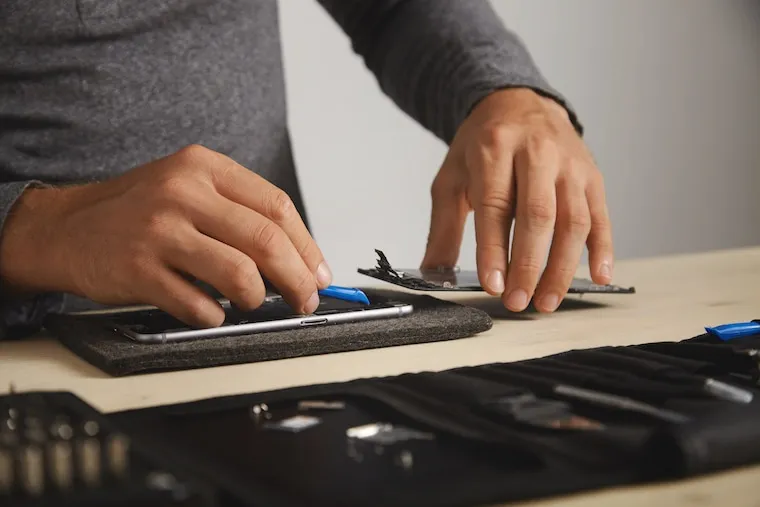
Before you register a thing, buy five to ten dead or cracked phones off Facebook Marketplace or eBay (“for parts” lots run $10-$40 each) and rebuild them. Replace screens, swap batteries, do a charge-port. The goal is not to learn once, it is to get repeatable: to do an iPhone screen in under 30 minutes without cracking the replacement or pinching a flex cable. Watch the teardown for every model on iFixit before you open it, and use a proper heat source and suction, not a hair dryer and a fingernail. Nobody should pay you until a screen swap is boring.
This is the step people skip because it is not exciting, but it is what separates a repair business from an expensive hobby. If you are starting broke, the practice-phone route also doubles as your first inventory, and the fuller path is in starting with no money.
Step 2 (week 2-3): Register the business and get insured
Once you can actually fix phones, make it a business. Form an LLC with your secretary of state ($50-$500), get a free EIN from irs.gov the same day, open a business bank account, and pull a local business license and sales-tax permit so you can charge and remit tax. Add general liability insurance ($400-$700 a year) before you touch a customer’s device, because you are now responsible for other people’s $1,200 phones. The full walkthrough, including the data-liability wrinkle nobody warns you about, is in setting up and registering the business.
Step 3 (week 3): Open supplier accounts and buy your first parts
With an EIN and a resale certificate in hand, open accounts at the two suppliers most US shops run on: MobileSentrix and Injured Gadgets. Both sell to the trade at prices a walk-in retail buyer never sees, and both stock screens, batteries, and the small parts (flex cables, charge ports, cameras) you will burn through. Do not buy a case of every screen. Buy two or three units each of the models that actually walk into your area, and reorder as tickets come in. The complete first-order list is in buying equipment and supplies.
| Screen tier | Typical cost to you | What it is | When to stock it |
|---|---|---|---|
| Aftermarket / incell (iPhone) | $18-$35 | Budget LCD copy | Older iPhones, price-shoppers |
| Hard/soft OLED (iPhone) | $35-$75 | Better color, truer feel | Most mid-range tickets |
| Service/genuine-grade | $80-$180 | OEM-quality panel | Newer Pro models, quality-first customers |
| Samsung OLED (with frame) | $90-$220 | Usually replaced as an assembly | Flagship Samsung, higher ticket |
Step 4 (week 3-4): Set prices and take your first paid tickets
Now you charge. Price each job as parts plus labor plus a margin that survives the occasional comeback: a screen that costs you $40 typically retails at $99-$149, a battery that costs you $12 retails at $59-$89. Take your first paying customers from a low-overhead base first: a mall kiosk, a booth, a home bench, or mail-in. Use a real intake ticket every time (device, passcode or “customer declined,” pre-existing damage, price quoted) and a repair-shop point of sale rather than cash in a drawer. The full pricing method is in setting prices and billing.
Step 5 (month 2-3): Prove demand, then decide on a storefront
Do not sign a lease on hope. Run the low-overhead version until you have completed 15-20 paid tickets and can see your real weekly volume, average ticket, and which models dominate. That data makes the storefront decision a math problem instead of a gamble. A retail lease adds $1,200-$3,500 a month in rent plus utilities and signage, and it only pays if walk-in volume covers it. Many owners never open a storefront and run kiosk-plus-mail-in permanently.
Storefront lease vs staying low-overhead
- A visible storefront generates walk-in traffic you never have to pay for per lead.
- A real address and window signage build trust that a home bench cannot.
- You can hold inventory, run multiple benches, and grow past a solo operator.
Storefront lease vs staying low-overhead
- Rent is a fixed $1,200-$3,500 monthly bill due whether or not phones come in.
- A multi-year lease locks you in before you know the location actually pulls.
- Break-even climbs by dozens of tickets a month just to cover the door.
The decision rule: sign the lease the month your kiosk or bench is consistently turning away work, not the month you feel impatient.
Getting found is the part that decides everything
You can nail all five steps and still stall if nobody local knows you exist. Two pieces are free and worth doing the day you take your first ticket: claim and fully complete your Google Business Profile with real photos of your bench and work, and text every satisfied customer a review link before they leave. Your first 20-30 reviews pull more first-time callers than any ad, and the local checklist is in promoting the shop locally.
The higher-stakes part is the website and search that turn a searcher into a booked repair. A repair site that ranks for “screen repair near me” and converts on mobile earns more than any other channel, but the gap between a site that converts and one that just looks fine is invisible until you compare the numbers, and Google Ads for repair lives in a restricted category most people build wrong. That is the work we do. To have the site handled instead of guessed at, get a free video walkthrough. For ads and SEO, see our services. If you have the idea but not the plan, start at expntl.com.
Frequently asked questions
How long does it take to start a phone repair business step by step?
You can be taking paid tickets in about 30 days: two weeks getting repeatable on practice phones, one week to register and insure, and a few days to open supplier accounts and stock your first parts. Consistent profit from a real customer base usually takes three to six months. The storefront, if you open one at all, is a month-two or month-three decision made only after volume proves out.
What is the very first step, before spending real money?
Get repeatable on scrap devices. Buy five to ten dead phones for $10-$40 each and rebuild them until an iPhone screen swap takes under 30 minutes with no cracked replacements. This costs almost nothing, doubles as starter inventory, and prevents the expensive mistake of committing to overhead before your hands are reliable.
Do I need a storefront to start?
No, and most owners should not start with one. A mall kiosk, a booth, a home bench, or mail-in lets you take paid work for a fraction of the cost while you learn your real demand. Sign a $1,200-$3,500-a-month lease only after 15-20 completed tickets show that walk-in volume will cover it.
Where do I buy parts as a new shop?
MobileSentrix and Injured Gadgets are the two US suppliers most shops run on, both selling to the trade at prices retail buyers never see. Open accounts with your EIN and resale certificate, and buy two or three of each in-demand model rather than a full case, reordering the fast movers as tickets come in.
How much money do I need for the whole sequence?
A lean launch runs under $2,000: roughly $300 in tools, $180 in practice phones, $200 to register, $550 for a first-year liability policy, and $400 in starter parts, with zero rent. The bigger numbers only appear if and when you choose a storefront, and the full breakdown is in how much you need to start.
Your move
Reading this does not book a job.
The owners who pull ahead are the ones who change one thing this week. If you want that one thing to be a website that sells and ads that put it in front of the right people, we build and run both for you.
Straight answer on whether we can help, usually the same day.