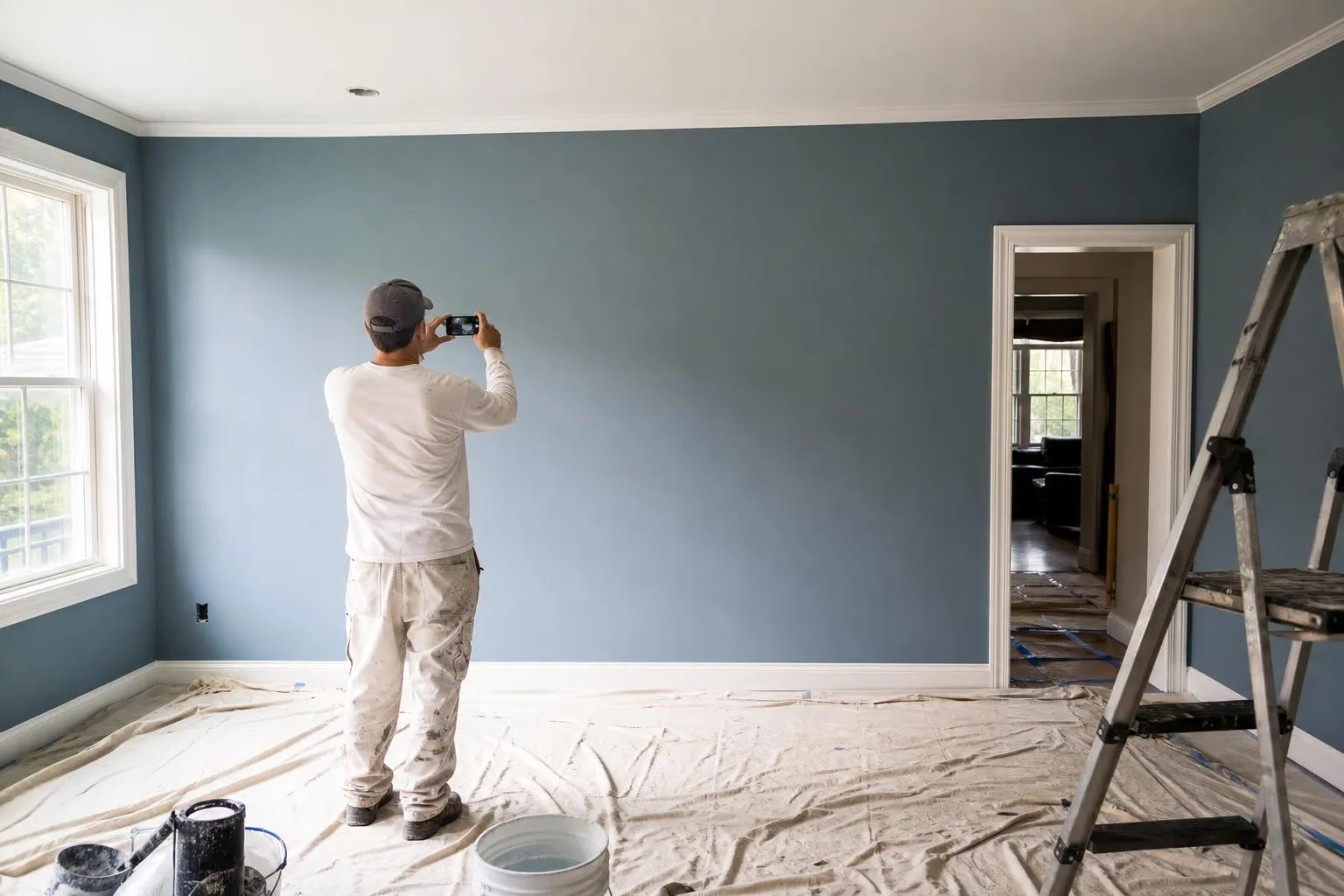
How much profit can a painting business make

Painting is a good-money trade, but the average margin, roughly 10% to 20% net, hides an enormous spread. Two painters can run the same revenue and one keeps $80k while the other keeps $12k, and the difference is almost never how many jobs they landed. It is four levers: how efficiently their crews bill, what materials cost as a share of revenue, whether they upsell, and how much of their work comes from repeat and referred customers who cost nothing to win. Here is how the money actually breaks down and which levers move it the most.
Gross margin and net margin are different animals
Painters conflate two numbers and it costs them. Gross margin is revenue minus direct job costs, paint, materials, and the labor on that job. On a healthy repaint that is 45% to 60%. Net margin is what is left after overhead, insurance, vehicle, marketing, software, your office time, and it lands at 10% to 20% for a well-run shop. The gap between them is the business, and the reason a painter with “great margins on every job” can still take home almost nothing: overhead ate the gross.
Know both, per job and per year. A job can carry a fat gross margin and still lose money if it dragged crew off two other jobs or generated a callback. The pricing method that protects gross is in setting the best prices and billing, and the launch-cost picture behind the overhead line is in how much you need to start.
Where the money actually goes on $300k in revenue
Here is a realistic profit-and-loss for a two-to-three-painter residential shop doing $300,000 a year. The exact figures move with your market, but the shape, and where the leaks hide, holds everywhere.
| Line | % of revenue | On $300k | Note |
|---|---|---|---|
| Revenue | 100% | $300,000 | Interior and exterior repaints |
| Materials (paint, supplies) | 18% | $54,000 | Keep 15% to 25% |
| Field labor (crew wages + tax) | 33% | $99,000 | Excludes your own pay |
| Gross profit | 49% | $147,000 | What’s left for overhead + profit |
| Insurance, workers comp | 6% | $18,000 | GL, auto, comp |
| Vehicle, fuel, tools | 7% | $21,000 | Payments, gas, repairs |
| Marketing, website, software | 6% | $18,000 | Ads, CRM, hosting |
| Owner salary + admin | 15% | $45,000 | Your pay for running it |
| Net profit | 15% | $45,000 | On top of your salary |
Notice the owner is paid twice here: a $45k salary in overhead for the work, plus a $45k net as the business owner. That is a healthy structure. Squeeze labor efficiency or materials by a few points and the net line moves fast. The growth moves that scale this are in how to grow a painting business.
The four levers that move net margin
More leads is the lever painters reach for and the weakest of the four. Here is what actually moves net, in order of impact. First, billing efficiency: fewer wasted hours per paid day is pure margin, because you already pay the wage. Second, materials discipline: contractor pricing at Sherwin-Williams (20% to 40% off list), less waste, and accurate takeoffs keep materials under 20%. Third, upsells at the point of trust: while you are already on site, adding trim, a deck stain, or a garage doubles the ticket at almost no acquisition cost. Fourth, repeat and referral mix: a customer who calls you back costs nothing to win, so a business running 40% repeat work carries far less marketing drag than one buying every lead cold.
Pull all four and a 10% net business becomes a 20% one on the same revenue. The lead and referral side is in how to get clients and customers and how to promote a painting business locally.
Solo, small crew, or scaled: what each really keeps
Revenue and take-home are not the same, and bigger is not automatically better. A solo painter running $120k to $180k in revenue often keeps $50k to $90k, because there is almost no overhead and no crew to pay, the owner is the labor. A two-to-four-person crew at $300k to $600k keeps $45k to $110k in net on top of the owner’s salary, but carries real overhead and management load. Scaling past that trades margin for volume: bigger shops often run leaner net percentages but on much larger revenue.
The honest read: solo is the highest margin percentage and the lowest ceiling; crews trade some margin for a higher absolute number and a business that can run without you in the van. Which to chase depends on whether you want the best hourly rate or an asset you can eventually step back from. When and how to add that first crew member is in when and how to hire and train staff.
Stay solo vs build a crew
- Solo keeps the highest net margin percentage, with almost no overhead or payroll drag.
- Every dollar of profit is yours, and there is no crew to keep busy in a slow month.
- You control quality on every job, protecting the reviews and repeat rate that feed you.
Stay solo vs build a crew
- Your revenue is capped at what one body can physically paint, so income plateaus.
- Any sick week or injury stops all income, because you are the only earner.
- You can never step back; the business is a job that ends the day you stop working.
Getting found is the part that decides everything
Every profit lever assumes the calendar stays full, which means the phone has to ring. A couple of things are free and worth doing this week; the rest is where doing it badly costs more than not doing it.
Free, now: claim and fully complete your Google Business Profile, load real before-and-after photos, and ask every finished customer for a review the day you collect payment, because reviews and referrals are the cheapest, highest-margin leads you will ever get. The local playbook is in how to promote a painting business locally.
Now the high-stakes part. A painter’s website is a machine that turns a homeowner searching at 9pm into a booked estimate, and the gap between one that converts and one that just looks fine is invisible until you compare the lead numbers, a site converting 2% of visitors instead of 6% quietly loses two-thirds of your leads and the margin they carry. That is the work we do. To have the site handled instead of guessed at, get a free video walkthrough. For Google Ads, SEO, and paid social, see our services. If you have the idea but not the plan yet, start at expntl.com.
Frequently asked questions
What is the average profit margin for a painting business?
Net margin runs 10% to 20% for a well-run painting business after all overhead and owner salary. Solo painters can show higher percentages because they have almost no overhead, while larger crews often trade margin percentage for higher absolute dollars. If you are below 10%, the usual culprit is underbidding or wasted crew hours, not high costs.
How much can a painting business owner actually take home?
A solo painter who stays booked commonly clears $50k to $90k in owner take-home. A two-to-four-person crew doing $300k to $600k can pay the owner a $45k to $80k salary plus a 10% to 20% net on top, so $90k to $180k total in a strong year. It depends heavily on efficiency and repeat-customer mix, not just revenue.
Is painting more profitable than other trades?
Painting has a low equipment bar and strong margins on labor, which makes the percentage return attractive, but individual tickets are smaller than roofing or HVAC. The advantage is fast, low-cost entry and steady repeat demand; the ceiling on a solo operator is lower than trades with bigger jobs. Efficiency and upsells close most of that gap.
What kills a painting business’s profit?
Underbidding to win volume, wasted crew hours, materials creeping past 25% of revenue, and buying every lead cold instead of building referrals. Any one of these can turn a busy calendar into a break-even year. The fix is rarely more jobs; it is tightening the four levers of efficiency, materials, upsells, and repeat work.
How do I increase my painting business’s profit fastest?
Improve billing efficiency first, get crews from 4 to 6 productive hours a day and margin jumps with no new leads, then open contractor accounts to cut materials, then upsell on-site work while you already have the customer’s trust. Those three cost nothing and move net margin more than any marketing campaign. Chase repeat and referral work to keep it there.
Your move
Reading this does not book a job.
The owners who pull ahead are the ones who change one thing this week. If you want that one thing to be a website that sells and ads that put it in front of the right people, we build and run both for you.
Straight answer on whether we can help, usually the same day.