Best way to start and get into painting business

The best way to get into painting is not to buy a sprayer and start knocking on doors. It is to nail the two things that actually decide whether you eat: prep good enough that the work lasts, and a price that pays you after materials, gas, and taxes. Everyone can roll a wall. The painters who fill their calendar are the ones whose lines are crisp, whose caulk does not crack in a year, and whose quote is not the cheapest on the block. Here is how to start lean and get those two things right from job one.
Pick a lane before you buy a brush
The word “painter” hides four different businesses with different tools, crews, and margins. Interior residential repaints are the easiest entry: low equipment bar, steady demand, mostly brush and roller work, and homeowners who pay on completion. Exterior residential adds ladders, power washing, and weather risk but bills higher per day. New-construction and commercial work is volume and spray, but you wait 30 to 60 days to get paid and bid against crews with ten trucks. Cabinet and specialty finishing (lacquer, faux, epoxy floors) is the highest dollar-per-hour lane and the hardest to fake.
Start where the money comes in fastest and the skill bar matches yours. For almost every first-timer that is interior repaints, then adding exteriors once you own the ladders. The full sequence is laid out in how to start a painting business step by step.
Prep is the job; paint is the reward
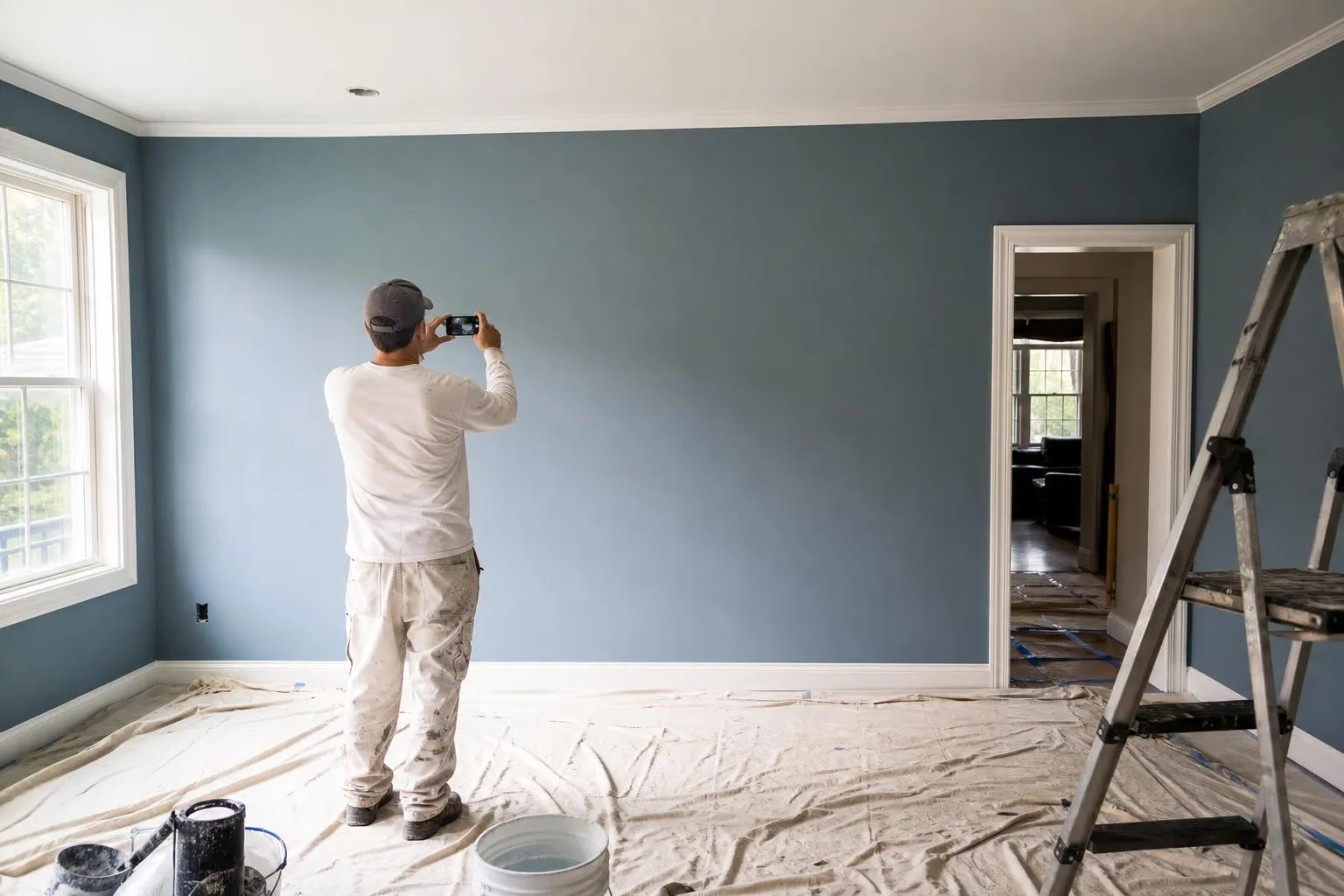
Amateurs think painting is applying paint. It is not. On a real interior repaint, taping, patching, sanding, caulking, priming stains, and protecting floors is 60% to 70% of your hours. The paint goes on in the last third. Customers cannot judge your cut line from a photo, but they absolutely notice when the patch telegraphs through in raking light, when the caulk gap opens over winter, or when a drop of Behr ends up on their hardwood.
This is also where you win the bid without being cheapest. When you walk a job, name the prep out loud: “I’ll skim these nail pops, caulk this crown, and spot-prime the water stain in the hall so it doesn’t bleed through.” The homeowner who just got a lower quote from a guy who said none of that will pay your number, because you sounded like the person who has done it before.
Buy the working kit, not the catalog
You need enough to do clean work and nothing else. A serious first kit for interior and light exterior work looks like this:
| Item | Buy range | Note |
|---|---|---|
| Airless sprayer (Graco Magnum X7 or TrueCoat) | $350 to $700 | Cuts a repaint day in half once you can mask fast |
| Extension ladder + 6’ step | $250 to $500 | Werner or Little Giant, fiberglass near electrical |
| Brushes and rollers (Purdy, Wooster) | $150 to $300 | Buy good sash brushes; cheap ones cost you the line |
| Drop cloths, plastic, tape (FrogTape/3M) | $150 to $300 | Canvas over plastic on floors so you don’t slip |
| Sander, putty knives, caulk gun, mud | $150 to $350 | The prep kit that actually earns the money |
| Used cargo van or trailer | $2,000 to $6,000 | A high-mile Transit or Express is plenty to start |
That is roughly $3k to $8k all in, most of it the vehicle. The line-by-line and quality picks are in buying equipment and supplies for a painting business, and if cash is tight, start a painting business with no money shows what you can rent or defer.
Price the job or work for free
Painting dies from underpricing, not lack of demand. Two ways to price, and you should be able to do both. Per square foot of floor area is the fast quote for interior repaints: $2 to $6 depending on ceiling height, trim, and how many colors. Per labor hour is the honest check underneath: figure a fully loaded day, then make sure the square-foot number clears it. A one-person day should net you $300 to $500 after materials, or the job is not worth doing.
Always collect a deposit. A 30% to 50% deposit before you buy paint means the homeowner has skin in the game and you are not floating $400 of Sherwin-Williams on your own card. Progress-bill on anything over a few days: deposit, a draw at the halfway point, balance on walkthrough. The full method, including how to handle change orders and upsells, is in setting the best prices and billing.
Bid per square foot vs bill per hour
- Square-foot quotes close faster because the homeowner gets one clean number, not a running meter.
- You keep the upside on jobs you run efficiently: finish a $2,400 repaint in three days instead of four and the extra day is yours.
- It forces you to walk and measure the job properly, which surfaces the surprises before you commit a price.
Bid per square foot vs bill per hour
- Underestimate the prep on an old, cracked, heavily-patched house and the fixed price eats your margin alive.
- Popcorn ceilings, lead-era trim, and water damage are hard to price by the foot until you have done a hundred of them.
- A vague scope invites the “while you’re here” creep that turns a profitable bid into a loss unless you write change orders.
Getting found is the part that decides everything
You can prep like a craftsman and price like an operator and still starve if the phone does not ring. A few things are free and worth doing this week; the rest is where doing it badly costs more than not doing it at all.
Free, now: claim and fully fill out your Google Business Profile, add real before-and-after photos of your own work (not stock), and text every finished customer a review link the day you collect the balance. Then run the oldest play in painting, the referral loop: leave two yard signs and a stack of cards, and offer a small thank-you for any neighbor they send. The local checklist is in how to promote a painting business locally, and the wider lead system is in how to get clients and customers.
Now the high-stakes part. A painter’s website is not a brochure; it is a machine that turns a homeowner searching “house painter near me” at 9pm into a booked estimate. Good means it loads in under three seconds on a phone, shows your reviews and real photos above the fold, and has a click-to-call and a quote form that works. The gap between a site that converts and a pretty one that does nothing is invisible until you compare the lead numbers. That is the work we do. To have the site handled instead of guessed at, get a free video walkthrough. For Google Ads, SEO, and paid social, see our services. If you have the idea but not the plan yet, start at expntl.com.
Frequently asked questions
Do I need experience to start a painting business?
You need enough to do clean prep and a crisp cut line, which is a few dozen jobs, not a decade. If you have never painted professionally, sub yourself out to an established crew for a season first or start on your own place and friends’ homes. The business skills, quoting, deposits, scheduling, matter as much as the brush, and those you learn on real paid jobs.
How much can I make in the first year?
A solo residential painter who stays booked commonly clears $50k to $90k in owner take-home in year one, before adding help. It swings on how many big interior and exterior jobs you land versus small rooms, and how well you priced them. The profit breakdown walks the margins.
Should I start solo or hire a crew right away?
Start solo or with one helper. Payroll, workers comp, and the burden of keeping a crew busy will sink you before demand is proven. Bring on your first W-2 painter the month you are consistently turning work away, not before. The timing and training are covered in when and how to hire staff.
What’s the fastest way to get my first paying jobs?
Repaint three homes at cost for people who will leave a public review and let you photograph the work, then turn those into your Google Business Profile and a stack of before-and-afters. Word of mouth in a single neighborhood plus real photos beats any cold ad when you have zero track record.
Do I need a license to paint houses?
It depends on your state and job size. Several states require a contractor’s license once a job crosses a dollar threshold (often $500 to $2,500), and lead-era homes bring EPA RRP rules into play. The setup and registration guide has the state-by-state picture.
Your move
Reading this does not book a job.
The owners who pull ahead are the ones who change one thing this week. If you want that one thing to be a website that sells and ads that put it in front of the right people, we build and run both for you.
Straight answer on whether we can help, usually the same day.