How to Advertise HVAC Business on Google
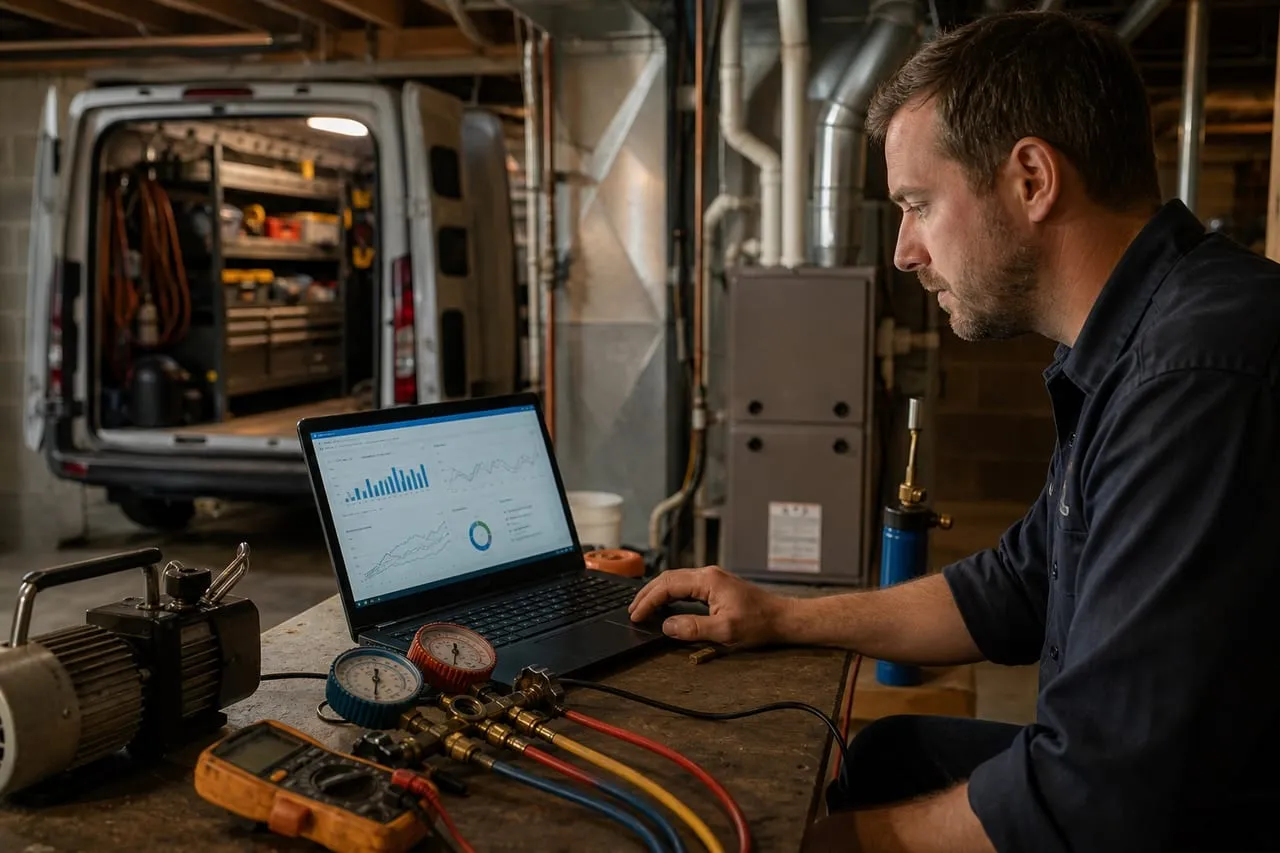
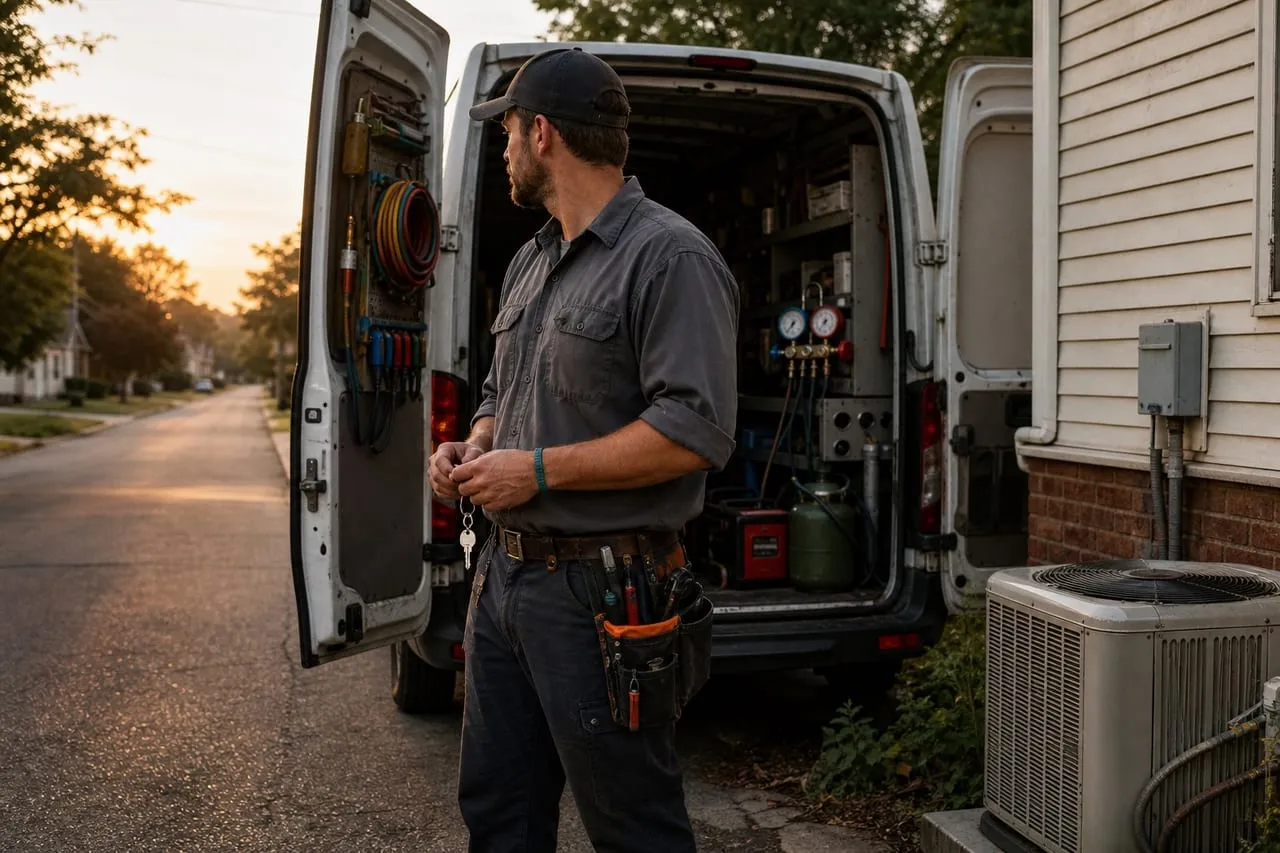
Google is where HVAC emergencies happen. Somebody whose AC just stopped at 4pm in July is on Google in under 60 seconds. Showing up in the top 3 results, paid or organic, is the entire game. Three Google channels matter: Local Services Ads, Search Ads, and Google Business Profile. Run them as a stack.
Local Services Ads (LSAs) Come First
LSAs sit above every other Google result, show a Google Screened badge, and only charge you when a qualified lead calls. For HVAC, they’re the highest-ROI paid channel and the lowest barrier to launch.
- Setup requires. State contractor license verification, EPA 608 cert, $1M+ liability COI, owner background check. Approval takes 7-21 days.
- Cost per lead. $25-$55 for service calls, $45-$95 for replacement leads. Cheaper than Search Ads.
- Service categories. Pick all of them you actually serve: AC repair, AC installation, furnace repair, furnace installation, heat pump, ductwork, IAQ.
- Budget setting. Set weekly budget, Google auto-bids per lead. $300-$1,500/week for solo, $2k-$8k/week for 2+ vans.
- Dispute bad leads. Google refunds calls that were spam, out-of-area, or for services you don’t offer. Dispute every one within 30 days.
LSAs reward reviews. The more Google reviews and the higher your rating, the higher you rank in LSAs. Target 50+ reviews at 4.7+ stars within your first year.
The structural reason LSAs beat everything else for a newer shop is risk transfer. With Search Ads you pay for clicks, and your first thousand clicks fund your own education while you learn negatives and bids. With LSAs you pay only when a homeowner in your area calls about a service you actually offer, so Google absorbs the targeting risk. That makes LSAs the one paid channel where a one-van shop with zero ads experience competes on nearly even footing with the $5M operator, because rank is driven by reviews, answer rate, and proximity, none of which can be bought with budget alone.
Search Ads for Urgency Keywords
Search Ads catch the people LSAs miss. Some Google searchers scroll past LSAs and click traditional search results. Bid on the keywords that signal urgency and intent.
| Keyword tier | Examples | Peak-season CPC | What it signals |
|---|---|---|---|
| Urgent repair | ”AC not cooling [city]”, “furnace not heating”, “emergency HVAC repair”, “AC repair near me” | $8-$22 | Same-day job, highest close rate |
| Replacement | ”AC replacement cost”, “new furnace install”, “heat pump installation”, “HVAC quote [city]“ | $12-$35 | A 2-6 week decision with a $6k-$12k ticket |
| Brand | Your own business name | $1-$4 | Defense against competitor poaching |
Negative keywords are half the battle in month one: DIY, parts, salary, school, training, manual, used, free, careers, jobs, walmart, lowes, home depot. Add 80-150 negatives in your first month. And use phrase match and exact match, not broad match. Broad match burns through budget on irrelevant searches.
Ad copy that converts:
- Headline 1: “AC Repair in [City]”
- Headline 2: “Same-Day Service | Licensed + Insured”
- Headline 3: “[X]+ 5-Star Reviews”
- Description: “Diagnostic fee credited toward repair. Call now for same-day service.”
Send all ad traffic to a service-specific landing page (not your homepage). Click-to-call header, 3 trust signals, schedule-online widget. See how to make a website.
One expectation to set: Search ROAS is lumpy in a way LSA ROAS is not. Repair keywords pay back steadily, week after week. Replacement keywords can run three quiet weeks and then close one good-better-best quote that makes the whole quarter. Shops that evaluate replacement campaigns on a two-week window almost always kill them right before the math would have turned. Give replacement keywords 60-90 days and judge them on closed quotes, not on calls.
Google Business Profile + Maps
LSAs and Search are paid. GBP is free and arguably more important. Most “HVAC near me” searches end with a click on a Map listing, not a paid ad.
- Verify GBP. Google sends a postcard or runs a video verification.
- Categories. Primary “HVAC contractor”, secondary “Air conditioning repair service”, “Heating contractor”, “Furnace repair service”.
- Service area. 15-25 mile radius around your shop. Avoid the mistake of setting it 100 miles to “cast a wide net” - it tanks your ranking.
- Photos. 30+ at minimum: van, techs, equipment, install before/after, customer site (with permission).
- Posts. Weekly Google Posts about offers, completed jobs, IAQ tips. Keeps your profile “fresh” in the algorithm.
- Reviews. Every customer asked, every review responded to (especially the negative ones).
GBP plus LSAs plus 100+ reviews is the local pack winning combination. See how to run Google Ads for the technical execution.
GBP is also the conversion layer underneath your paid spend, which is the part most owners miss. A homeowner clicks your LSA, then taps through to the profile to check reviews before dialing. If the profile shows 12 reviews and one blurry photo, you just paid for a lead that called the 4.8-star shop listed below you. And after the first 50 reviews, velocity matters more than raw count: a profile whose newest review is eight months old reads abandoned, to the algorithm and to humans. Fresh reviews every month are the maintenance dose.
Sequencing: What to Turn On, and When
Run the stack in this order. Week one, claim and build GBP while you file LSA verification, because approval takes 7-21 days and reviews take longer than everything. Weeks two through four, LSAs go live, and your only jobs are answering every call inside 30 seconds and asking every customer for a review. Month two, add Search with urgent-repair keywords only, at $25-$40/day, and let it accumulate conversion data. Month three, add the replacement campaign once landing pages and call tracking are proven on repair traffic.
The budget logic behind the order: each layer costs more to learn than the one above it. LSAs need almost no optimization, Search needs weekly negative-keyword pruning and bid management, and replacement campaigns need 60-90 days of patience. Stacked gradually, every new layer is funded by one that already works, which is the difference between scaling a system and gambling a budget.
Should you run the Google stack yourself, or hand it off?
GBP and LSAs are simple enough that most owners should run them in-house for good, and the free profile work is nobody’s job but yours anyway. Search Ads are the piece that quietly punishes part-time attention, since negative-keyword pruning and bid management reward someone who is in the account every week. We put the honest decision criteria in one place: 7 signs your business needs a Google Ads agency. Keep the parts that are working and hand off only the layer that is leaking. When you want that layer run for booked jobs, request a free proposal.
Frequently asked questions
Should I run LSAs or Search Ads first?
LSAs first. Lower cost per lead, less optimization needed, and the badge builds trust. Add Search Ads at month 2 to catch the searches that scroll past LSAs.
How much budget do I need to make Google work?
Minimum $1,200/mo combined (LSAs + Search) for a solo operator. $3k-$6k/mo for a 2-van shop. Below $800/mo Google can’t optimize and CPAs balloon.
What’s the ROI on Google Ads for HVAC?
$3.50-$7 in revenue per $1 spent on LSAs. $2.50-$5 per $1 on Search Ads. Budget for $4 average across the channel.
Does my website matter for Google Ads?
Yes, hugely. Slow site = high cost per conversion. Mobile-broken site = wasted clicks. Make sure your service pages load in under 3 seconds and have a phone number above the fold. See the channel mix and how to get clients.