Identifying the Ideal Locations for Excavation Business
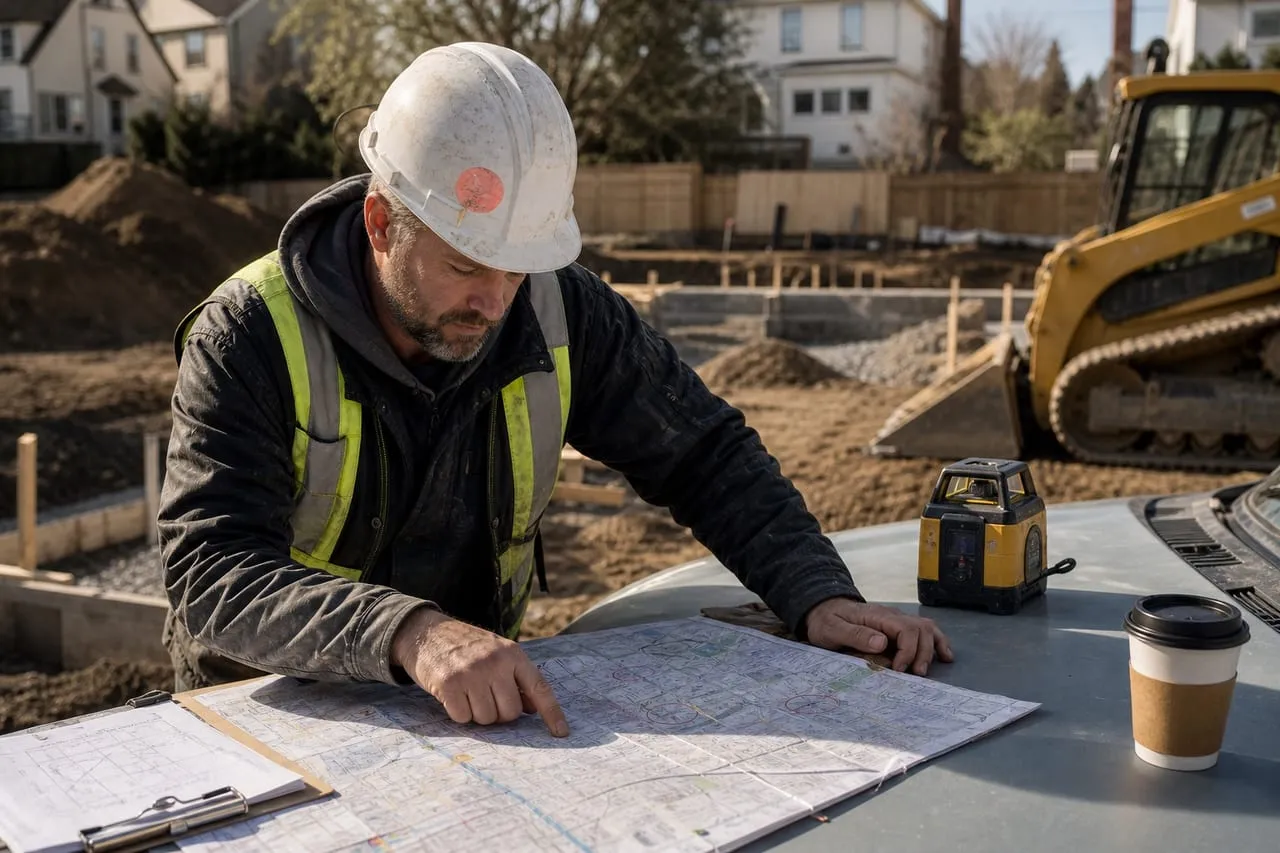
The right location for an excavation business is the intersection of where builders are active, where regulations are workable, and where you can profitably drive to job sites without burning a day on the road. The mistake new excavators make is basing themselves where they live regardless of work. Drive 30 minutes to the boom zone, not the other way around.
What Makes a Location “Ideal”
Three factors stack to make a region work for excavation.
- Active construction permits: pull building department data for the last 12 months. Counties issuing 500+ single-family permits a year are excavation gold.
- Suburban expansion or commercial corridor growth: developers are buying raw land and turning it into pads. That’s site-prep work.
- Reasonable regulatory load: some California counties require 6 months of pre-construction permitting. Same work in Texas or Tennessee gets approved in 3 weeks. Margin lives in the difference.
- Drive time: 50-mile radius from your yard is the practical limit. Beyond that you’re paying for windshield time you can’t bill.
Permits are the leading indicator and everything else lags it. Population growth shows up in permit filings 12 to 18 months before it shows up as poured foundations, which is exactly the window you need to build builder relationships before the work peaks. The threshold matters too: a county running 500+ single-family permits supports several full-time dirt outfits, and at 2,000+ the established subs are turning work away, which means a competent newcomer can be busy within a season instead of within two years.
Niche-Specific Location Patterns
Where you base depends on what you do.
- Residential excavation: subdivision-heavy suburbs. Williamson County TX, Wake County NC, Maricopa County AZ, Polk County FL. Look for 2,500+ lots in active development within 30 minutes.
- Commercial site prep: industrial corridors and big-box retail expansion. Logistics hubs (Dallas, Indianapolis, Atlanta, Phoenix) have constant pad work for warehouses and last-mile distribution.
- Utility trenching: fiber-build markets, water-main replacement towns, rural electrification zones. Talk to local 811 about which utility primes are bidding work.
- Urban infill: tight downtown sites in cities like Austin, Nashville, Charlotte. Small footprint, high price per cubic yard, requires precise machine work and demolition.
- Septic and rural: any county where municipal sewer ends. Steady residential work, less competition than urban markets.
One location factor that never makes the relocation lists: what’s under the grass. Shallow-rock country means hammer time and blasting subs on digs that looked routine from the surface, sandy markets cut fast but cave and need shoring, and high water tables turn basements into dewatering projects. None of these kill a market, but they decide what you bid and what attachments you own. The allowances for rock, water, and haul-off covered in pricing and billing exist precisely because of this, and the local operator who knows his county’s dirt prices those allowances correctly while the out-of-town bidder eats the surprises.
The second invisible factor is haul-off distance. Every market has a real cost to get rid of spoils and demo debris, set by how far the nearest fill site, transfer station, or C&D landfill sits from the work. Where clean-fill swaps happen ten minutes away, your trucking line stays small; where the nearest dump is 45 minutes each way, every basement dig carries hours of unbillable truck time. Two markets with identical machine rates can differ 10 to 15 percent in realized margin on this line alone, so scout the dump map as carefully as the permit map.
Scope Your Service Area Correctly
Don’t claim a 100-mile radius. Pick a tight area you can dominate, then price the distance honestly.
| Zone | Radius | Minimum job | Mobilization rule |
|---|---|---|---|
| Primary | 0 to 25 miles | None, bid everything | Same-day moves, small jobs welcome |
| Secondary | 25 to 50 miles | $8k+ | Plan overnight stays for multi-day work |
| Project | 50+ miles | $40k+ and multi-week | Per-diem the crew, price the mobilization |
A focused 25-mile radius with strong builder relationships beats a 100-mile sprawl every time. See how to promote locally for area-specific marketing tactics and how to identify clients for who to target in each zone.
Yard, Storage, and Home Base
Where you park the equipment matters less than where the work is, but a few things help.
- Secured fenced yard: equipment theft is real. Insurance discounts for secured storage.
- Near a fuel depot or co-op: bulk diesel pricing saves $0.30 to $0.60 a gallon over retail.
- Highway access: 5 minutes to a major interstate beats a cheaper yard 25 minutes off the highway.
- Land you own or lease cheap: $400 to $1,200 a month for a half-acre fenced yard in most markets.
Geography also sets your working year, which quietly sets your revenue ceiling. A sunbelt operator gets 11 to 12 workable months; a northern operator gets 8 to 9 after frost and thaw, and that gap alone swings annual revenue 20 to 30 percent at identical rates and identical skill. It does not make northern markets bad, it makes winter revenue (snow contracts, interior demo support) part of the location decision instead of an afterthought. The annual income bands in how much profit an excavation business makes assume you priced your climate into the plan.
Frequently asked questions
Should I relocate to start an excavation business?
If your home market has flat permits and saturated competition, yes. Moving 60 miles to a boom market can double your first-year revenue. Operators in Phoenix, Austin, Nashville, Boise, and Raleigh are crushing it. Operators in Cleveland and St. Louis grind harder for the same dollars.
How do I research a market before committing?
Pull 12 months of building permits from the county website. Drive the area for two weekends and count active jobsites. Call three local concrete contractors and ask who they use for excavation. If the same two names come up and they’re booked out, the market has room.
Urban or suburban?
Suburban for new construction excavation. Urban for demolition, tight-site infill, and utility work. Different equipment mix.
Should I cover multiple states?
Not until year three. Multi-state licensing, reciprocal bonding, and DOT compliance add overhead. Master one state first.
What if I’m in a slow market and can’t move?
Lean into the work that’s recession-proof: utility upgrades, septic, drainage, and snow removal. Add municipal work through public bid sites. Margins are tighter but volume is steady.
Your move
Reading this does not book a job.
The owners who pull ahead are the ones who change one thing this week. If you want that one thing to be a website that sells and ads that put it in front of the right people, we build and run both for you.
Straight answer on whether we can help, usually the same day.