Buying Equipment and Supplies for Excavation Business
Buy the smallest machine that does the work you’re bidding, finance it instead of paying cash, and don’t underbuy on the truck and trailer. Most starting excavators overspend on a glamour machine and then can’t move it because the trailer is rated 6,000 lbs under the load. Get the combo right and your iron pays for itself in the first season.
Pick the First Machine Based on Niche
Your first machine should match 80 percent of the work you’ll bid in year one.
| Work you’re bidding | First machine | Example models | What it costs |
|---|---|---|---|
| Residential driveways, drainage, landscaping | Compact track loader | Bobcat T595 or T770, CAT 259D3 or 299D3 | $55k to 90k new, $35k to 60k used low-hour |
| Foundations, septic, sewer laterals, utility | Mini excavator, 4 to 5 ton class | Bobcat E50, CAT 305 CR, Kubota KX040 | $65k to 95k new |
| Commercial site prep, mass grading | Full-size excavator | CAT 320, Komatsu PC210 | $250k+ new. Don’t start here |
Buy used with under 2,000 hours from a dealer with a powertrain warranty. Pay the dealer markup for the warranty. A blown final drive on a private-party machine wipes out a quarter of profit.
When you walk a used machine, the hour meter is the least honest gauge on it. Pins and bushings tell the truth: grab the bucket and check for slop, look for fresh paint over weld repairs, and on track machines budget for the undercarriage, because tracks, rollers, and idlers are roughly half of a compact track loader’s lifetime maintenance bill. A 1,400-hour machine at 60 percent undercarriage is a better buy than an 1,100-hour machine at 20 percent, whatever the listing price says.
Buying used: pros
- Payment roughly half of new for the same dig capability
- The brutal first-year depreciation already happened to someone else
- A 12-month dealer powertrain warranty covers the failures that actually bankrupt you
Buying used: cons
- Wear items arrive sooner: hoses, pins, undercarriage, cylinders
- You inherit the previous owner’s greasing habits, good or bad
- Auction and private-party “deals” hide final-drive and slew-ring problems no test drive reveals
The decision rule is simple: under 2,000 hours plus a dealer warranty means used wins on math. New only makes sense once utilization is proven and your CPA wants the Section 179 deduction against a strong year, which is a year-three conversation, not a startup one.
Truck and Trailer: Don’t Cheap Out
The trailer needs to haul the loaded machine plus attachments with margin. A mini excavator weighs around 11,000 lbs. Add a trailer at 4,500 lbs and you’re already at 15,500 lbs.
- Truck: 3500HD or F-350 dually, gas or diesel, gooseneck or fifth-wheel hitch. Used $35k to $55k.
- Trailer: the GVWR must cover machine, attachments, and the trailer’s own weight. That means a 16,000-lb class deckover for a 5-ton mini; a 14,000-lb trailer only legally carries skid steers and minis under about 4 tons. Full-size machines ride a 22-ton lowboy. New deckovers run $9k to $15k.
- Tie-downs: four 3/8” Grade 70 chains and binders. $300.
- Magnetic light kit if your trailer lights are unreliable.
Here is the weight math nobody runs until a DOT officer runs it for them. Once your truck and trailer ratings total past 26,001 lbs with a trailer rated over 10,000 lbs, you are in CDL territory. A one-ton truck with a 16,000-lb deckover crosses that line. This is exactly why so many one-truck operators spec the 4-ton class: a Kubota KX040 at roughly 9,300 lbs rides a 14k trailer legally behind a 3500HD with no CDL, while the 5-ton E50 or CAT 305 quietly buys you a heavier trailer and a CDL question along with the deeper dig. Pick the machine and the haul setup as one decision, not two.
Hand Tools and Locating
The machine does the heavy work, but the job is won and lost on finish grade.
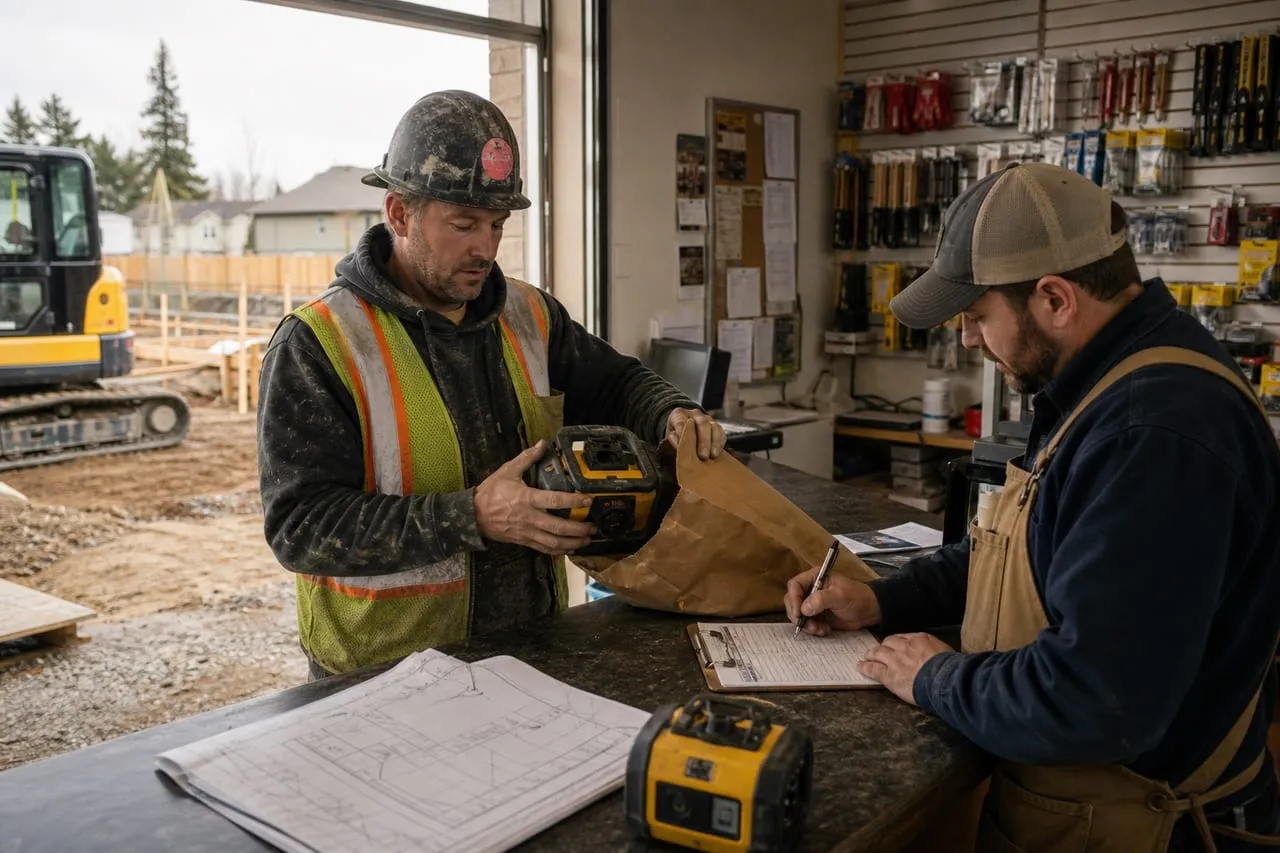
- Laser level (Topcon RL-H5A) and grade rod: $1,200.
- Transit or rotary laser with receiver for the operator: $800 to $1,500.
- Locating wand for finding existing utilities the 811 ticket missed.
- Shovels, rakes, tampers, hand level.
- 6-ft and 12-ft trench box if you’ll do utility work deeper than 5 ft. OSHA non-negotiable.
The laser level is the highest-ROI item on this page. A pad that checks out on grade the first time the concrete crew shoots it is what gets you the builder’s next fourteen houses; a re-dig is what gets you replaced. Spend the $1,200 and train every helper to use it.
Safety Gear and Daily Supplies
Before you cut a check on the machine, budget the recurring stuff.
- Hi-vis vests, hard hats, steel-toe boots for every crew member.
- Fire extinguisher mounted in the truck and on the machine.
- DEF, oil, grease, and a 100-gallon fuel transfer tank in the truck bed (Transfer Flow or RDS, around $1,800).
- First aid kit and OSHA-compliant tailgate-safety log.
The transfer tank looks like a luxury until you price the alternative: a 30-minute fuel detour at the start of every workday is roughly ten lost billable hours a month, and the tank also unlocks bulk diesel pricing that runs $0.30 to $0.60 under retail.
See how much you need to start for the full capital breakdown. For dispatching this gear day to day, how to successfully run the business covers the operational side.
Frequently asked questions
New or used for the first machine?
Used, low-hour, from a dealer with a 12-month powertrain warranty. New gives you peace of mind but doubles the payment. A 1,200-hour CAT 305 from a Cat dealer with Cat Financial is the best risk-adjusted buy.
How much should I put down?
10 to 20 percent. Less than that and the payment crushes you in slow months. More than that and you’ve drained the working capital you need for payroll and the 45-day gap before your first GC invoice clears.
Should I rent before I buy?
If you’re unsure about niche, rent for three to six months. Sunbelt and United Rentals will charge $2,500 to $4,500 a month for a mini excavator. Bake it into the bid as a line item. Once you’re consistently billing 100+ machine hours per month, the math flips to buying.
What attachments do I actually need?
For a mini excavator: a 12”24”and 36” bucket plus a grading bucket and a thumb. For a skid steer: bucket, grapple, pallet forks, and a hydraulic auger if you do post or pier work. Skip the specialty stuff until a job pays for it.
Your move
Reading this does not book a job.
The owners who pull ahead are the ones who change one thing this week. If you want that one thing to be a website that sells and ads that put it in front of the right people, we build and run both for you.
Straight answer on whether we can help, usually the same day.