How to Successfully Run an Excavation Business
Successfully running an excavation business comes down to four disciplines: keeping your iron running, dispatching jobs efficiently, bidding accurately every time, and watching the money like a hawk. The operators who clear $200k a year and the ones who scrape by $60k a year run the same machines and bid in the same markets. The difference is operational discipline applied daily.
Equipment Maintenance: Don’t Skip the PM
A blown engine or final drive on a financed machine can end the business. Preventive maintenance is non-negotiable, and it runs on a fixed clock:
| Interval | Task |
|---|---|
| Daily, before the machine moves | 10-minute walk-around: fluids, hydraulic leaks, undercarriage and tracks, grease pivot points |
| Weekly | Track tension check, air filter clean |
| Every fill | DEF top-off |
| Every 250 hours | Engine oil and filter |
| Every 500 hours | Hydraulic filter |
| Annually | Hydraulic oil sampled for water contamination |
| Manufacturer’s hour interval | Track replacement (skipping it destroys final drives) |
Write down every PM in a logbook that lives in the cab. Skip dealer maintenance contracts at first ($300+ a month each); do the work yourself or hire a mobile mechanic at $90 an hour.
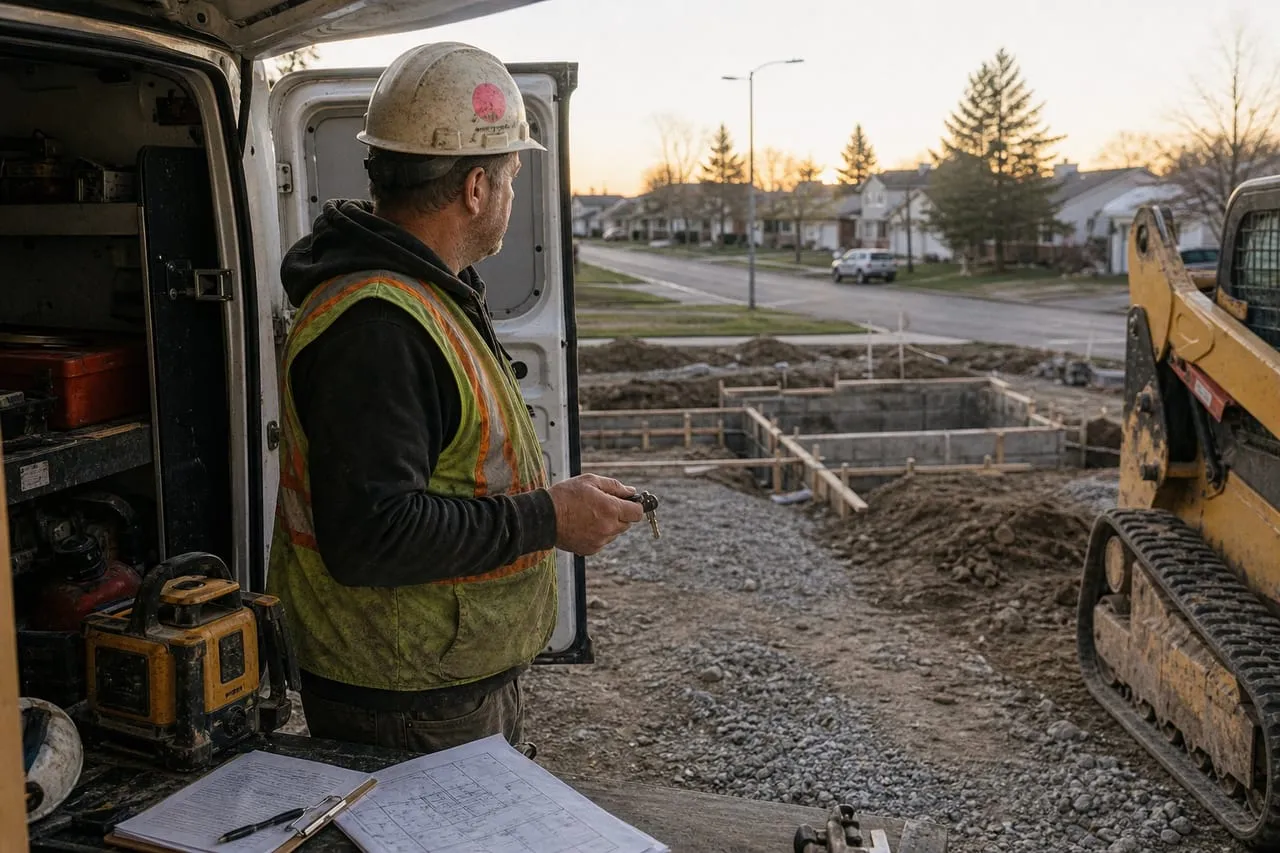
PM looks like a mechanical discipline. It is actually a financial one. A final drive on a mini ex runs $4,000 to $7,000 installed, and the two weeks of downtime cost more than the part: 50 to 70 billable hours gone while the machine payment, insurance, and payroll keep drawing. Against that, the daily walk-around costs ten minutes and catches most failures while they are still a $40 hose or a $90 mobile-mechanic visit. No other ten minutes in this business pays a higher rate.
The logbook earns its keep twice. Day to day it keeps the 250 and 500 hour intervals honest. At trade-in time, a Kubota, CAT, or Bobcat with documented services consistently brings real money over an identical machine with a shrug for a service history, because the buyer is pricing the risk you removed.
Dispatch and Daily Operations
You can’t be everywhere. Your dispatch system is what makes a multi-crew operation work.
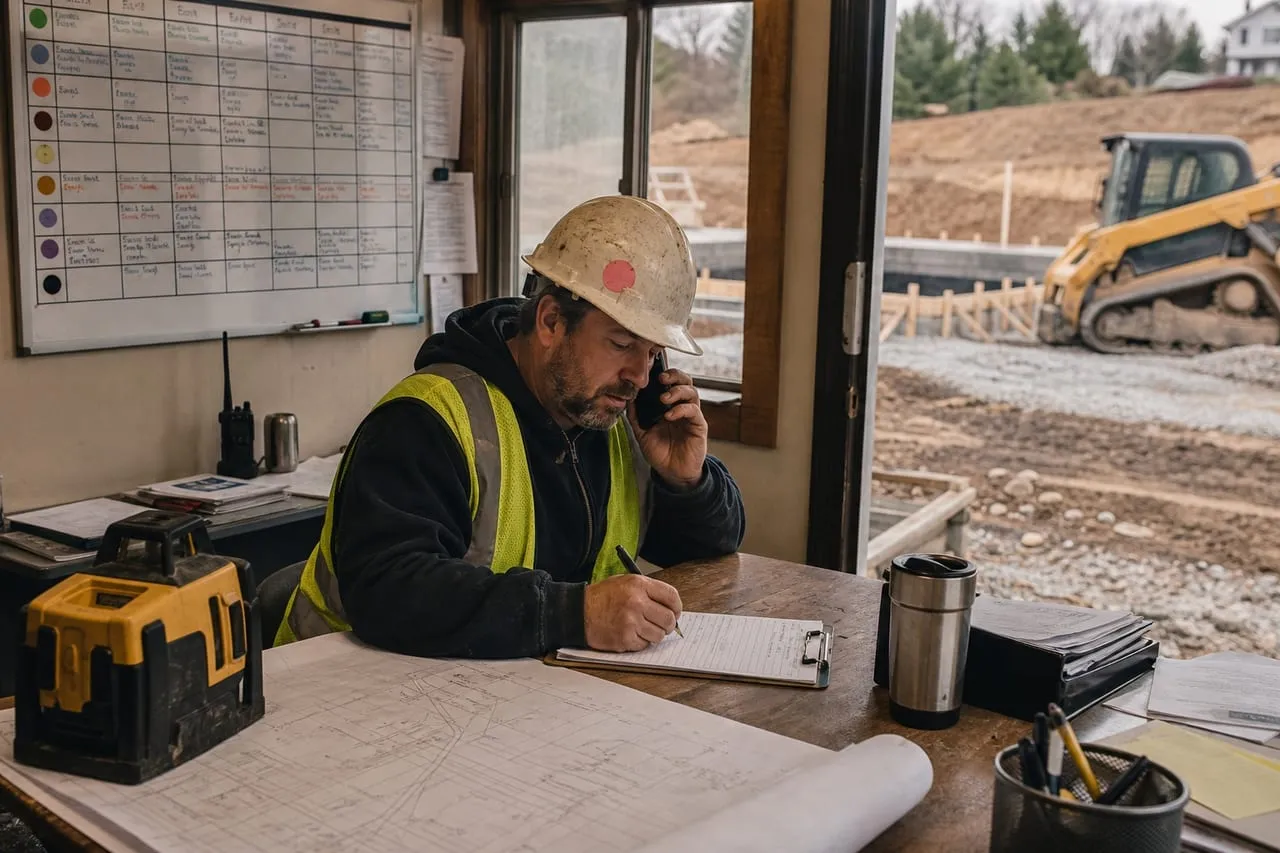
- Weekly schedule meeting: Sunday afternoon, review the next 5 days. What machine is on what site, when does it mobilize, what’s the scope.
- Daily morning huddle: 6:45 AM 10-minute call or in-person. Confirm crew assignments, locating tickets, materials needed.
- Site-specific scopes: every job has a one-page scope sheet the foreman has on the truck. Cuts confusion and change-order disputes.
- End-of-day check-in: foreman texts progress photos and a one-sentence status. 2 minutes.
For larger operations, software like Buildertrend, JobNimbus, or Procore manages this. For 1 to 2 crews, a shared Google Sheet and a group text works.
The scope sheet is the most underrated item on that list because it is change-order armor. Every billing dispute in this trade starts the same way: “I thought that was included.” A one-page sheet that states what is in scope and, more importantly, what is not (rock beyond the allowance, haul-off beyond the included loads, standby) turns those arguments into signed extras. The foreman cannot defend a line he has never seen, so the sheet rides on the truck, not in your email.
The deeper failure mode this system prevents is the owner as human router. If every decision flows through your phone, you are the dispatch system, and the company’s capacity is capped at your attention span. The Sunday meeting and the scope sheets transfer routing onto paper, which is what later lets a foreman run a crew without you; see hiring and training for building that bench.
Utilization: The One Number on the Dashboard
If you track a single operational metric, track billable machine hours. A single-shift machine has roughly 170 available hours a month; the healthy floor is 75 percent of that, about 110 to 130 billed. Utilization is upstream of everything else on this page: it sets your true cost per hour (a machine billing 100 hours costs meaningfully more per hour than one billing 130), it exposes pipeline gaps weeks before the bank account does, and it is the dataset that justifies, or vetoes, the next machine and operator.
Bidding Cadence and Discipline
Bid accuracy is the difference between profit and loss.
- Know your true cost per machine hour: equipment payment, fuel, insurance, maintenance, operator wage, overhead allocation. Update annually.
- Quote from takeoffs: cubic yards of cut, fill, and haul-off, linear feet of trench, square feet of pad. Not eyeballed.
- Allowances: rock, water, unsuitable soil, and haul-off priced separately. Make these line items, not lumped into the base bid.
- Bid turnaround: 48 to 72 hours max. Builders move on if you take a week.
- Win/loss tracking: log every bid won and lost with the dollar amount. Aim for a 30 to 50 percent win rate. Higher means you’re bidding too low. Lower means too high.
“Update annually” is doing quiet, heavy work in that first bullet. Costs drift up every year on their own: diesel jumps fifty cents, the insurance renewal lands 10 percent higher, the mechanic’s rate climbs. If your billable rate stays flat while the cost stack creeps, you donate 5 to 8 points of margin without a single bad bid, and it reads as “busy but broke” on the P&L. Re-run the cost-per-hour math every January, before the spring bidding season prices a whole year of work on stale numbers.
Read the win rate the same honest way. Winning 70 percent of bids feels like dominance and is actually a pricing error: the market is telling you there was money on the table in most of those wins. Nudge rates up until you start losing the jobs that were only choosing you on price. Those were the worst jobs in the stack anyway.
See pricing and billing for the full cost-per-hour math.
After-Action Job Reviews
The single best operational improvement you can make.
- Every job over $10k: review actual hours vs bid hours within 7 days of completion.
- Note what went wrong: rock you didn’t expect, change orders not billed, standby time you ate.
- Update bid templates with what you learned.
- 30-minute review meeting with the foreman monthly to share lessons.
Operators who do this profit 8 to 15 percent more on year-three jobs vs year-one jobs in the same market.
The reason the review must happen within 7 days is memory, not discipline for its own sake. A month later, the standby afternoon and the slow haul cycle have blurred into “tough job”, and tough jobs teach nothing. Reviewed while fresh, every overrun converts into a named cause, and every named cause becomes a line in the bid template. That is the whole compounding mechanism behind the 8 to 15 percent figure: the bids learn.
Financial Discipline
Cash flow kills more excavators than bad jobs.
- Separate operating and tax accounts: 25 to 30 percent of every deposit into a tax account immediately.
- Invoice on schedule: weekly billing for residential, monthly progress draws for commercial. Don’t wait until job-end.
- Watch AR aging: anything over 60 days, the owner makes a phone call. Anything over 90, threaten lien.
- Maintain 60-day cash reserve: covers the inevitable slow month or breakdown.
- Review P&L monthly: with your bookkeeper. Spot trends before they bite.
See how to grow for the scaling-stage playbook.
Frequently asked questions
What’s the biggest operational mistake?
Underutilization. A $70k machine sitting idle costs $1,500 a month whether you billed or not. Aim for 75+ percent billable hours and adjust pricing and pipeline to hit it.
How do I handle weather days?
Bid in 5 to 10 weather days per season. For utility and trenching work, have a backup indoor or covered task for the crew (shop work, equipment cleaning). Pay foremen salary so weather doesn’t punish them.
Should I do my own bookkeeping?
Use QuickBooks Online and have a bookkeeper enter transactions weekly. A CPA reviews quarterly. Owner spends 1 hour a week reviewing reports. Don’t try to do it all yourself past the first 90 days.
How often should I price-check competitors?
Twice a year. Ask 3 builder clients what they’re paying others for similar scope. Adjust pricing accordingly.
What’s the single best operational habit?
Walking the jobsite at the end of every day before the crew leaves. Catches sloppy work, missed scope items, and tells the crew you care.